By Dr. Chris Cormier, DC — The Nerve Health Institute, Lafayette, Louisiana
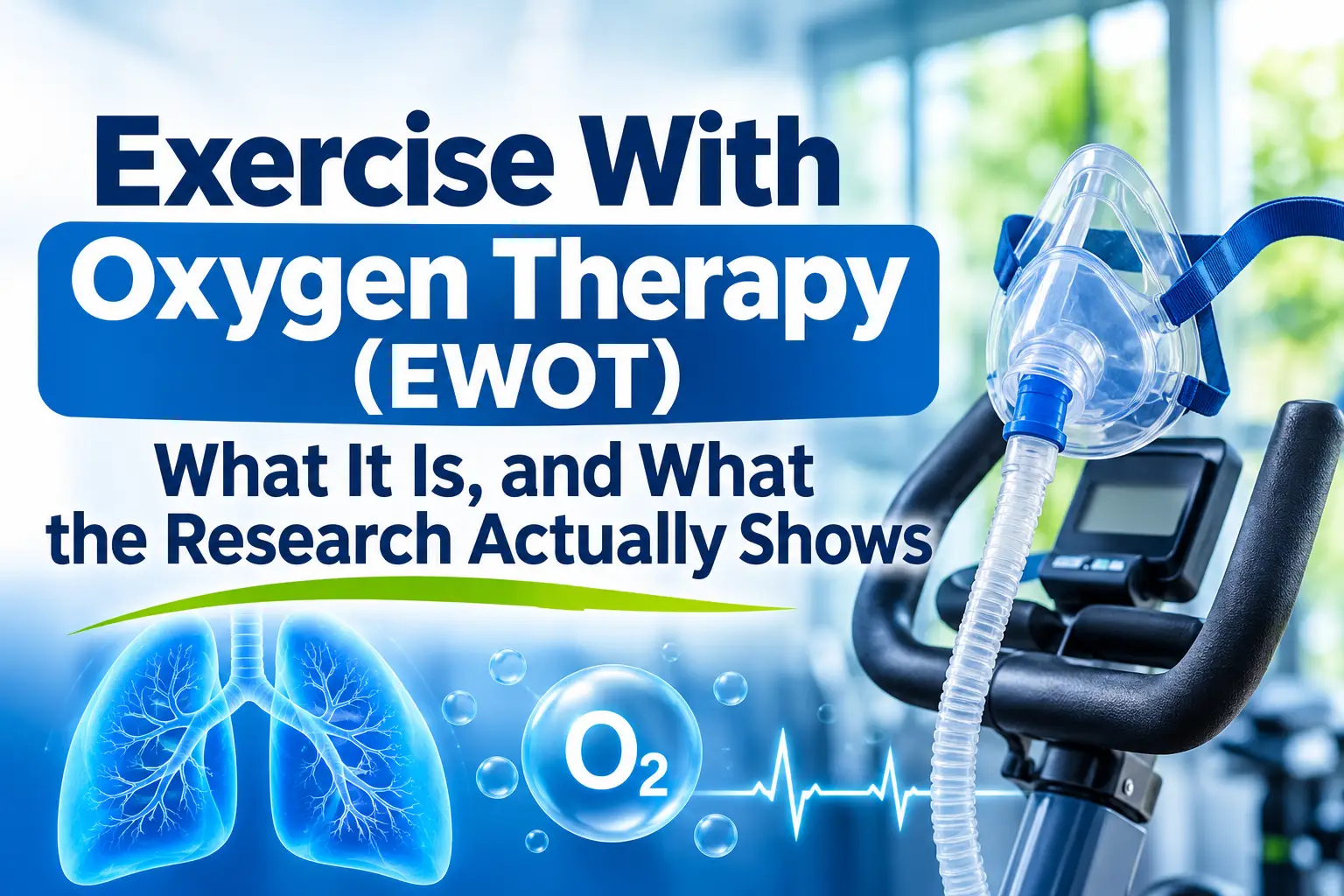
Exercise with oxygen therapy is exactly what the name says: you exercise, at a moderate effort, while breathing air with a much higher oxygen content than the room you are standing in.
It is one of the simpler things we offer and one of the more interesting, and it is also an area where the marketing has run some distance ahead of the evidence. So this page does both halves — what it is, and what is actually established.
Why movement is the active ingredient
Start here, because it is the part that makes EWOT make sense.
Oxygen delivery is not mainly a question of how much you breathe in. In a healthy person at rest, blood oxygen saturation already sits near the top of its range. What changes dramatically is where that oxygen goes — and that is governed by circulation and by demand.
When you move, your heart rate rises, vessels in working tissue open, and blood reaches places that get very little during a sedentary day. Movement is the thing that opens the door. We have written the free version of that up at BodyChargers.
EWOT does not replace the exercise. It is the exercise, with the inspired oxygen raised while you do it.
What a session involves
Moderate, sustained effort — typically on a bike or a treadmill — while breathing oxygen-enriched air through a mask, for a short, timed period rather than a long one.
It is deliberately brief. This is not something to do for hours, and anyone offering it that way has misunderstood the therapy. The reasoning behind short, dosed sessions is set out in full at EBOO Prime.
You should expect to be asked about your health history and current medications before your first session, and to have the effort level set with you rather than for you.
What the evidence actually supports
Here is where we will be more specific than most pages on this subject, because the picture is genuinely interesting and it is not uniform.
Acute performance: well supported
A meta-analysis of 51 studies on hyperoxia and sea-level exercise found clear improvements in performance during the session itself. Time to exhaustion showed a large effect (g = 0.89), time trials a small-to-moderate effect (g = 0.56), graded exercise tests a small-to-moderate effect (g = 0.40), and dynamic muscle function a small effect (g = 0.28).
The same analysis found that an inspired oxygen fraction of at least 0.30 was enough to produce at least a small benefit — which is a useful detail, because it means the effect does not depend on extreme concentrations.
Training adaptations and recovery: not yet settled
This is the part usually left out, and we would rather say it.
For hyperoxia used across a training programme, and for hyperoxia used in recovery, the same analysis found trends in a favourable direction — but the authors are explicit that “small sample size and wide disparity in experimental protocols preclude definitive conclusions.”
So: good evidence that you can work harder during the session, and genuine uncertainty about whether that translates into better adaptation or faster recovery over weeks. Anyone telling you the recovery question is settled is ahead of the research.
And what it is not
EWOT is a performance and conditioning practice. It is not a treatment for any disease, and we do not present it as one. If you have seen it promoted as a cure for a long list of conditions, that claim has been circulating for years and it has no basis.
For the therapies that do carry formal clearances, and what those clearances cover, see our hyperbaric oxygen therapy page — we publish the full cleared list there.
The safety conversation, which is mostly about the exercise
People expect the oxygen to be the risk. In practice the more important question is the exertion.
Exercise clearance comes first
If you have a heart condition, uncontrolled blood pressure, chest pain on exertion, or you have been largely sedentary for a long stretch, get clearance from your doctor before starting any exercise programme — this one included. That is not a formality and it is the single most important line on this page.
We would rather send you away with a note for your physician than start you on a bike the same afternoon.
Breathing conditions
COPD and conditions involving respiratory muscle weakness need assessing properly, because carbon dioxide handling rather than oxygen is the relevant concern. That is a conversation with the clinician managing it.
Oxygen dose
At normal atmospheric pressure and over short sessions, the oxygen exposure here sits well within tolerances — the thresholds that matter involve raised pressure, prolonged exposure, or both. That is precisely why sessions are short and timed rather than open-ended.
And the practical one
High oxygen concentration creates a fire risk. No smoking, no open flame, no petroleum-based products near the equipment. Any facility running this should tell you that unprompted.
Who tends to get the most out of it
In our experience, three groups.
- People already training, who want to work at a higher output within a session. This is the use the evidence supports most directly.
- People rebuilding conditioning after a long period of inactivity, where being able to sustain moderate effort for longer makes the session more productive — with clearance first.
- People who find a chamber unsuitable, since this involves no pressure and no enclosure. More options at hyperbaric chamber alternatives.
And one group it is not for: anybody hoping to skip the exercise. The movement is not the delivery mechanism for the oxygen — it is the other way round.
Where it sits alongside everything else
EWOT raises inspired oxygen during effort. EBOO works on the circulation side. Hyperbaric raises dissolved oxygen under pressure and carries formal clearances for specific conditions. They address different constraints, and the full comparison is at EBOO Prime.
Which, if any, is right for you is an assessment question. And before any of it, the free layer — movement, breathing, daylight, sleep — is where we would start, in that order: where to start with your health. How the nervous system governs the whole business is in how the brain controls the body.
Frequently asked questions
What is exercise with oxygen therapy?
Moderate exercise, usually on a bike or treadmill, performed while breathing oxygen-enriched air through a mask, for a short timed session. The exercise creates the demand that drives circulation; the raised oxygen is what you breathe while doing it.
Does EWOT actually work?
For performance within the session, yes — a meta-analysis of 51 studies found clear improvements, with a large effect on time to exhaustion and smaller effects across other test types. For longer-term training adaptation and recovery, the same analysis found favourable trends but concluded that small sample sizes and varied protocols prevent definitive conclusions.
Is EWOT a treatment for disease?
No. It is a performance and conditioning practice and we do not present it as a treatment for any condition. Claims that it cures long lists of diseases have circulated for years without basis.
Do I need medical clearance first?
If you have a heart condition, uncontrolled blood pressure, chest pain on exertion, or have been largely sedentary for a long period, yes — before any exercise programme, this one included. The exertion is the more significant consideration here, not the oxygen.
How long is a session?
Short and timed rather than extended. This is not something to do for hours, and the oxygen exposure in a brief normobaric session sits well within established tolerances precisely because of that.
Is it safe to breathe that much oxygen?
At normal atmospheric pressure over short sessions, the exposure sits well inside the thresholds that matter — those involve raised pressure, prolonged exposure or both. The practical precaution is fire: no smoking, flame or petroleum-based products near the equipment.
Can I do EWOT instead of exercising?
No. The movement is doing the primary work by raising circulation and demand; the oxygen is what you breathe while doing it. Without the exercise there is no therapy.
If you want to try it
Come and ask what the protocol is, how long a session runs, and whether you are someone who should see a physician first. We will give you a straight answer, including if that answer is not yet.
See what we work with on our conditions page, or get in touch.
Dr. Chris Cormier, DC
The Nerve Health Institute — Lafayette, Louisiana
At-home protocols at bodychargers.com. Circulation and oxygenation at ebooprime.com. More on how I practice at drchriscormier.com.
Spark your cells to optimal longevity.