
ALS Explained: Understanding the Diagnosis and What Support Looks Like
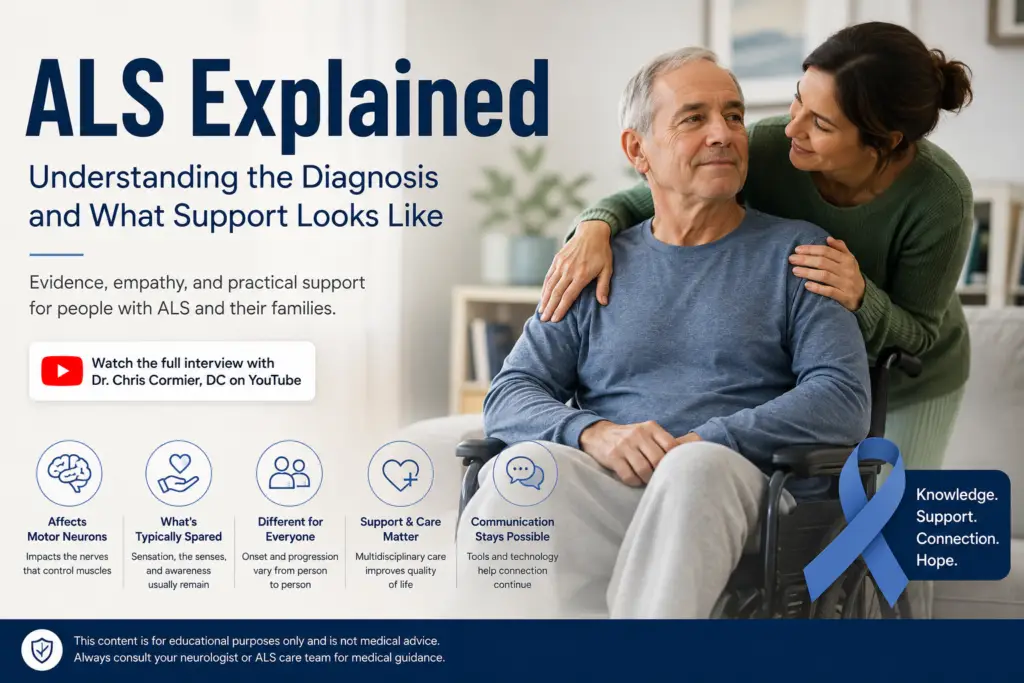
Few diagnoses land as heavily as ALS. The weeks before it usually involve a hand that stopped cooperating, a foot that catches on stairs, a voice that tires by evening — and a long stretch of appointments where nobody can say what it is. Then a name arrives, and with it a great deal of information that’s difficult to absorb in one sitting. This article is written for people in that period, and for the families around them. It covers what ALS is, why it presents so differently from person to person, what the evidence says actually helps, and where supportive care fits alongside neurological treatment. At The Nerve Health Institute in Lafayette, Louisiana, Dr. Chris Cormier, DC has spent nearly three decades working with people managing complex neurological conditions. What follows reflects an educational perspective on nervous system support and quality of life. It is not medical advice, and nothing here should replace care from your neurologist or ALS clinic. What Is ALS? ALS — amyotrophic lateral sclerosis — is a progressive neurodegenerative disease affecting motor neurons, the nerve cells that carry signals from the brain and spinal cord to the muscles. As these neurons deteriorate, the muscles they control weaken and waste. ALS is not an autoimmune condition, and it is not caused by stress or lifestyle. The name itself is descriptive. Amyotrophic refers to muscle wasting. Lateral points to the side regions of the spinal cord where affected nerve fibres run. Sclerosis describes the hardening that develops there as those fibres are lost. Around 90 to 95 percent of cases are sporadic, meaning they occur without a family history and without an identifiable cause. The remaining 5 to 10 percent are familial, linked to inherited genetic variants such as C9orf72 and SOD1. Research into these genetic forms has moved quickly, and it is where several of the newer targeted therapies have emerged. What Does ALS Affect, and What Does It Leave Alone? ALS targets the motor system specifically — upper motor neurons in the brain and spinal cord, and lower motor neurons running out to the muscles. Several things are typically spared, and this matters enormously for daily life: Diagram showing what ALS affects – motor neurons, muscle strength, speech and swallowing, breathing muscles – and what it typically spares, including sensation, bladder and bowel control, eye movement and the senses What ALS affects and what it typically leaves intact. Sensation, awareness and the senses generally remain, which is why communication and connection stay possible throughout. Cognition is more nuanced than it was once thought. Many people with ALS experience no meaningful cognitive change. Around half develop some degree of change in thinking or behaviour, and roughly 15 percent develop frontotemporal dementia. This is worth knowing rather than fearing — it’s something an ALS clinic screens for and plans around. Why Does ALS Progress Differently in Different People? Two people diagnosed the same month can have very different courses, and the starting point is a large part of why. Limb-onset ALS begins in an arm or a leg — a weak grip, a dropped foot, difficulty with buttons or stairs. It accounts for roughly two thirds of cases. Bulbar-onset ALS begins with speech and swallowing, often as slurring or a change in voice quality. It tends to progress somewhat faster on average. Respiratory-onset ALS is less common and begins with breathing difficulty, frequently noticed first at night. Rate of progression also varies considerably. Median survival is often cited as two to five years from diagnosis, but that figure conceals a wide spread — a meaningful minority live substantially longer, and some forms progress very slowly over decades. Why Are Early ALS Symptoms So Easy to Miss? Early ALS is quiet. A thumb that won’t grip a jar lid, a slight limp late in the day, cramping and muscle twitching that seems unremarkable. These are things almost everyone experiences at some point, and in isolation they point nowhere in particular. The pattern that eventually distinguishes ALS is painless, progressive weakness that doesn’t recover with rest and gradually spreads to adjacent regions. The average delay between first symptom and diagnosis is around ten to sixteen months — partly because ALS is a diagnosis of exclusion, and partly because several treatable conditions must be ruled out first. That delay is worth taking seriously, but for a specific reason. Getting to a neurologist promptly matters because some conditions that mimic ALS are treatable — cervical myelopathy, multifocal motor neuropathy, myasthenia gravis, and certain metabolic and infectious causes among them. Persistent unexplained weakness warrants proper neurological assessment, not because early intervention reverses ALS, but because the diagnosis needs to be correct. What Actually Helps in ALS? This is the section that matters most, and the evidence here is reasonably clear. Multidisciplinary ALS clinic care. This is the single best-supported intervention. Attending a specialist ALS clinic, where neurology, respiratory therapy, nutrition, physical and occupational therapy, speech pathology, and social work coordinate in one place, is associated with longer survival and better quality of life than fragmented care. If you take one thing from this article, take this. Respiratory support. Non-invasive ventilation, typically started when breathing measures decline, is associated with extended survival and significantly improved sleep, energy, and cognitive clarity. Many people delay it longer than they need to. Nutritional support. Weight loss is an independent predictor of poorer outcomes. Maintaining calorie intake matters, and feeding tube placement — considered before respiratory function declines too far — is a quality-of-life decision as much as a clinical one. Disease-modifying medication. Riluzole and other approved therapies offer modest benefit. Modest is not nothing, and these decisions belong with your neurologist. Physical and occupational therapy. Not to rebuild lost strength, but to maintain range of motion, prevent contractures and falls, and adapt the environment as needs change. Communication technology. Voice banking, done early while speech is still clear, and eye-gaze devices later preserve something central to being a person among people. Where Does Supportive and Complementary