
AMPS: A Nervous System View of Amplified Musculoskeletal Pain Syndrome
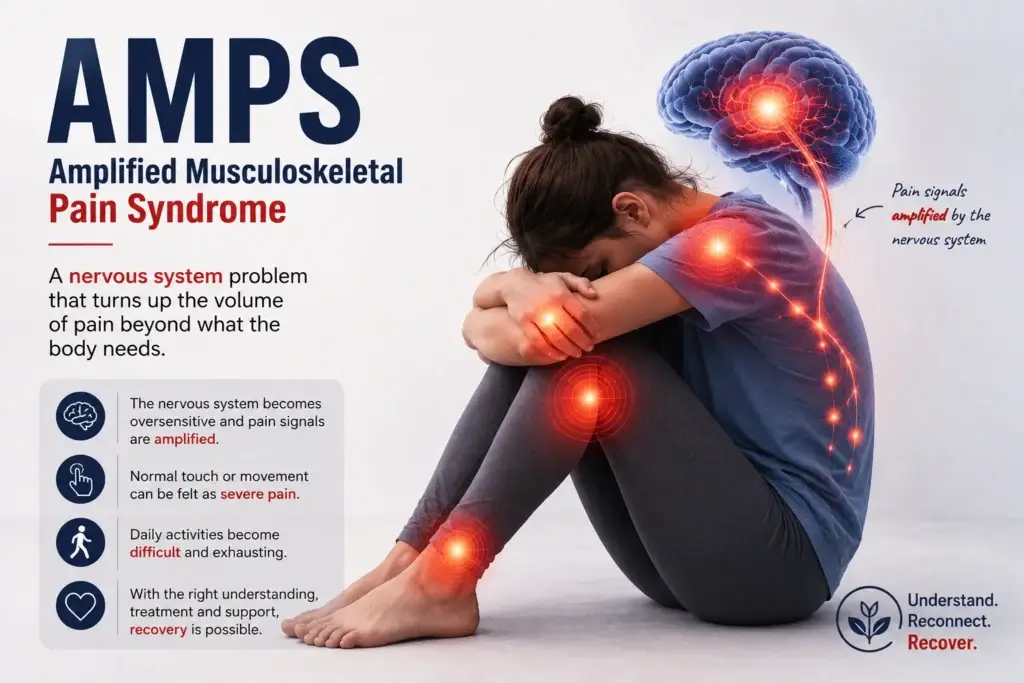
Someone who was perfectly well a few months ago now flinches at a hand on the shoulder. Getting dressed has become a negotiation. Work or school has slipped away. And somewhere in the middle of it, someone has suggested — gently or otherwise — that this might be psychological. If that is roughly where you are, or where someone you care for is, this article is written for you. Here is a clear look at what Amplified Musculoskeletal Pain Syndrome is doing at the level of the nervous system, why AMPS symptoms behave in ways that seem to make no sense, and what a connection-focused assessment examines. What AMPS Is, and How It Relates to CRPS Amplified Musculoskeletal Pain Syndrome sits within the same family as Complex Regional Pain Syndrome. The names differ and the underlying picture is closely related. AMPS is used as an umbrella term covering localised amplified pain, more widespread forms, and patterns that come and go. The defining feature is in the name. Pain is amplified — the volume is turned up far beyond what the situation warrants. Ordinary touch can arrive as severe pain. Movement can become difficult. And it frequently begins after something that looked entirely unremarkable at the time: a virus, a minor injury, a run of illness that seemed to resolve. People say some version of the same sentence, whether about themselves or about someone they are caring for. They were completely fine, and then they were not. That observation is accurate, and it is worth taking seriously rather than explaining away. Does AMPS Only Affect Children? This is worth clearing up, because the impression is widespread and it leaves a lot of adults assuming the term cannot apply to them. The AMPS label emerged largely from paediatric practice, and diagnosis does cluster in children and adolescents. That is where you will most often see the term used, and it is why most of what is written about AMPS is addressed to parents. Amplified pain itself is not restricted by age. Adults experience the same underlying picture regularly — they simply tend to be given a different label for it, most often CRPS, fibromyalgia, or central sensitisation. The mechanism being described is closely related in each case. So if you are an adult who has been handed one of those terms, or no term at all, what follows applies to you. And if you are a parent reading on behalf of a child, it applies just as directly. The nervous system picture is the same one. Why the Volume Gets Turned Up The way I look at it, this is a communication problem before it is a pain problem. Your brain is the power company. Every cell in the body is wired back to it, and nerves are the lines carrying that connection. When a group of cells loses proper connection, those cells do not go quiet — they begin signalling that something is not right. Pain is one of the ways that signal arrives. Sensation runs from body to brain as input. When that channel is working, something sharp registers as sharp within milliseconds. When it degrades, interpretation goes wrong — and it goes wrong in ways that sound impossible until you have seen them. Warmth reported as cold. Something sharp not registering as sharp at all. The lightest touch arriving as severe pain. This is the single most useful thing to understand about AMPS. Nobody here is overreacting. The nervous system is reporting faithfully on information that is arriving distorted. It Is Not In Anyone’s Head People dealing with amplified pain tend to hear two things, and both do real damage. The first is that they could manage if they tried harder. The second is usually unspoken but clearly felt — that something about the person, the household, or in the case of a child the parenting, is contributing. Adults describe being quietly reassessed as anxious or unmotivated. Parents describe being questioned about their parenting by people who cannot understand what has happened. So let us be direct. The pain is real and it has a physical basis in how signals are being carried and interpreted. Amplified pain is a nervous system phenomenon — not a character trait, not a lack of effort, and not a parenting outcome. Once it is framed that way, the person stops being the puzzle to be explained and the signalling becomes the thing to work on. That is a far better place for everybody to stand. Why Scans Often Come Back Clear A great many people arrive having been told imaging shows nothing wrong, and have found that this settles nothing at all. There is a straightforward reason. The common assumption is that a nerve must be compressed to malfunction. It is not so — plenty of compressed nerves conduct well, and plenty of uncompressed nerves conduct poorly. An MRI shows the structure of the nerve. It does not show the quality of energy travelling along it. So both things can be true at once. The structure is intact, and the communication is not. That is why the examination here looks at connection directly: there are 88 primary nerves branching off the brain and spinal cord, and because the route and function of each is known, flow can be assessed pathway by pathway and expressed as a percentage. It turns something vague into something specific, and gives you a baseline to measure against. Why a Gentle, Graded Approach Matters Here By the time someone with AMPS arrives here, they have usually had a difficult run of it — needles, procedures, examinations that hurt. Many have become wary of clinical settings altogether, whether they are eleven or forty-five, and that is an entirely reasonable response to their experience. So nothing here is forced. Everything is graded. We begin well below the threshold that provokes a reaction and build tolerance in small steps, letting the nervous system establish that input can arrive safely. In practice