
ADHD and the Nervous System: Why It Is Not Just a Focus Problem
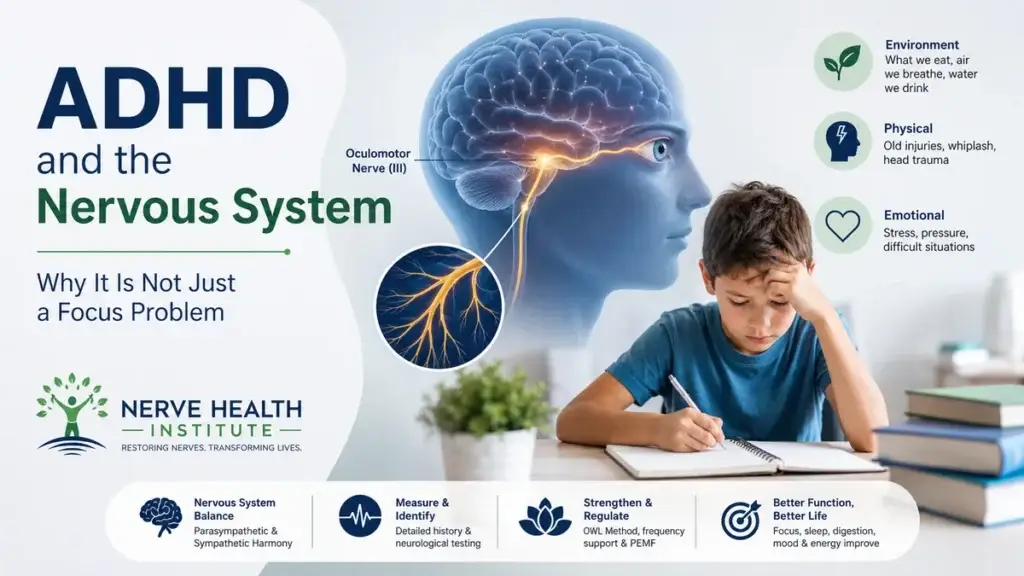
Ask anyone living with ADHD about their focus and you get a contradiction. It vanishes for the twenty-minute task that genuinely matters, then arrives in full force for something nobody asked them to do, holding steady for hours. Attention is clearly not in short supply. What is missing is regulation — the ability to direct it, sustain it, and switch it. That makes ADHD a nervous system question rather than an attention one, and it is a far more useful place to start. Here is what ADHD and the nervous system look like together: the specific nerve at the centre of it, why ADHD focus comes and goes, and what can actually be measured. The Oculomotor Nerve and ADHD Dr. Chris Cormier calls one nerve the hub of this entire condition, and most people have never heard of it. The link between the oculomotor nerve and ADHD is where his whole approach begins. Running from the back of your brainstem, the oculomotor nerve controls the small muscles in your eyes that shift focus between near and far. Zoom in, zoom out. Screen, then the person across the room. Page, then whiteboard. Count how much of your day depends on that. Hundreds of adjustments an hour, none of which you notice — until the nerve carrying that instruction is not at full strength, and every one of them becomes work. There is more to it, and this is where ADHD and digestion connect. Branches of the oculomotor nerve run into the organs, which is why focus difficulty and digestive trouble show up so often in the same person. Where the connection into the pancreas is weak, digestive enzyme production can drop, and that ripples outward. Seen separately they look like two problems. Seen as one connection issue, the picture is far simpler. Why Does ADHD Focus Come and Go? This is the question that puzzles families most. Some days it is fine. Some days nothing works. Nothing obvious has changed. Dr. Chris explains it as nerves being switched on and off by what surrounds you. Three categories do most of the work. Environmental. Something eaten that did not agree. Mould in the air. What is in the water. These can affect that oculomotor nerve directly — which is why focus can shift from one day to the next with no apparent cause. Physical. An old whiplash. A knock to the back of the head years ago. Where those nerves never fully recovered, the effect persists quietly. Emotional. Sustained pressure, or a particular situation. Most people have noticed feeling drained around a certain person or after a certain conversation — Dr. Chris would say you are feeling nerves switching off. He uses an analogy worth remembering. If your car runs fine, you fill up at a gas station, and it starts sputtering as you pull away, you know exactly what happened — bad fuel. Nobody hesitates to make that connection about a car. Almost nobody makes it about themselves. A sugary doughnut tastes wonderful and ten minutes later you feel dreadful, and the link goes unmade. Once you start noticing which inputs switch you on and which switch you off, you have information you can act on. That is a genuinely empowering position to be in. ADHD Is Not a Discipline Problem This is the part worth reading twice, especially if you are a parent. Dr. Chris describes it as a breaker box. When a breaker trips, the appliance does not run — not from lack of willpower, but because power is not reaching it. No amount of encouragement helps. Resetting the breaker does. A child who cannot get through a worksheet is not choosing to fail at it. Asking for twenty minutes of concentration when the connection cannot yet support twenty minutes is like handing someone an eighty-pound dumbbell and asking for ten repetitions. It is not attitude. It is capacity — and capacity can be built. Understanding that ADHD is not a discipline problem lifts a weight off the whole family. The child is not the problem. The parenting is not the problem. There is a breaker to find, and something specific to do about it. ADHD and the Nervous System: Two Sides Out of Balance Your nervous system has two sides. The parasympathetic handles calm, digestion, sleep and repair. The sympathetic handles alertness and response. You want both strong and reasonably balanced. What often shows up in this picture is a sympathetic side doing most of the work while the calming side sits underused — which explains a great deal. Why the system stays switched on during quiet moments. Why sleep is difficult. Why digestion is unreliable. Why getting to lunchtime can feel like a full day’s effort. The encouraging part is that this can be addressed directly. Finding which parasympathetic pathways are underactive and strengthening them gives the calm side of the system room to do its job — and that is where families tend to notice change first. What Gets Measured Two parts, and the first one takes time. A detailed history covering those three categories of stress and the journey that led here. Most people have never been asked to lay them out together, and patterns surface when they do. Then a neurological examination of the connection itself. There are 88 primary nerves branching off the brain and spinal cord — the major power lines, including the pair of oculomotor nerves at the top. Because the route and function of each is known, EnergyFlow can be assessed pathway by pathway and expressed as a percentage. For a condition normally assessed through questionnaires and behaviour reports, a physical measurement is a genuinely different starting point. And the assessment itself does something useful — as the brain registers where power has dropped, it begins directing attention back to those areas. The OWL Method: Oxygen, Water and Light Alongside connection, the work centres on the OWL method — oxygen, water and light, the three ingredients cells depend on