
Multiple Autoimmune Conditions: Why Symptoms Keep Moving Instead of Resolving
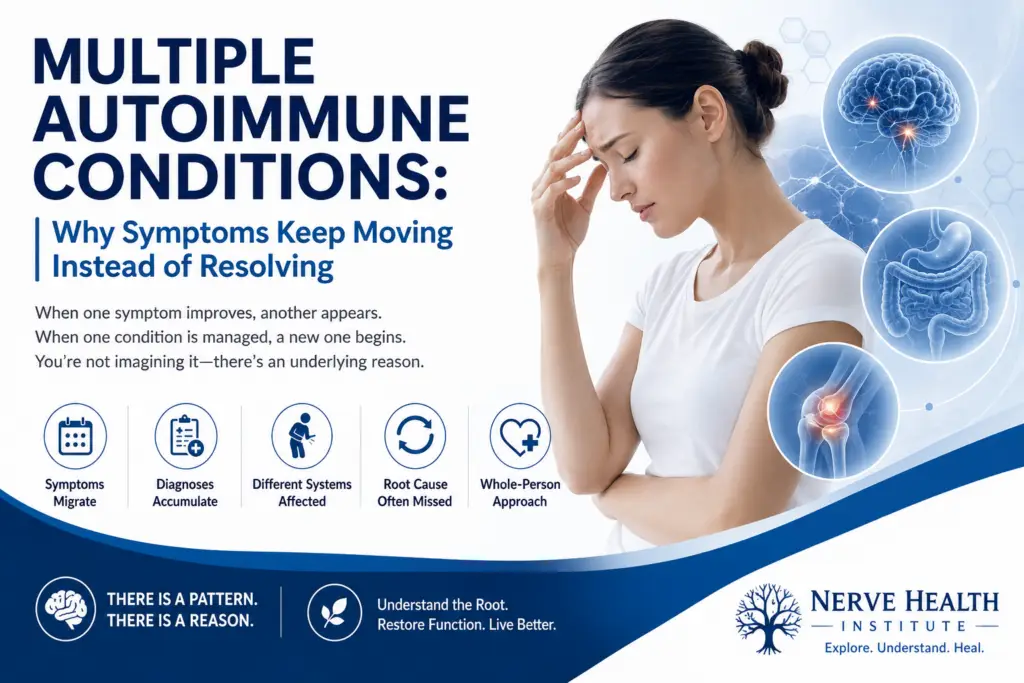
There is a folder most people in this position end up keeping. Results from a rheumatologist, a gastroenterologist, an endocrinologist, maybe a neurologist. Each set of notes is thorough. Each specialist is competent. And each one is looking at the part of you that falls inside their department, which means nobody in the folder is looking at the thing you actually experience — a body where something is always going on, and where fixing one area seems to coincide with another one starting up. People living with multiple autoimmune conditions describe this constantly. The symptoms migrate. The diagnoses accumulate. And the explanations, taken one at a time, never quite add up to the whole. That experience is real, and it points to something worth understanding. Why One Diagnosis So Often Becomes Two or Three Autoimmune conditions cluster. Somebody who develops one is measurably more likely to develop another, and that pattern is well recognised in the medical literature rather than being anything controversial. What clustering tells you is that these conditions are not really 200 unrelated diseases that happen to share a category. They are 200 names for where a shared process happened to land. The label describes the location and the tissue involved. It does not describe why the process began, or why it is now finding new places to appear. Which is why a second diagnosis so rarely feels like new information to the person receiving it. They already knew something broader was going on. The system simply had to wait for it to become nameable. Why Symptoms Migrate Between Systems Fatigue, brain fog, aching joints, digestive changes, unpredictable energy — these turn up across almost every autoimmune diagnosis, regardless of which tissue holds the label. That overlap is a clue. Symptoms that appear across every category are unlikely to be produced by the tissue-specific part of each condition. They are much more likely to be produced by something that touches every system at once. There is only one candidate that fits: the nervous system, which regulates everything else. When it is not working well, the effects do not stay in one department — they show up as sleep that does not restore, digestion that is unreliable, energy that arrives and leaves without pattern, and thinking that feels a step slower than it should. Different specialists see different pieces of that. Nobody is wrong. The picture is just being split five ways. Two Settings, and Why One of Them Gets Stuck The autonomic nervous system runs on two settings that trade against each other. The sympathetic side is protection — alert, guarded, ready. The parasympathetic side handles digestion, repair and rest, and it is where the great majority of healing occurs. Years of unpredictable symptoms, appointments that end without answers, and never quite knowing what tomorrow holds keep a system tilted toward protection. And once it has been there long enough, it stops being a response to anything current and simply becomes the default. Someone in that state has less repair capacity available for every condition they are carrying — which is precisely the position multiple diagnoses put you in. The useful part is that this is a state rather than a fixed trait, and states respond to input. The Layer That Labs Are Not Designed to Measure Bloodwork is essential. It confirms diagnoses, tracks activity and guides medication, and nothing substitutes for it. What it measures is chemistry. What it does not measure is whether signal is reaching the tissue in question — whether the connection between brain and cells in a given region is running at capacity or well below it. Every organ, joint and gland you have is wired back through that network, and the quality of that connection shapes how well the tissue performs regardless of what the markers say. We call that layer EnergyFlow. It explains the gap patients name most often: results that look acceptable next to a body that plainly disagrees. Both are accurate readings of different things. What a Whole-System Evaluation Looks Like A full history, taken once. Not five partial histories held by five departments — one continuous account covering physical events, sustained emotional load, environmental exposures and the order in which everything appeared. For people with several diagnoses, this is frequently the first time anyone has assembled the whole sequence, and the sequence is usually where the useful information is. A detailed neurological examination. We assess function across the 88 major nerves branching from the brain and spinal cord, mapping where signal is running below capacity. It is closer to walking a breaker box than to checking whether the building has power. Daily foundations. Sleep, hydration, breathing, light exposure, movement capacity and stress load — the inputs that determine how much recovery capacity you have available at all. The output is not a challenge to any diagnosis in your folder. It is the connective view between them, plus a plan for the layer your specialists are not resourced to work on. Foundations Before Technology Oxygen, water and light do more work here than most people expect, and they are the inputs you control directly. Slow breathing with a longer exhale shifts autonomic state within minutes. Hydration drives circulation and clearance. Morning daylight anchors the rhythm that governs how deeply you sleep, and sleep is where most repair happens. When several conditions are drawing on the same limited recovery capacity, raising that capacity benefits all of them at once — which is exactly what makes the foundations disproportionately valuable in this situation rather than merely sensible advice. Where Frequency and Clinic Technology Fit Every tissue carries its own resonant frequency — thyroid tissue is tuned differently from intestinal tissue, and differently again from heart tissue. When tissue drifts under sustained load, it performs less well, much like a guitar string that has gone flat. Plans at the Lafayette clinic are built individually and draw from: Pace matters more here than in almost any other group we see. A