
Myelin Repair: Can Damaged Myelin Actually Heal?
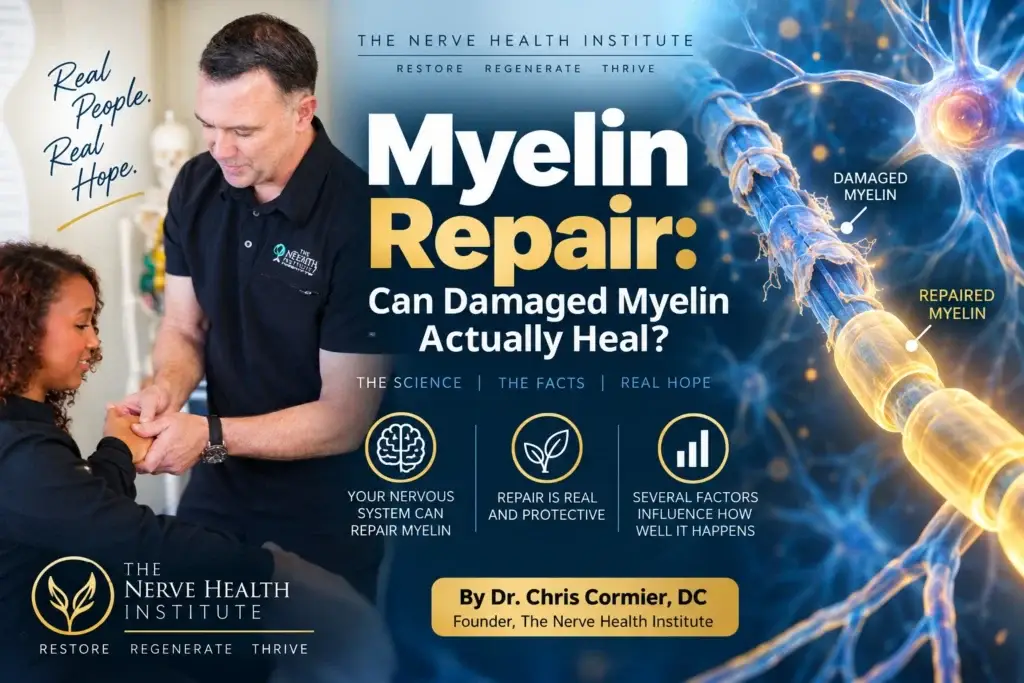
By Dr. Chris Cormier, DC — Founder, The Nerve Health Institute It is the question almost everyone with MS asks eventually, usually not out loud. The damage that has already happened — is that it? Is myelin something you lose permanently, or is the nervous system capable of rebuilding it? The answer is more encouraging than most people are told, and it comes with conditions that matter. Myelin repair is a real biological process. Your nervous system does it on its own, without being asked. But how well it does it depends on things worth understanding, and several of them you can influence. Yes — the Nervous System Repairs Myelin on Its Own Myelin is the insulating sheath wrapped around nerve fibres. Think of the coating on an electrical cable: it keeps signal travelling fast and cleanly, and it protects the fibre underneath. In MS, patches of that coating are damaged. What is less widely known is that the central nervous system carries its own repair crew. Cells called oligodendrocyte progenitor cells sit distributed throughout the brain and spinal cord, making up a meaningful share of the support cells present. When myelin is damaged, these cells activate, migrate to the site, multiply, and mature into new myelin-forming cells that wrap fresh sheaths around the exposed fibre. This process is called remyelination, and it is genuinely protective. It restores conduction speed, it returns metabolic support to the nerve fibre, and it makes that fibre less vulnerable to permanent degeneration afterwards. It is also the reason many people notice symptoms easing in the weeks after a relapse. That is not luck. That is repair happening. How Well It Works Depends on Three Things How fresh the damage is Repair is most effective early in the life of a lesion. Researchers describe remyelination as more robust when damage is new — the local environment at that point is still favourable, and the repair cells respond well. An older lesion is a harder job. The environment around it has changed, debris clearance has become less efficient, and the repair response is less likely to complete. Age Remyelination is highly efficient in young adults and becomes less so with age. This is not unique to myelin — every regenerative process in the body follows the same curve — but in a disease lasting decades it matters a great deal, and declining repair capacity is thought to be part of why MS shifts into its more progressive phase over time. Importantly, the research does not identify an age beyond which repair stops being possible. Pathology studies find evidence of remyelination occurring to some degree across all ages. Less efficient is not the same as none. The condition of the surrounding environment Repair cells do not work in isolation. They depend on the immune cells that clear away damaged myelin debris, on the local blood supply, on the surrounding tissue matrix, and on the overall metabolic state of the region. This is the part that interests me most, because it is the part that is not fixed. The repair cells are present. Whether the environment lets them finish the job is a different question, and environments can be worked on. What Repaired Myelin Is Actually Like Worth being straight about: newly formed sheaths tend to be thinner than the original myelin, and repair is often partial rather than complete. Thinner does not mean useless. Remyelinated fibres conduct again, they receive metabolic support again, and they appear to be better protected against further injury than bare fibres. Function improves even when the restoration is not perfect. So the honest framing is neither “the damage is permanent” nor “it all grows back”. It is that repair happens, it is real, it is usually partial, and how much of it happens is influenced by factors that are not entirely outside your control. The Part People Get Backwards Here is where I want to be very clear, because the biology above gets misused. Some people read that myelin repairs itself and conclude that treatment matters less — that if the body rebuilds, medication can be reduced or skipped. That conclusion is exactly backwards, and acting on it is the most damaging thing you could do with this information. Repair capacity declines over time and with each episode of damage. Every new lesion draws on a resource that does not fully replenish. Disease-modifying therapy exists to reduce how many new lesions form — which means it is not working against your repair capacity, it is protecting it. Understood properly, remyelination biology is an argument for treating early and consistently, not for treating less. Stay on your therapy, keep your neurology appointments, and never change a dose based on anything you read online — including this page. There are currently no approved therapies that directly enhance remyelination. It is an active research field and a genuine unmet need. When something arrives, it will come through that route, not through a wellness clinic. So What Actually Supports the Process? If the repair crew is already present and the limiting factor is the environment they are working in, then the useful question becomes: what shapes that environment? That question has occupied me for nearly three decades, and my answer is built on the OWL Method — Oxygen, Water and Light — the three ingredients every cell in your body physically runs on. Oxygen Oxygen is the number one ingredient in a cell and the first thing to run short. Repair is metabolically expensive work, and tissue that is short of oxygen cannot clear waste efficiently or rebuild at the rate it should. Most people breathe shallowly and spend their lives indoors, and by the time someone has been managing a chronic neurological condition for years, their capacity has usually dropped further. Water You are around 60% water, and every delivery and clearance transaction in your body happens in that medium. Debris clearance around a lesion is one of those transactions. Both the quantity and