
The EMSELLA Chair, Explained: 11,200 Pelvic Floor Contractions in 28 Minutes
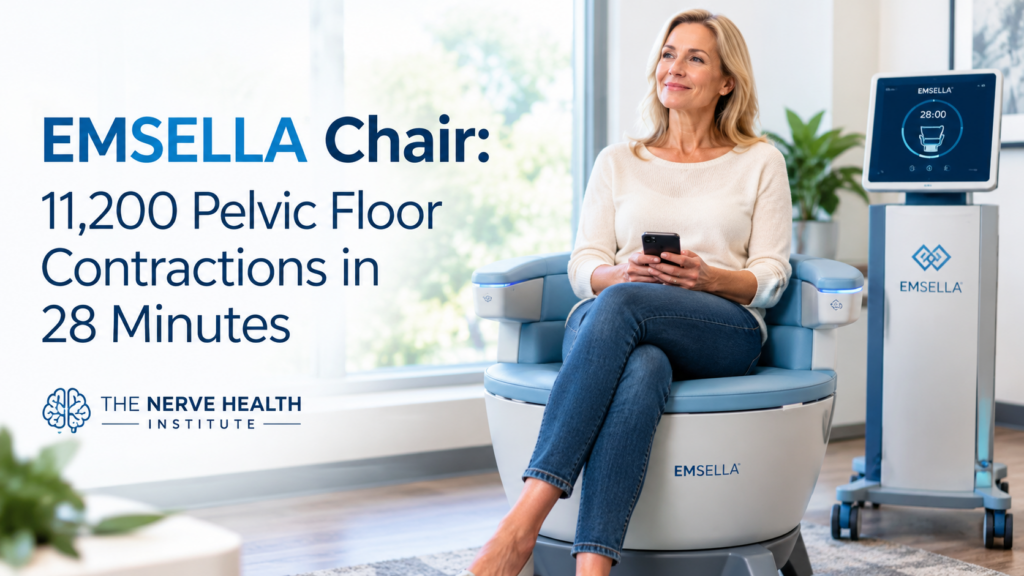
By Dr. Chris Cormier, DC — The Nerve Health Institute, Lafayette, Louisiana You wake up at two in the morning to go to the bathroom. Maybe again at four. You have stopped trusting yourself on a trampoline, or during a sneeze, or on a long drive without knowing where the next rest stop is. And somewhere along the line, someone told you this is just what happens as you get older. It is common. It is not something you simply have to live with. At The Nerve Health Institute we use the EMSELLA chair — a device that triggers 11,200 full pelvic floor contractions in a single 28-minute session while you sit fully clothed and read your phone. We have had it in the clinic for over a year and a half, and it has become one of the treatments patients talk about most. Here is exactly what it is and how it works. What the EMSELLA chair actually does The EMSELLA chair is built by BTL, a Czech medical technology company whose engineering teams develop the device platform. It uses HIFEM technology — high-intensity focused electromagnetic energy — delivered through the seat of the chair. You sit down fully dressed. The chair is switched on, and a focused electromagnetic field passes through the pelvic floor, causing the entire muscle group to contract. Not a partial squeeze — a complete, supramaximal contraction of the whole pelvic floor, repeated 11,200 times across 28 minutes. You can feel each wave, and you can hear the device clicking as it cycles. There is no surgery, no needles, no undressing and no recovery time. Patients walk out and drive themselves home or back to work. Why 11,200 contractions matters Most people know Kegels. The instruction is simple enough — squeeze the muscles you would use to stop the flow of urine — and there are apps that will coach you through sets at home. The challenge is volume and quality. A dedicated home routine might produce a few hundred voluntary contractions a week, and many people are not fully activating the right muscles to begin with. One EMSELLA session produces 11,200 complete contractions in less than half an hour — a training stimulus the pelvic floor simply cannot be given voluntarily. What patients often notice afterwards is that Kegels themselves become easier. The chair reconnects the muscle group and makes the home work more effective, which is a large part of why we pair the two. What the clinical research shows The strongest published study on this technology is a prospective, multicentre trial of 75 women published in Lasers in Surgery and Medicine, with a mean participant age of 55. Participants received six sessions, twice weekly. The results: Improvements were seen across stress incontinence, urge incontinence and mixed presentations. Supporting studies using the same protocol have reported quality-of-life gains sustained at six months, and these were small single-arm studies rather than large randomised trials — which is worth knowing when you compare it against other options, and which matches what we see in the clinic. Who we see benefit most Women after pregnancy and through menopause Pregnancy and delivery place enormous demand on the pelvic floor, and hormonal change through menopause affects tissue quality. Many women accept leaking during a sneeze, a laugh or a workout as permanent. It generally is not — the muscles are usually still there and still connected, they have simply lost strength and coordination. That is exactly what this technology is designed to address. Men, including after prostate treatment Men have a pelvic floor too, and almost nobody trains it. We have seen strong results in men dealing with urinary control issues, including men who have been through prostate treatment. The device is cleared for urinary incontinence in both men and women, and men sit in exactly the same chair, fully clothed, for the same 28 minutes. Anyone whose core has quietly gone offline The pelvic floor is part of your deep core. When it weakens, the effects can show up in core stability, posture and lower back comfort — which is why some patients come to us for one thing and notice improvements in another. Our conditions library covers the presentations we see most often. The nervous system connection — and why this fits the OWL Method This is the part that makes EMSELLA more than a muscle treatment in our clinic, and it is the reason it sits comfortably inside how we practise. Your nervous system has two broad modes. The sympathetic side is the surviving side — alert, braced, ready for threat. The parasympathetic side is the healing side — the state in which your body digests, repairs and sleeps properly. The parasympathetic system runs partly through the vagus nerve and partly through the sacral nerves, which supply the pelvic floor and bladder. So when we strengthen and reconnect the pelvic floor, we are working directly in sacral parasympathetic territory. Patients frequently report that the benefits are not limited to bladder control — they describe feeling calmer and sleeping better through a course of treatment. How it maps onto oxygen, water and light Our framework is the OWL Method — oxygen, water and light, supported by frequency, magnetism and nutrients. Oxygen is the first ingredient in every one of your roughly 30 trillion cells. Water quality determines what those cells are working with. And light energy is how the nervous system communicates: every muscle cell in your body is wired back to the brain, and that signalling traffic is what keeps tissue alive and responsive. Every one of those 11,200 contractions is a signal travelling to and from the brain. The chair is not only training muscle — it is reigniting the connection to it. That is the same principle behind our full-body red light therapy, applied to a different system. About waking up at night Getting a full night without a bathroom trip is one of the most common reasons people come in, and