
Why a Non-Invasive Clinic Added One Invasive Therapy
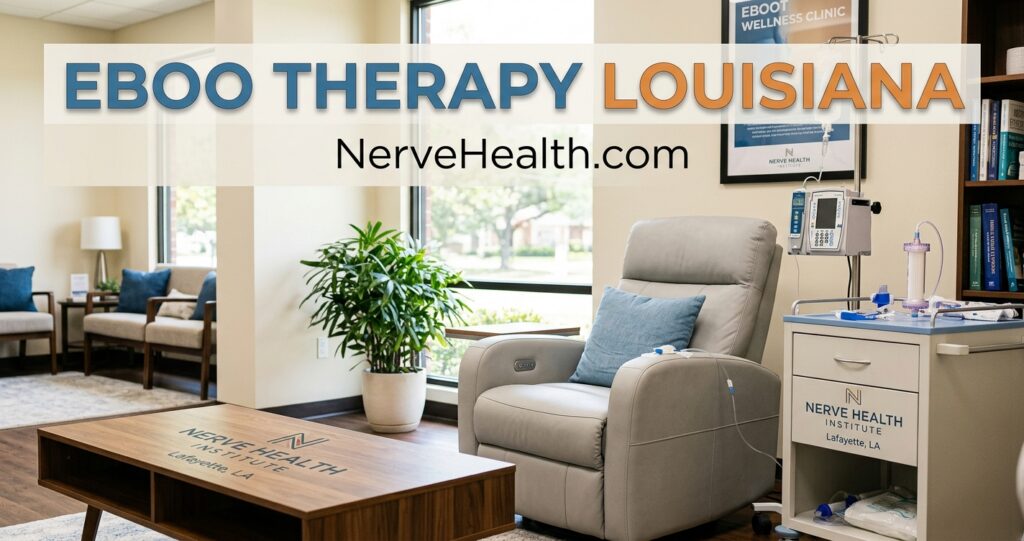
By Dr. Chris Cormier, DC — The Nerve Health Institute, Lafayette, Louisiana For decades this clinic has been entirely non-invasive. That was not an accident and it was not a limitation — it was the whole design. Nothing broke the skin, and the results came from working with what the body already does. So when I tell you we added a therapy that involves an IV in each arm, the first thing worth explaining is what the bar had to be. The one thing I could not reach Our approach is built on replenishing what the body runs on, in order: oxygen, water, light, then frequency, magnetism and nutrients. That is the OWL Method, and it is the subject of most of what I write. But over years of doing that work well, I kept running into the same structural limit. Replenishing what goes in is only half of a system. The other half is what comes out. Your body has a remarkable set of systems for that already — kidneys moving around 180 litres of fluid a day, a liver, lungs, skin, lymph. Those systems do an extraordinary job. And in the world we actually live in, they are doing it against a steadily rising workload. That is not a dramatic statement, it is just a description of modern life. None of us chose microplastics. Nobody signed up for what is in the air on a busy road. You can live carefully and still be living on this planet — and I say that as someone whose family tries very hard. Detoxification as the seventh element This is the idea that made me change my mind, and it is the useful part of this whole article. I had always taught six ingredients. What I came to see is that there is a seventh consideration sitting alongside them, and it is not an ingredient at all — it is clearance. Replenishing works better when there is room for it to work. Think of it as the order of operations in a kitchen. You can bring in the best ingredients available, but if the bench is covered, you are cooking around the clutter. Clear the bench and the same ingredients go further. That is where EBOO sits in our approach. Not as a replacement for the six, and certainly not as a shortcut past them — as the step that makes the rest of the work easier. Why blood specifically Because of what blood does for a living. The National Library of Medicine describes it plainly: “blood transports oxygen and nutrients to body tissues and returns waste and carbon dioxide,” and it “distributes nearly everything that is carried from one area in the body to another.” Everything. That is the point. I tell patients the two most important connections in the body are the brain to the cells and the heart to the cells — the first carries the signal, which we covered in how the brain controls the body, and the second carries the supplies. Blood is the delivery network for roughly 30 trillion cells. Anything that supports that network doing its job well is worth taking seriously. What EBOO actually is Extracorporeal blood oxygenation and ozonation. The long name describes the process accurately, which is rare. Blood is drawn from one arm, passed through a filter, then through an oxygenation and ozonation stage, and returned through the other arm. It is a continuous loop rather than a draw-and-return, which is why you sit for it rather than lie down and wait. We run it here as EBOO Prime, a separate operation inside the clinic, with a nurse of 25 years’ standing who runs the sessions and handles all the screening. The full technical description lives on the what is EBOO and how it works pages. What a session is actually like This is the part people want to know and it is rarely described properly anywhere, so here it is. I will add a personal note, because it is the honest version. I do not love needles. I was uneasy before my first session, and I say so to patients who tell me the same thing. It turned out to be a non-event, and the sitting is genuinely restful — an hour where nothing is being asked of you is not a bad hour. Who it suits, and how we decide This is a medical procedure with IV access, so the answer is decided individually, in person, and not on a web page. It is for adults. Our nurse screens every prospective patient against a full list of contraindications before anything is scheduled — certain medical histories, certain conditions, and circumstances affecting the arms and veins all come into that assessment, and sometimes the answer is that it is not the right fit. I want to be clear that I regard that screening as one of the best things about how we run it. A clinic that will tell you no is a clinic you can trust when it says yes. If you are considering it, the first step is a conversation where we go through your actual situation. Where it does not sit Worth stating plainly, because it protects the value of the therapy rather than diminishing it. EBOO is a supportive wellness therapy focused on circulation and oxygenation. It is not a treatment for a diagnosed disease and it is not a substitute for care you are receiving elsewhere. If you have a condition under management, keep managing it — and tell us about it, because it is part of the picture. It also does not replace the unglamorous work. Nothing does. How you sleep, how you breathe, what you drink, what light you get — those are still where most of the ground is won, and they are free. We cover them in the best sleep environment and across the BodyCharger platform. A clear session and a bad week afterwards is not a mystery, it