
Most People Have Never Had Their Nerves Properly Checked
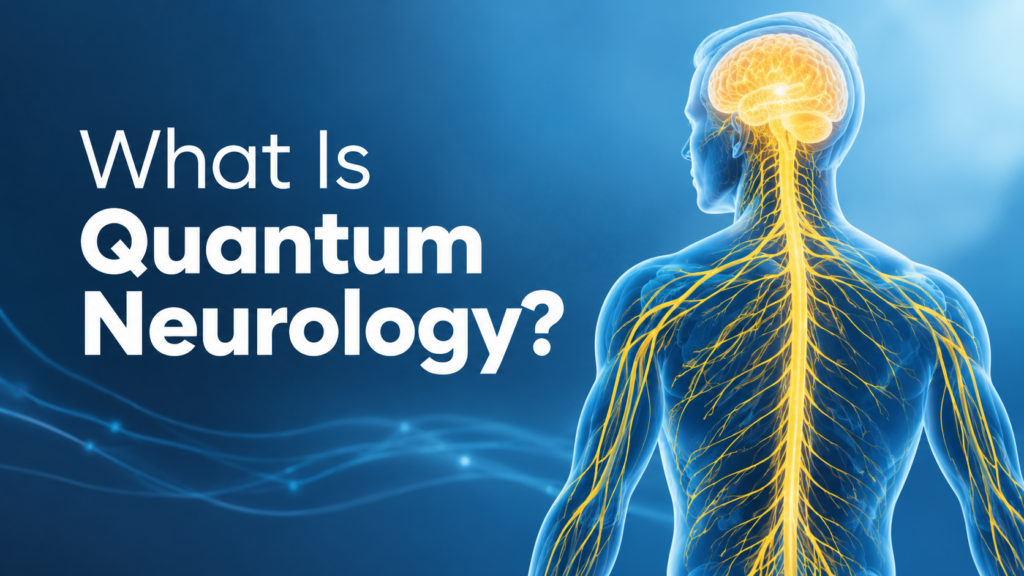
By Dr. Chris Cormier, DC — The Nerve Health Institute, Lafayette, Louisiana Here is something that stopped me in my tracks when I first properly understood it, and it is still the thing I find myself saying most often. Most people go their entire lives without anyone ever checking how well their nerves are actually working. You will have your blood pressure taken dozens of times. Your cholesterol, your weight, your blood work, your teeth, your eyes. Nerve function, pathway by pathway, almost never comes up — and it sits underneath an enormous amount of what people come to see me about. I wrote a book called The Hidden Diagnosis for exactly that reason. This article explains the method we use to look at it. What is Quantum Neurology? Plainly: Quantum Neurology is a rehabilitative method for assessing and supporting nerve function, pathway by pathway, across the body. Before anything else, the most important sentence on this page, and I want it up high rather than buried: It is not a treatment for any named condition. It is a rehabilitative approach to nerve function. Those are different things, and anyone describing it as a treatment for a disease is describing it incorrectly — including if they are enthusiastic about it. What it does is give us a way to find where communication between brain and body is working well and where it is not, and then work on the places it is not. Why nerve function is the thing underneath As the National Institute of Neurological Disorders and Stroke puts it, “all sensations, movements, thoughts, memories, and feelings are the result of signals that pass through neurons.” Every one of those. Which means that whenever something in the body is not doing its job well, one entirely reasonable question is whether the signal is getting there properly. That question is asked far less often than it deserves to be. I describe the brain and spinal cord as the power company, with 88 major nerve pathways running out of it like power lines to every part of you. It is a simple picture and it holds up in conversation, which is why I have kept using it for years. We go into the full version of that in how the brain controls the body. What an assessment actually involves This is the part people are most curious about, and it is simpler than it sounds. Manual testing, pathway by pathway We test each of the 88 major pathways by hand. We know where each one goes and what it should be doing, so we can work through them methodically rather than guessing at the general area of a complaint. It is not uncomfortable, it does not involve needles, and it takes a good deal less time than people expect. You feel the difference as we go Here is what surprises almost everybody. When we find a pathway that is testing weak, you can usually feel the weakness yourself once it is pointed out — and you can feel the difference after we work on it. That immediate feedback is unusual in healthcare and it is the reason most people leave the first visit with a very different attitude to the whole subject than they arrived with. You are not asked to take anything on faith. Then we build a plan A first assessment tells us where things stand. What follows depends entirely on what we find, and we go through it with you properly rather than handing you a standard package. One nerve, as an example Abstract explanations of nerve function tend to slide off people, so here is a concrete one I use often. There is a nerve called the oculomotor nerve, and part of its job is adjusting your eyes as you shift focus between near and far. Right now, reading this, it is working. Look up at something across the room and it adjusts again. Now imagine that pathway is working slightly better on one side than the other. Nothing dramatic happens. You simply find focusing a fraction harder than it should be — and you have no particular reason to connect that to a nerve, because why would you? For somebody whose work or sport depends on tracking something moving, that fraction matters. And the same logic applies right through the body: a pathway involved in lifting your foot, or stabilising a shoulder, or steadying a finger. Small shortfalls in specific places, producing effects people attribute to getting older or being out of practice. Where the method came from Like a lot of genuinely useful things in healthcare, it came out of somebody needing an answer for a member of their own family and not finding one in the places they looked first. The practitioner who developed it had a background in chiropractic and spent a long period working through the problem from first principles — how do you restore communication between a brain and a part of the body it has lost good contact with. What came out of that became a method, and then became something taught to other practitioners. I trained in it some years into my own practice, and I have written about that turn on drchriscormier.com, because it changed how I work more than anything else I have learned since school. How it fits with the rest of what we do The OWL Method Assessing nerve function tells us where to work. The OWL Method is what we work with — oxygen, water and light, supported by frequency, magnetism and nutrients, in that order. And the order is not arbitrary. Oxygen makes up roughly 65% of the mass of the human body, which makes it the most abundant element in you by a very wide margin. Water is next. Light is how the whole rhythm is set. Work on the most abundant ingredients first and everything downstream performs better — which is also why supplements sit sixth on my list rather