
Vitamin B6 Toxicity and Nerve Symptoms
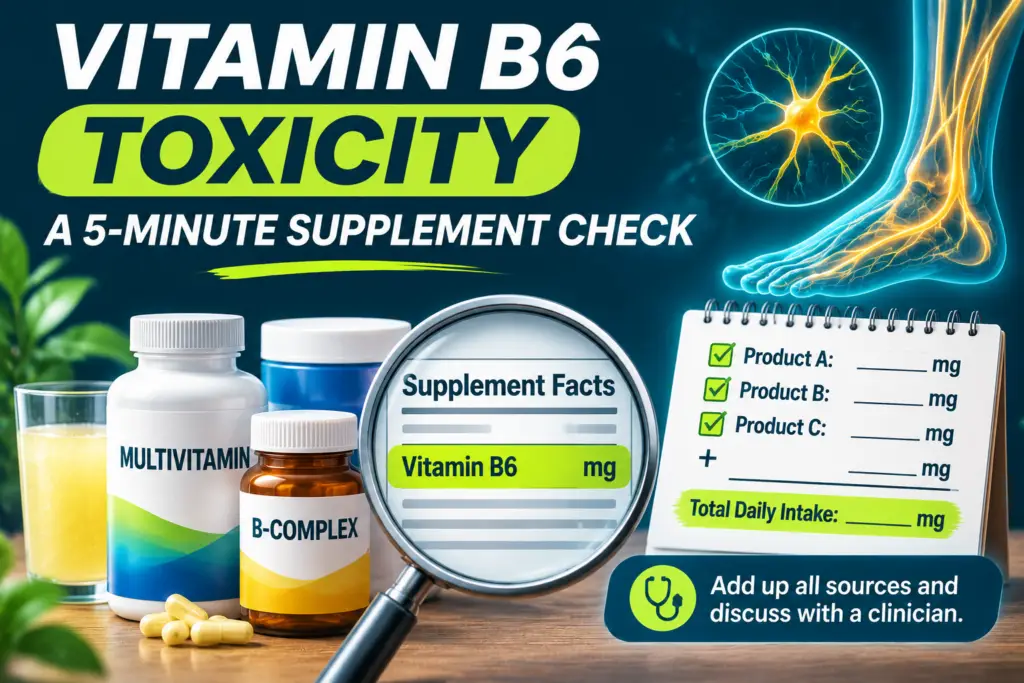
By Dr. Chris Cormier, DC — The Nerve Health Institute One of the most useful things a nerve clinic can tell you costs nothing, takes about five minutes, and happens at your kitchen table. Gather every supplement, powder and drink you take in a normal week. Add up the vitamin B6 in them. That is the whole exercise. We ask people to do this because vitamin B6 toxicity is one of a small number of causes of nerve symptoms that is genuinely simple to check, costs nothing to rule out, and tends to have a good outlook when it is caught reasonably early. In a field where a great many questions are complicated, this one is refreshingly not. What vitamin B6 does, and why the amount matters Vitamin B6 is an essential nutrient. It helps your body release energy from food, supports the production of neurotransmitters, contributes to making haemoglobin, and plays a genuine role in healthy nerve function. You need it. This is not an argument against vitamin B6. The daily requirement for adults is modest — roughly 1.3 to 1.7 milligrams, which is comfortably covered by ordinary food. Fish, poultry, potatoes, chickpeas and bananas all contribute. What makes this nutrient unusual, and worth a page of its own, is that both ends of the range have been described as risk factors for peripheral neuropathy. Too little is associated with nerve problems. So is a sustained excess. Most nutrients do not behave that way, and it is the reason vitamin B6 toxicity is a subject a nerve clinic thinks about at all. How much is too much Here the honest answer is that the official numbers do not agree with each other, and they have been moving. That is a tenfold spread between regulators looking at the same nutrient, which tells you something important: there is no single agreed threshold at which vitamin B6 toxicity begins. Individual tolerance appears to vary considerably. The Netherlands pharmacovigilance centre recorded 238 reports of nerve symptoms linked to vitamin B6-containing products between 2007 and 2024. Of those, 79 involved a product with a daily dose of 12 milligrams or less. Most published cases involve much larger intakes, often 200 milligrams a day or more sustained over months or years — but the lower-dose reports are the reason several regulators have moved towards more conservative limits rather than less. Australia tightened its restrictions on high-dose vitamin B6 supplements during 2025. The practical reading is not that small amounts are dangerous. It is that nobody can hand you a personal number, so knowing your own total is worth more than knowing anybody’s threshold. What vitamin B6 toxicity feels like The pattern is sensory rather than weakness-based, and it is usually symmetrical — both sides, rather than one. Two features of vitamin B6 toxicity matter more than the symptom list. The first is that onset is typically gradual, building over months or years of steady intake rather than arriving one morning. The second follows from it: almost nobody connects a slow change in their feet to a supplement they have been taking happily for two years. There is no reason they would. None of this is unique to vitamin B6 toxicity. Many causes of peripheral neuropathy produce a similar pattern, which is exactly why it needs a clinician rather than a web page to sort out. What the five-minute audit does is put one easily-checked, easily-corrected possibility on the table early instead of late. The part that matters most if you already have nerve symptoms This is the reason we wrote the page, and we would like to put it as kindly as we can, because it is an extremely easy thing to do and it reflects well on the people who do it. B vitamins are widely and reasonably associated with nerve health, and peripheral neuropathy is uncomfortable enough that people act on it quickly. So when somebody develops tingling in their feet, a very common and very sensible-looking response is to buy a B-complex, or a formula marketed for nerve support, and start taking it daily. Many of those products contain vitamin B6 at doses far above the daily requirement. If the symptoms happen to be related to B6 intake in the first place, the response can quietly add to the total. And because the symptoms continue, the natural next step is to take the supplement more faithfully. Somebody acting entirely sensibly, with good intentions and no way of knowing, can end up on the wrong side of a loop that nobody in the chain has any reason to spot. We are not telling you this to make anybody feel foolish. We are telling you because it is one of the few situations in nerve care where the fix is free, available today, and entirely within your control. That is a good position to be in. Do not stop anything a doctor has prescribed. Vitamin B6 is prescribed deliberately in some situations, and in those cases the prescriber needs to be part of the conversation. This is about the products you chose yourself. Where vitamin B6 adds up without anyone noticing Almost nobody arrives at a high total on purpose, which is why vitamin B6 toxicity is so rarely suspected. It happens through stacking, and through one quirk of how labels are written. The percentage problem Because the daily value for vitamin B6 is only around 1.7 milligrams, percentages on labels get very large very quickly. A product containing 75 milligrams is sitting at roughly four thousand per cent of the daily value. One analysis of energy products found vitamin B6 in around seven in ten of them, averaging well over three hundred per cent of the daily value per serving. A case report in a neurology journal described two servings of one product delivering in the region of four thousand seven hundred per cent. A number that large is hard to feel. Read the milligrams instead of the percentage and the picture