
Magnesium Forms: Which One Does What
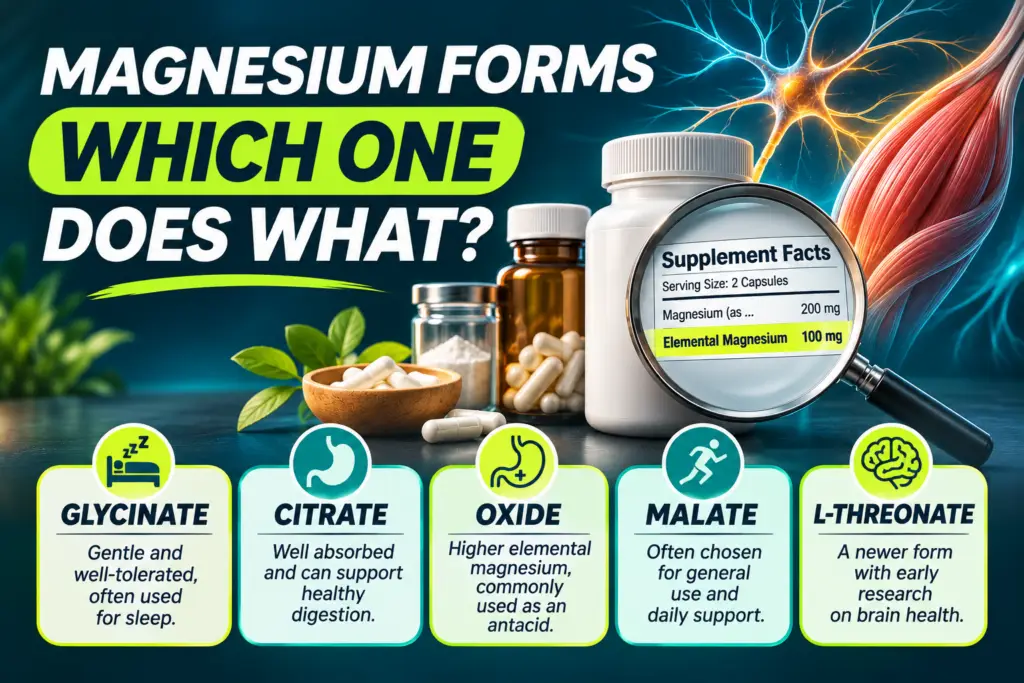
By Dr. Chris Cormier, DC — The Nerve Health Institute People arrive at the clinic having been told to take magnesium, having bought magnesium, and having no idea which of the eight versions on the shelf they were supposed to buy. It is a fair question and it deserves a proper answer, because magnesium forms genuinely are not interchangeable. We will start with the awkward part, though, because it changes how you read everything after it: for this particular mineral, a standard blood test will not settle the question for you. What magnesium does Magnesium is a cofactor in more than three hundred enzyme systems, including the ones governing protein synthesis, blood glucose control, blood pressure regulation, and — our own area of interest — muscle and nerve function. An adult body holds roughly twenty-five grams of it. Between half and sixty per cent of that sits in the skeleton, and most of the remainder is in soft tissue, mainly muscle. It is the second most abundant positively charged ion inside your cells. That distribution is worth holding onto, because it explains the problem with testing. Why the blood test does not answer the question Less than one per cent of your total body magnesium is in your blood serum, and those levels are held under tight control by the kidneys regardless of what is happening in your tissues. Which means the most commonly used test for magnesium status — serum magnesium — does not accurately reflect total body magnesium or the concentration in any particular tissue. Measuring the ionised, physiologically active fraction has been proposed as an improvement, but whether it reflects total body stores is still unknown. This is one of the few nutrients where we do not lead with a blood test, because the standard one cannot tell you what you actually want to know. We mention that partly because it is true and partly because it is the sort of thing a clinic has a small commercial incentive not to say. A serum magnesium level is easy to order and easy to charge for. It is also, on its own, close to uninformative about whether you would benefit from supplementing. What is genuinely useful instead is a plain look at what you actually eat, what else you take, what medications you are on, and what is going on with you. That is less satisfying than a number, and it is a better guide. How common is a shortfall, really You will often hear that essentially everybody is deficient in magnesium. That overstates it, and the accurate version is still a good reason to pay attention. National survey data indicate that over half of US adults take in less dietary magnesium than recommended, with around forty-eight per cent consuming less than the estimated average requirement. That is a statement about intake falling short of a target, which is not the same thing as a diagnosed clinical deficiency. The distinction matters because it changes what you should do. A widespread intake shortfall is a food argument before it is a supplement argument. A clinical deficiency is a medical matter for your doctor. The one line on the label that matters most Before any comparison of magnesium forms is useful, you need to know this: the number on the front of the bottle is often the weight of the whole compound, not the magnesium in it. Magnesium is never sold on its own. In all of the magnesium forms it is bound to something — an amino acid, an organic acid, or an inorganic salt — and that partner molecule makes up part of the weight. The proportion that is actually magnesium is called the elemental magnesium, and it varies enormously between forms. Find the elemental magnesium figure on the supplement facts panel. Everything below is easier to interpret once you have. The magnesium forms, and what each is for Glycinate (bisglycinate) Magnesium bound to the amino acid glycine. Roughly ten to fourteen per cent elemental magnesium, well absorbed, and notably gentle on the digestive system — tolerated well even by people who react to other forms. Commonly chosen for sleep and general repletion, and the form with the broadest everyday evidence behind it. Citrate Bound to citric acid. Around eleven to sixteen per cent elemental magnesium and reliably well absorbed; one randomised double-blind trial in forty-six healthy adults found citrate showed superior absorption over sixty days compared with the alternatives tested. It has a mild osmotic effect in the gut, drawing in water and softening stool, which at higher doses becomes a laxative effect — useful for some people, inconvenient for others. Below around 350 mg it generally does not cause that. Oxide The cheapest and the most elemental-dense at roughly sixty per cent magnesium by weight — and the least absorbed, with clinical studies putting fractional absorption at about four per cent. In the trial mentioned above, oxide produced no measurable difference from placebo. It works well as a laxative or antacid, which is largely what it is for. In fairness, some clinicians argue oxide is over-criticised and that the practical difference is smaller than the absorption figures suggest. We would still not choose it for repletion. Malate Bound to malic acid. Roughly eleven to fifteen per cent elemental magnesium, well absorbed, and generally less laxative than citrate. A reasonable general-purpose choice. L-threonate The interesting one. Low elemental content at around seven to eight per cent, but it appears to be the only form shown to meaningfully raise magnesium levels in the brain, which is mechanistically plausible given that magnesium modulates NMDA receptors involved in learning and memory. It is positioned for cognitive support, it is expensive, and the evidence base is thinner than for glycinate or citrate. Promising rather than established. Chloride Twelve to twenty-five per cent elemental magnesium and well absorbed. Perfectly respectable, less commonly chosen. Topical sprays and flakes Pleasant, and there is little good evidence that they raise body magnesium levels. If