
Hemophilia and Joint Health
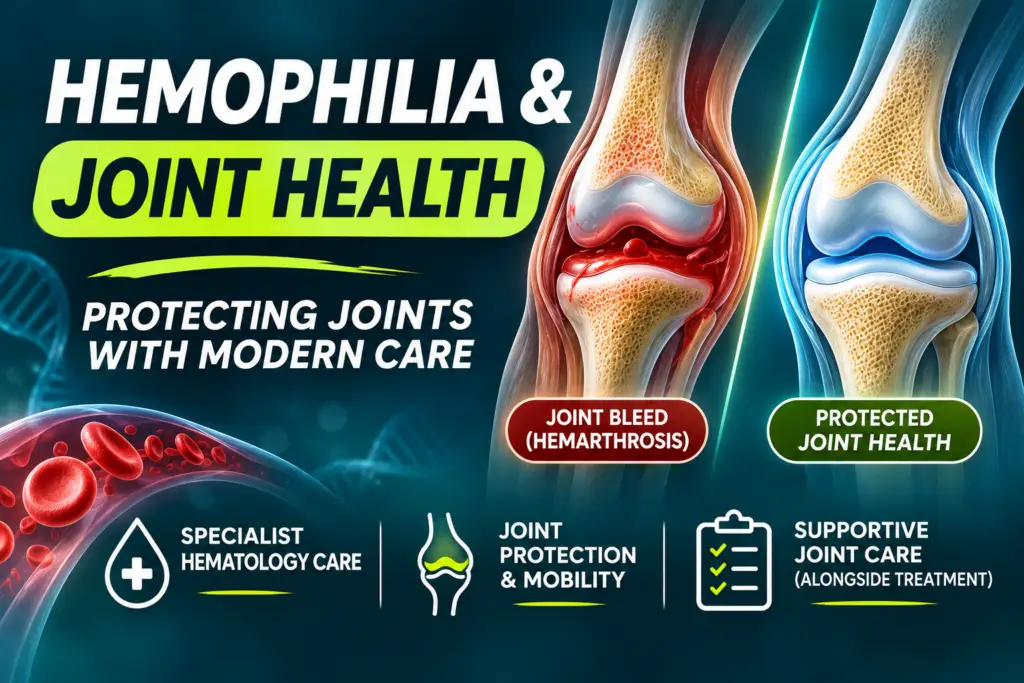
By Dr. Chris Cormier, DC — The Nerve Health Institute April 17th is World Hemophilia Day, and the honest way to mark it is to lead with the genuinely remarkable news, because there is some. Until the 1960s, median life expectancy for someone with severe hemophilia was around thirty years. Today, with modern treatment, a person with hemophilia can expect a virtually normal life expectancy and quality of life. That is one of the clearer success stories in modern medicine, and it was achieved by hematology rather than by anything else. What has not been entirely solved is joints. That is where this page concentrates, because hemophilia joint health is the area where day-to-day supportive care genuinely has something to contribute alongside specialist treatment. What hemophilia is, plainly Hemophilia is an inherited bleeding disorder. People with it do not produce enough of one of the proteins the blood needs in order to clot — factor VIII in hemophilia A, factor IX in hemophilia B. It affects more than a million people worldwide. It is graded by how much clotting factor is present. Severe hemophilia means less than one per cent of normal factor activity, moderate is one to five per cent, and mild is five to forty per cent. That grading matters because it shapes both the bleeding pattern and the treatment plan. It is caused by a change in a specific gene. We want to be direct about that on a clinic website, because it determines what can honestly be offered to anybody living with it, and we would rather be clear than encouraging. Hemophilia is a genetic condition. It is managed with specialist hematology care, and clotting factor replacement and related therapies are the treatment. Nothing on this page, and nothing offered by this clinic, changes the underlying condition or substitutes for that treatment in any way. If you or your child has hemophilia, your hemophilia treatment centre is the most important relationship you have. Why the outlook has changed so much The transformation came from preventing bleeds rather than only treating them once they happen. Alongside better life expectancy, the research describes substantially improved quality of life and participation — in sport, work and school. The modern aim is explicitly for people with hemophilia to live alongside everybody else rather than around the condition. It is worth adding, because it is true and it is why awareness days exist, that in places where access to these medicines is limited, preventable bleeding and permanent joint damage are still common. The science is solved considerably further than the distribution is. Why joints are the part that lingers Bleeding into a joint is called hemarthrosis, and in hemophilia it can follow minor trauma or occur with no apparent cause at all. Knees, ankles and elbows are the usual sites. A joint has limited capacity to repair itself at the best of times, and repeated bleeding into the same joint overwhelms it. Blood in the joint space drives inflammation, the lining thickens, cartilage is damaged, and over time this produces hemophilic arthropathy — a progressive and genuinely disabling joint condition that brings pain, stiffness and lost range of movement. Three things about hemophilia joint health are worth knowing, because none of them is obvious: Which is why the single most protective thing for hemophilia joint health is early, sustained prophylaxis — preventing the bleeds in the first place. Everything else, including everything we do, sits downstream of that. Signs worth taking to a doctor Awareness is the part of this where a page like ours can be most useful, because a number of people reach adulthood without a diagnosis, and mild hemophilia in particular can go unrecognised until surgery or a significant injury. People often normalise these things — bruising easily becomes “just how I am” rather than a question worth asking. Diagnosis is straightforward: a doctor orders blood tests that measure clotting and factor levels. It is not something to work out from a website, including this one. What we do, and what we do not We would rather set this out plainly than leave it to be inferred. The Nerve Health Institute is not a hemophilia treatment centre. We do not diagnose hemophilia, we do not treat it, and we do not offer anything that alters a genetic condition or reduces anybody’s need for clotting factor. Any suggestion that supportive care could take the place of that would be both wrong and dangerous, and we will not make it. If you have hemophilia, your hematology team is the treatment. Everything else, ours included, is support around the edges of a life — which is worth having, and is not the same thing. What we work with sits alongside that: the musculoskeletal and nervous system side of living with a long-term condition, and hemophilia joint health in particular: joints that have been through a lot, movement that has become guarded, sleep that is disrupted by pain, and the accumulated load of managing something for years. That is a real area and we are glad to work in it. It is a different claim from the one some clinics in our field make, and the difference matters. Where supportive care genuinely helps Always in coordination with the hemophilia team, and never as a substitute for a treatment plan. Movement, with specialist guidance Physical activity has moved from being discouraged to being actively recommended in modern hemophilia care, because strong muscle support around a joint protects it. Which activities, and at what intensity, is a question for a physiotherapist who works with bleeding disorders — that specificity is the whole point, and it is why we would not hand out a generic programme. Our page on muscle loss after 50 covers why muscle support around joints matters more with age. Sleep Repair happens during sleep, and chronic joint pain is one of the more reliable ways to lose it. Protecting sleep is one of the few things entirely within reach at