
ADHD Is Not Laziness
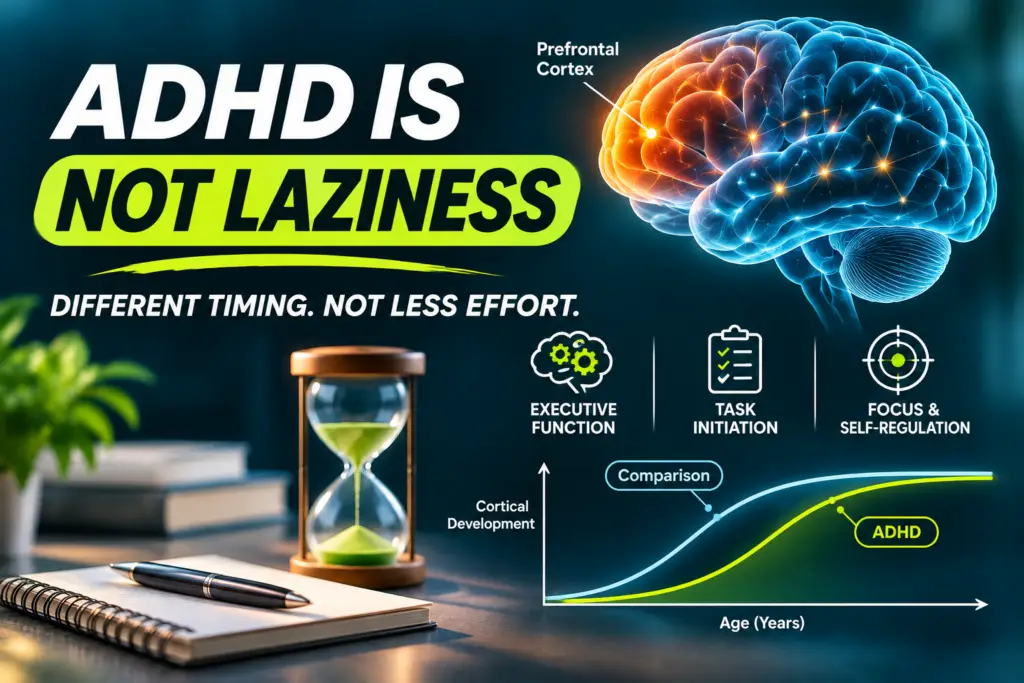
By Dr. Chris Cormier, DC — The Nerve Health Institute, Lafayette, Louisiana In nearly three decades of practice, I have heard the word lazy used about ADHD many times. Almost never by a teacher, and only occasionally by a parent. Overwhelmingly, it is used by the person themselves. They arrive having already reached a verdict, usually years earlier, and the verdict is that they are the problem. They sat through enough reports saying “could do better if he applied himself” to accept it as a description of their character. Adults diagnosed in their forties often describe the diagnosis as the first time anybody offered them an alternative explanation. So this page is about evidence rather than encouragement. ADHD is not laziness, and the reason is not that it would be unkind to say so. The reason is that brain imaging, developmental research and decades of executive function studies all describe something quite different from a person choosing not to try. What the brain scans actually showed The clearest single piece of evidence came from a study at the National Institute of Mental Health, published in 2007. Researchers analysed 824 MRI scans from 223 children with ADHD and 223 children without, tracking them repeatedly over several years rather than taking a single snapshot. They measured when each part of the cortex reached its peak thickness, which is a recognised marker of brain maturation. The median age at which half of cortical points reached peak thickness was around seven and a half years in the children without ADHD, and around ten and a half years in the children with it. A delay of roughly three years. Across regions, the delay ran at about two to three years depending on the area. And the delay was most pronounced in the lateral prefrontal cortex — the region responsible for suppressing inappropriate responses, holding a plan in mind, and exercising exactly the kind of control that the word lazy is usually reaching for. Delay, not deviance The finding that matters most is not the number of years. It is the word the researchers used. They described ADHD as characterised by delay rather than deviance in cortical maturation. The developmental curves in almost every cortical region ran lower than the comparison group but still ran parallel to them. Same sequence, same pattern, different timetable. The brain was not following a broken path. It was following the ordinary path, later. That distinction is worth sitting with, particularly for a parent. It also explains something families notice and struggle to articulate: a child who is plainly bright, plainly capable, and plainly unable to do the thing being asked at the moment it is being asked. One researcher put it as asking a ten-year-old to do the executive work of a thirteen-year-old. That is not a child refusing. That is a demand arriving before the machinery for it has finished arriving. This is the clearest reason ADHD is not laziness in any sense the word is normally used. A timetable is not a temperament. What executive function actually means Executive function is an umbrella term, and it covers more than most people assume. It includes planning, working memory, attention, inhibition, self-monitoring, self-regulation and task initiation. Task initiation is the one worth highlighting, because it is the one most often mistaken for a character flaw. The gap between knowing you need to start and being able to start is not a gap in willingness. It is a distinct cognitive function, and it can be weak while every other faculty a person has is perfectly intact. A large meta-analysis published in 2024 found executive function delay to be a feature running across neurodevelopmental conditions generally, with a moderate effect size of around 0.56 compared with control groups. This is a measurable, replicated, well-described difference — not a figure of speech. If you would like the wider picture of how the brain governs the rest of the body, we cover it in how the brain controls the body, and the ADHD-specific version in ADHD and the nervous system. Why “just try harder” is the wrong instruction I use an analogy in clinic that patients tend to remember, so I will use it here. Imagine somebody who has never lifted a weight in their life. You hand them an eighty-pound dumbbell and ask for ten repetitions. They will fail. Not because they are not trying — they may be trying far harder than the person next to them who manages it easily. The demand simply exceeds the current capacity, and no amount of exhortation changes that. Now tell somebody who cannot sustain attention that they must read a chapter in twenty minutes. It is the same request. And when they cannot, the thing they learn is not how to concentrate. The thing they learn is that they are the sort of person who fails at this. Saying ADHD is not laziness is not an argument for expecting less of anybody. It is an argument for sizing the request correctly, which is a different thing and usually produces more, not less. Scale the demand and the picture changes immediately. Three focused blocks of seven minutes is a different task from one block of twenty, even though the arithmetic is almost identical. The capacity is trainable and the demand is adjustable, and progress generally comes from moving both. Why effort is the wrong thing to measure Here is the part that tends to land hardest with adults who have spent years assuming the worst about themselves. People with ADHD do not expend less mental energy than everybody else. Research on error monitoring suggests they expend significantly more — more effort spent noticing and correcting mistakes, for an outcome that often looks the same or worse from the outside. So the common experience of working twice as hard for half the result is not a self-pitying story people tell themselves. It is a reasonable description of what the measurements show. If you only remember one