The treatment finished. Everyone told you the hard part was over.
And then your feet stayed numb. Buttons became difficult. You started watching the floor when you walked because your feet stopped reporting back reliably. Perhaps you mentioned it and were told it might improve with time, which was honest but not especially useful on a Tuesday afternoon when you could not feel the stairs.
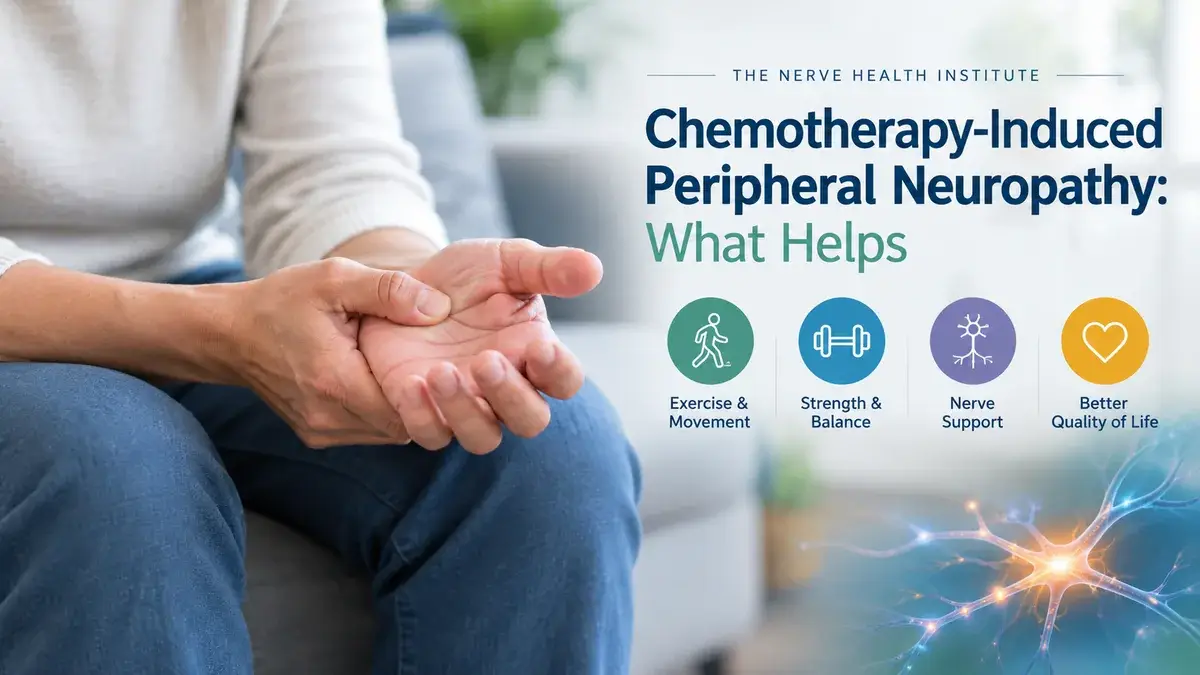
Chemotherapy-induced peripheral neuropathy is one of the most common lasting effects of cancer treatment, and one of the least well served. It deserves a clearer explanation than most people get, and there is more that can be done about it than most people are told.
How Common It Actually Is
Depending on the drug and the cumulative dose, somewhere between a third and two thirds of people receiving neurotoxic chemotherapy develop peripheral neuropathy. Platinum agents and taxanes are among the most frequently implicated.
For some, it fades over the months after treatment ends. For a substantial number it does not, and becomes a long-term feature of life afterwards. It is significant enough that it is one of the common reasons chemotherapy doses get reduced or stopped early, which makes it a problem worth taking seriously well before it becomes permanent.
If you are experiencing it, you are not an unusual case and you are not complaining about something minor.
What Is Actually Happening to the Nerves
Chemotherapy is designed to act on rapidly dividing cells. Peripheral nerves are caught in the crossfire, and the longest nerves in the body — those reaching the feet and hands — are the most exposed, which is why symptoms start at the extremities and work inward.
The damage involves the nerve fibre itself, disruption to mitochondrial function within the nerve, oxidative stress and inflammatory changes. What that produces is a nerve that is still physically present but not conducting properly.
That distinction matters, because it is the reason scans and standard tests so often look unremarkable while your hands plainly do not work the way they used to. The structure is there. The signal is not. At Nerve Health Institute we call that layer EnergyFlow, and it is what we assess.
Why Medication Alone Often Disappoints
Current oncology guidance is candid about this in a way that surprises most patients.
No medication has been established as effective at preventing this neuropathy. For treating it once established, guideline panels have identified only one drug with reasonable supporting evidence — duloxetine — and even that produces partial relief for some rather than resolution for most. Gabapentinoids are widely prescribed and have performed modestly in trials, often limited by side effects.
So if you have been prescribed something and found it underwhelming, that is consistent with the evidence rather than a failure on your part or your doctor’s. It also explains why the non-drug approaches have received so much research attention recently.
What the Evidence Supports
Exercise. This is the strongest of the non-pharmacological options and is increasingly recognised in oncology guidance as a supportive care measure during and after treatment. Systematic reviews report improvements in neuropathy symptoms, pain threshold, balance and strength. Programmes generally combine aerobic work, resistance training for major muscle groups, and sensorimotor or balance training, built gradually and around treatment cycles rather than against them.
Balance and fall prevention. When your feet cannot report position reliably, the systems that keep you upright lose their main source of information. Targeted balance work addresses this directly, and it matters practically — falls are a genuine risk in this group, not a theoretical one.
Sleep and fatigue management. Both interact with neuropathy symptoms and with recovery capacity generally.
Other options. Guideline panels have noted acupuncture and scrambler therapy as reasonable to consider, while being clear that larger studies are still needed. Cryotherapy and compression during infusion are being actively studied for prevention.
None of these is dramatic, and collectively they outperform what is available in a prescription pad. That is an unusual situation in medicine and worth knowing about.
The Wider Picture After Treatment
Neuropathy is rarely the only thing people are carrying when they arrive.
Fatigue that does not lift, deconditioning from months of reduced activity, disrupted sleep, and a nervous system that has spent a long period in a protective state all tend to arrive together. Those interact: poor sleep worsens pain perception, deconditioning worsens fatigue, and a system held in protection recovers more slowly than one that is not.
Working on one piece in isolation tends to underperform. Working on the pattern tends to do better, and that is where an approach that looks at the whole system rather than the presenting symptom earns its place.
What an Evaluation Involves
A full history. Your treatment regimen, when symptoms began and how they have changed, what else you were carrying before treatment started, and what your current medical team is managing.
A detailed neurological examination. Function assessed across the 88 major nerves branching from the brain and spinal cord — mapping where signal is running below capacity rather than assuming the affected areas are only the ones you can feel.
Balance and functional capacity. What you can currently do safely, which sets the starting point for everything else.
Daily foundations. Sleep, hydration, breathing, light exposure and activity — the inputs that determine how much recovery capacity you have to work with.
The output is a plan paced to where you actually are, designed to be shared with your oncology team rather than run in parallel to it.
Where Clinic Technologies Fit
Plans draw from the non-invasive technologies available at our Lafayette clinic, including Quantum Neurology for targeted nerve function work, PEMF & Grounding, Theralight360, HBOT and BRT Bioresonance.
One thing needs saying clearly about timing. If you are in active cancer treatment, or have a current diagnosis, every one of these needs to be cleared with your oncologist before you start. Some modalities are not appropriate during active treatment, and light-based therapy in particular should not be applied over a known or suspected tumour site. We ask about this at screening, and where the answer is that something should wait, it waits.
Pace is also set low deliberately. People arriving after months of treatment have less reserve than they are used to having, and intensive protocols in that state produce setbacks rather than progress.
Watch: Dr. Chris Cormier on Supportive Care
In this conversation, Dr. Chris Cormier, DC discusses the supportive side of cancer care — why he is explicit that the clinic is not a cancer clinic, what he works on for people dealing with neuropathy and fatigue after treatment, and where he believes that work does and does not belong.
Individual results vary. Cases discussed reflect clinical experience and are not a prediction of outcome for any other person.
What This Is — and What It Is Very Much Not
This needs to be unambiguous.
We are not a cancer clinic. We do not treat cancer, we do not claim to, and we never will. Nothing offered here affects a tumour, a diagnosis or a prognosis. Any page anywhere suggesting that oxygen, light, frequency or any similar modality treats cancer is making a claim that is neither supported nor safe to act on.
Your oncology team leads your care, and their treatment plan is the thing protecting you. Chemotherapy, radiotherapy, surgery and immunotherapy exist because they work. Nothing on this page is a reason to delay, decline, reduce or stop any part of that, and we would decline to work with anyone who came to us intending to substitute this for oncology care.
What we do is supportive care: nerve function, balance, fatigue, sleep and daily capacity, for people living with the effects of treatment. That is a real and often neglected need, and it is the whole of what we offer.
Tell your oncologist you are considering this. Any good supportive care provider will want that conversation to happen, and any provider who prefers it did not is one to walk away from.
Tracking Changes
Neuropathy shifts gradually, which makes it hard to judge from memory. A short weekly record helps you and your medical team:
- Where the numbness or tingling reaches — draw the boundary on a hand and foot outline
- Pain level, and what kind it is
- Balance — anything you have stopped doing because it feels unsafe
- Fine motor tasks: buttons, keys, writing, jar lids
- Fatigue through the day
- Sleep quality
Mapping the boundary is particularly useful. It is the clearest way to see whether an area is expanding or receding, and it gives your oncology team something concrete if you are still in treatment and dose decisions are being weighed.
Report new or worsening symptoms to your oncology team promptly, especially during active treatment. Early reporting can influence dosing decisions while that still makes a difference.
Continuing at Home
BodyChargers by Dr. Chris covers the at-home side — the OWL foundations of Oxygen, Water and Light, breathing, sleep and nervous system regulation. For anyone in or recently out of treatment, check with your oncology team about what is appropriate for your situation before starting anything new.
Key Takeaways
Chemotherapy-induced peripheral neuropathy is common, frequently long-lasting, and poorly served by medication — that last point is acknowledged in oncology guidance rather than being a fringe opinion.
The non-drug approaches, particularly graded exercise and balance work, currently have the better evidence. They are unglamorous, they are cheap, and they are where most people should start.
And if your feet have stopped reporting back reliably, that is a functional problem that can be assessed, not something you simply have to accept because everything else looks normal.
Nerve Health Institute in Lafayette, Louisiana provides supportive care alongside oncology teams, for local and visiting patients. Contact us today.
This article is educational and is not medical advice. It does not diagnose or treat any condition, and nothing described here treats cancer. Cancer requires management by an oncology team. Always consult your oncologist before starting any new therapy or exercise programme during or after treatment.
Frequently Asked Questions
Does chemotherapy neuropathy go away?
For some people it improves gradually over the months after treatment ends. For a substantial proportion it persists longer term. The honest answer is that it varies with the drug, the cumulative dose and the individual, and nobody can tell you in advance which group you will be in. What is clearer is that doing nothing is not the best available option.
Why does medication not help much?
Because the evidence for it is genuinely limited, and oncology guidance says so. No drug has been established as preventing this neuropathy, and only one — duloxetine — has reasonable evidence for treating it, with partial benefit for some. If your prescription has underwhelmed you, that matches the research.
Is exercise safe with neuropathy and after chemotherapy?
For most people yes, and it is increasingly recommended as supportive care during and after treatment. The caveats are real though: it needs to be graded to your current capacity, balance work should be done safely given fall risk, and your oncology team should sign off on the plan, particularly during active treatment.
Can you treat my cancer?
No. We are not a cancer clinic and we do not treat cancer in any form. Our work is supportive — nerve function, balance, fatigue and daily capacity — alongside the oncology team managing your care. We would turn away anyone hoping to use this as a substitute for that.
Can I come while I am still in chemotherapy?
Sometimes, with your oncologist’s agreement, and with the plan built around your treatment cycles. Some modalities are not appropriate during active treatment, so that conversation happens at screening and the answer is occasionally that we should wait.
Is it too late if my treatment finished years ago?
Not necessarily. Long-standing neuropathy can still be assessed functionally, and balance, strength and daily capacity commonly improve with targeted work regardless of how long the symptoms have been present.
Do you accept my insurance?
Coverage varies by plan and by service. Call the clinic on +1 (337) 456-6555 for a clear answer for your situation.
Ready To Take Control Of Your Health?
Get Treatment → nervehealth.com/get-treatment/
The Nerve Health Institute
108 Republic Ave. Ste. B, Lafayette, LA 70508
+1 (337) 456-6555