By Dr. Chris Cormier, DC — Founder, The Nerve Health Institute
Colorectal cancer can develop quietly for years before it announces itself. A polyp forms, changes slowly, and produces no symptoms at all while it does so.
That is the cruel part, and it is also the hopeful part. A disease that takes years to develop is a disease with a long window in which it can be found — and found early, colorectal cancer is one of the most treatable cancers there is.
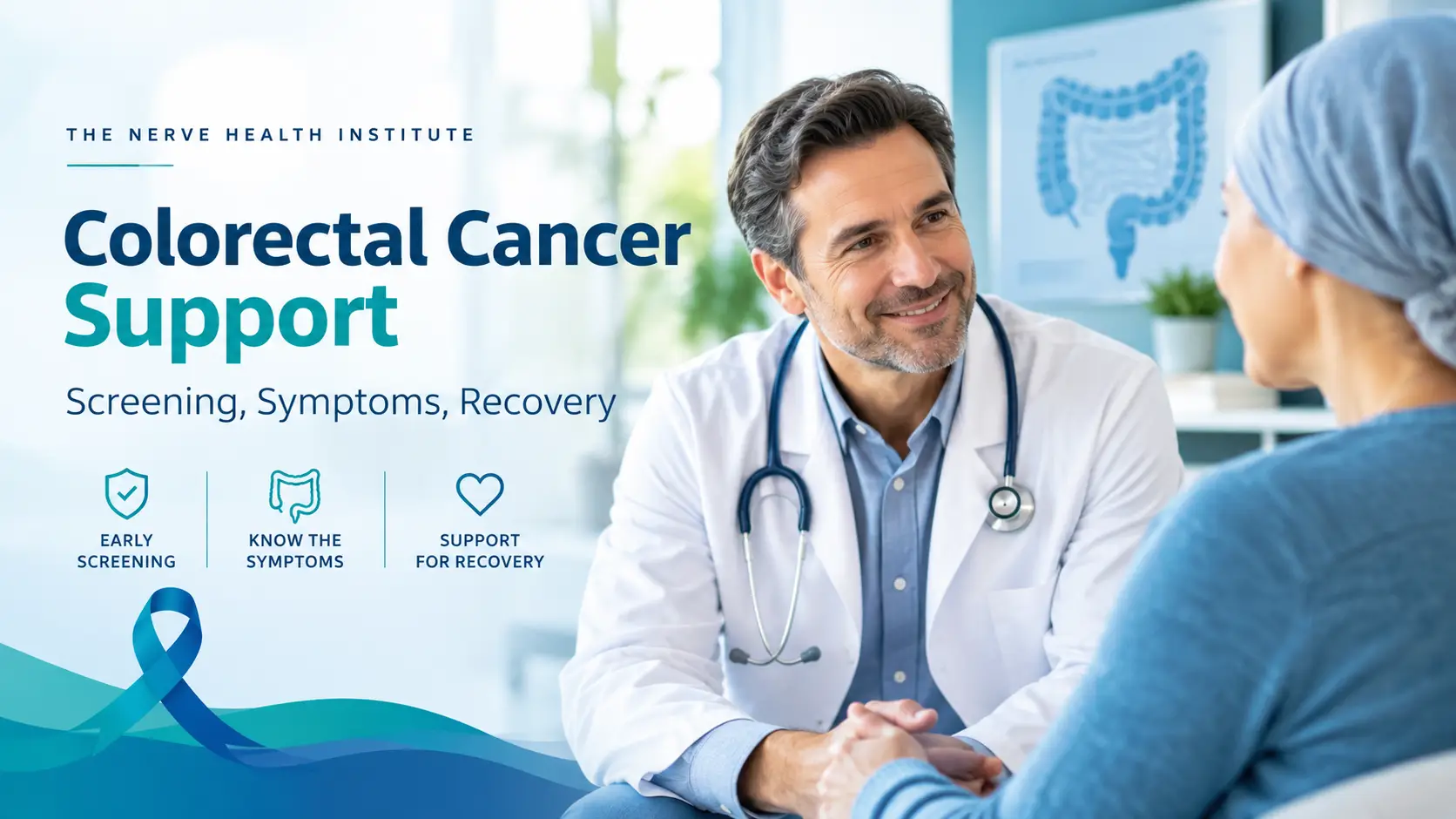
So I am going to do something slightly unusual for a clinic page. Before I tell you anything about what we offer, I am going to tell you about screening, because that is the single most valuable thing on this page. Then I will explain what colorectal cancer support looks like here — which is cellular and functional care alongside your oncology team, and nothing more than that.
Screening Is the Part That Actually Saves Lives
Guidelines now recommend that adults at average risk begin colorectal cancer screening at age 45, not 50. That change was made because the disease is appearing more often in younger adults — people in their forties, thirties and even twenties — and the previous starting age was missing them.
You can read the current guidance directly from the CDC and the US Preventive Services Task Force. I link to them rather than paraphrasing because this is the one subject on this page where I want you reading a primary source.
Several options exist, including at-home stool-based tests as well as colonoscopy. The best screening test is the one you will actually do. If the idea of a colonoscopy is what has been stopping you, ask your doctor about the alternatives rather than continuing to put it off.
And if you have a family history of colorectal cancer or polyps, inflammatory bowel disease, or a known genetic syndrome such as Lynch syndrome, you may need to start earlier. That is a conversation to have now rather than at 45.
The Symptoms Never to Dismiss Because of Your Age
This is where early-onset cases are being missed. Symptoms in younger adults get attributed to haemorrhoids, to diet, to stress, to training — and the evaluation does not happen.
Get assessed promptly if you have:
- Rectal bleeding, or blood in the stool — bright red or dark
- A persistent change in bowel habit — looser, more frequent, narrower, or newly constipated
- Abdominal pain or cramping that does not settle
- A feeling that the bowel does not empty completely
- Unexplained weight loss
- Unexplained fatigue, or iron-deficiency anaemia on a blood test
Most of these turn out to be something less serious. That is exactly why they get dismissed, and it is why so many younger patients are diagnosed late. If symptoms are present, what you need is not a screening test — it is a diagnostic evaluation, and a colonoscopy is usually the right one.
If you are under 45 and have been told you are too young to worry, ask again. Persist.
What Colorectal Cancer Support Means at Our Clinic
Now the part about us, and I want the boundary stated before the services rather than after them.
We are not a cancer clinic. Nothing we do cures, prevents or treats cancer. I say that in every interview I give and I will say it here. Our work is cellular and functional support for people living through treatment and recovering afterwards — and that is a real need that nobody else in the care pathway is assigned to.
What people come to us for, in practice, is the damage treatment leaves behind. Chemotherapy regimens used in colorectal cancer are among those most associated with peripheral nerve damage — numbness and tingling in the hands and feet, loss of fine motor control, unsteadiness. That is covered in detail in our article on chemotherapy-induced peripheral neuropathy, and it is the most common reason people find us after treatment.
Alongside that: fatigue that outlasts the treatment, months of lost conditioning, disrupted sleep, and a system that has spent a long stretch in a protective state. Our wider approach to this is set out in holistic cancer support.
The OWL Method: What Every Cell Runs On
Everything we do is built on a framework I developed over nearly three decades. I call it the OWL Method — Oxygen, Water and Light — because these are not wellness concepts. They are what your cells are physically made of and run on.
Oxygen — the number one ingredient
Oxygen is what cellular energy production runs on, and it is the first thing to run short. A cell low on oxygen cannot clear waste efficiently, produce energy well, or repair at the rate it should. After months of treatment, most people’s capacity to move air and circulate it has dropped considerably. This is the foundation everything else sits on.
Water — the medium everything happens in
You are around 60% water, and every transaction in your body — nutrient delivery, waste removal, signal transmission — happens in that medium. We work on both the quantity and the quality, because both change what the cell actually receives.
Light — the energy your nervous system runs on
Your brain and nervous system operate on light energy, travelling like fibre optics through a network reaching every cell. We also evolved under a sun that is roughly half near-infrared, and we now spend the overwhelming majority of our lives indoors. Restoring that is not a metaphor; it is something we do with specific equipment.
Alongside these sit frequency, magnetism and nutrients — the supporting ingredients that make the first three usable. Most people start at nutrients and skip the entire hierarchy above.
The Technologies We Use, and What Each One Is For
Quantum Neurology and the 88-nerve assessment
Quantum Neurology is where our work differs most. Your brain is a power company wired to trillions of cells through 88 major nerves branching off the brain and spinal cord. We test function across all of them and map exactly where power is not arriving — what we call EnergyFlow. For someone with treatment-related nerve damage, this is the assessment nobody else in your care team performs.
Hyperbaric Oxygen Therapy
HBOT is a pressurised chamber driving oxygen into tissue at concentrations you cannot achieve by breathing normally. I trained in hyperbaric medicine alongside a room of surgeons and dentists using it before and after procedures for exactly this reason — what it does for tissue recovery.
EWOT and LiveO2
EWOT alternates high-concentration oxygen with a reduced mixture during light exercise, creating a brief demand state that triggers vasodilation. You get the delivery effect as well as the supply, and the exercise involved can be genuinely light — which matters enormously for someone depleted after treatment.
Theralight360
Theralight360 delivers full-body red and near-infrared photobiomodulation at therapeutic intensity. One important caution: light therapy is not applied over a known or suspected tumour site, and timing during active treatment is cleared with your oncologist first.
PEMF and Grounding
PEMF & Grounding addresses magnetism. The earth carries a charge we are meant to be in contact with, and shoes and indoor living have removed it almost entirely. Patients consistently describe feeling settled afterwards.
BRT Bioresonance
BRT Bioresonance works with frequency. Every tissue carries its own resonant tune — the cells in your sigmoid colon are tuned differently from those in your small intestine or pancreas, much like strings on a guitar — and sustained stress pulls tissue out of tune. Frequency has been studied for many decades; this is not a new idea.
EBOO Prime
EBOO Prime circulates blood through a filtration stage and an oxygenation and ozonation stage before returning it. We write about it in more depth, including where the evidence sits and who it is not suitable for, at ebooprime.com. It is not appropriate for everyone, and during active cancer treatment it is a decision for your oncologist.
Between Appointments
Not everyone can reach Lafayette, and even those who can are here for a few hours at most. BodyChargers by Dr. Chris is the at-home platform — the same OWL foundations, frequency device programmes and daily methods, with the 28-Day Cell Sparking Challenge turning the whole framework into one small change a day.
Portable frequency devices can target specific areas including the digestive tract, and simple neurological exercises — something as basic as gentle vibration over the abdomen at a setting that feels right to you — help maintain the brain’s connection to that region. For anyone in or recently out of treatment, check with your oncology team about what is appropriate for your situation first.
The Honest Limits — and Why I Publish Them
You will not find this section on most clinic websites. It belongs here.
We do not treat, cure or prevent colorectal cancer. Nothing we offer acts on a tumour, a polyp, a diagnosis or a prognosis. Any page anywhere suggesting that oxygen, light, frequency or blood filtration treats cancer is making a claim that is neither supported nor safe to act on.
We do not screen for it or diagnose it either. That requires a colonoscopy or an approved stool-based test ordered through a physician. If you are 45 or older and have not been screened, or you have symptoms at any age, that comes before anything on this page — including before booking with us.
Your oncology team leads your care. Surgery, chemotherapy, radiotherapy and immunotherapy exist because they work. Nothing here is a reason to delay, decline, reduce or stop any part of that, and we would decline to work with anyone intending to substitute this for oncology care.
And we cannot promise you outcomes. What people commonly report is better energy, better sleep, improved nerve function and more capacity for daily life. Those are meaningful and they are not guaranteed, and I would rather you know that before you spend anything.
I publish this because the alternative health field has a serious problem with cancer, and pretending otherwise helps nobody. If knowing exactly where my limits sit makes you trust what remains, that is the right result. If it sends you back to your oncologist instead, that is also a good outcome.
Key Takeaways
Screening from age 45 is the most effective thing available for this disease, and symptoms at any age deserve evaluation rather than reassurance. If you take one action from this article, make it that one.
Colorectal cancer support at the Nerve Health Institute means cellular and functional care — nerve function, oxygenation, energy and daily capacity — for people going through treatment and recovering afterwards. It works alongside oncology, never instead of it.
You can read more about how I think about this work at drchriscormier.com, and we welcome local and visiting patients in Lafayette, Louisiana. Contact us today.
— Dr. Chris Cormier, DC
Founder, The Nerve Health Institute and BodyChargers by Dr. Chris
Frequently Asked Questions
What does colorectal cancer support involve at your clinic?
Cellular and functional care alongside your oncology team — the OWL foundations of oxygen, water and light, our 88-nerve functional assessment, and technologies including hyperbaric oxygen, full-body red light, PEMF and grounding, bioresonance and EBOO Prime. It is aimed at nerve function, energy, sleep and daily capacity, not at the cancer itself.
At what age should colorectal cancer screening start?
Current guidance recommends starting at 45 for adults at average risk, lowered from 50 because the disease is appearing more often in younger adults. People with a family history, inflammatory bowel disease or a genetic syndrome such as Lynch may need to start earlier — ask your doctor now rather than waiting.
What symptoms should I get checked?
Rectal bleeding or blood in the stool, a persistent change in bowel habit, abdominal pain that does not settle, a sense that the bowel does not empty, unexplained weight loss, and unexplained fatigue or iron-deficiency anaemia. Most turn out to be something less serious — which is precisely why they get dismissed and why younger patients are diagnosed late.
I am under 45 with symptoms. Am I too young for this to matter?
No. Rates in people under 50 have been rising, and specialists are explicit that symptoms should not be dismissed on the basis of age. If symptoms are present the goal is not screening but diagnosis, and a colonoscopy is usually the appropriate test. If you have been brushed off, ask again.
Does anything you offer treat or prevent colorectal cancer?
No. Nothing we do cures, prevents or treats cancer, and we are not a cancer clinic. Our work is supportive — nerve function, oxygenation, energy and recovery capacity — alongside the oncology team managing your care.
Can I come while I am still in chemotherapy?
Often yes, with your oncologist’s agreement and with the plan built around your treatment cycles. Some modalities are not appropriate during active treatment, and light therapy is never applied over a known or suspected tumour site. That conversation happens at your first visit.
I have numbness in my hands and feet after chemotherapy. Can that improve?
This is the most common reason people come to us after colorectal cancer treatment. It is a functional nerve problem, oncology guidance is candid that the medication options for it are limited, and non-drug approaches including graded exercise and targeted nerve work currently have the better evidence. Our article on chemotherapy-induced peripheral neuropathy covers it in detail.
Do you accept my insurance?
Coverage varies by plan and by service. Call the clinic on +1 (337) 456-6555 for a clear answer for your situation.
Ready To Take Control Of Your Health?
Get Treatment → nervehealth.com/get-treatment/
The Nerve Health Institute
108 Republic Ave. Ste. B, Lafayette, LA 70508
+1 (337) 456-6555