By Dr. Chris Cormier, DC — Founder, The Nerve Health Institute
The advice is always the same. Eat better, move more.
And for a great many people the advice is not wrong — it is simply unusable. If your knees hurt going down stairs, if you are exhausted by the middle of the afternoon, if walking any distance means paying for it tomorrow, then “move more” is not a plan. It is a description of something you already cannot do.
That gap is what I want to talk about, because obesity and chronic pain reinforce each other in a way that almost nobody addresses directly. And in nearly three decades of practice, the thing I have found most useful is not to start with weight at all. It is to start with what is blocking movement.
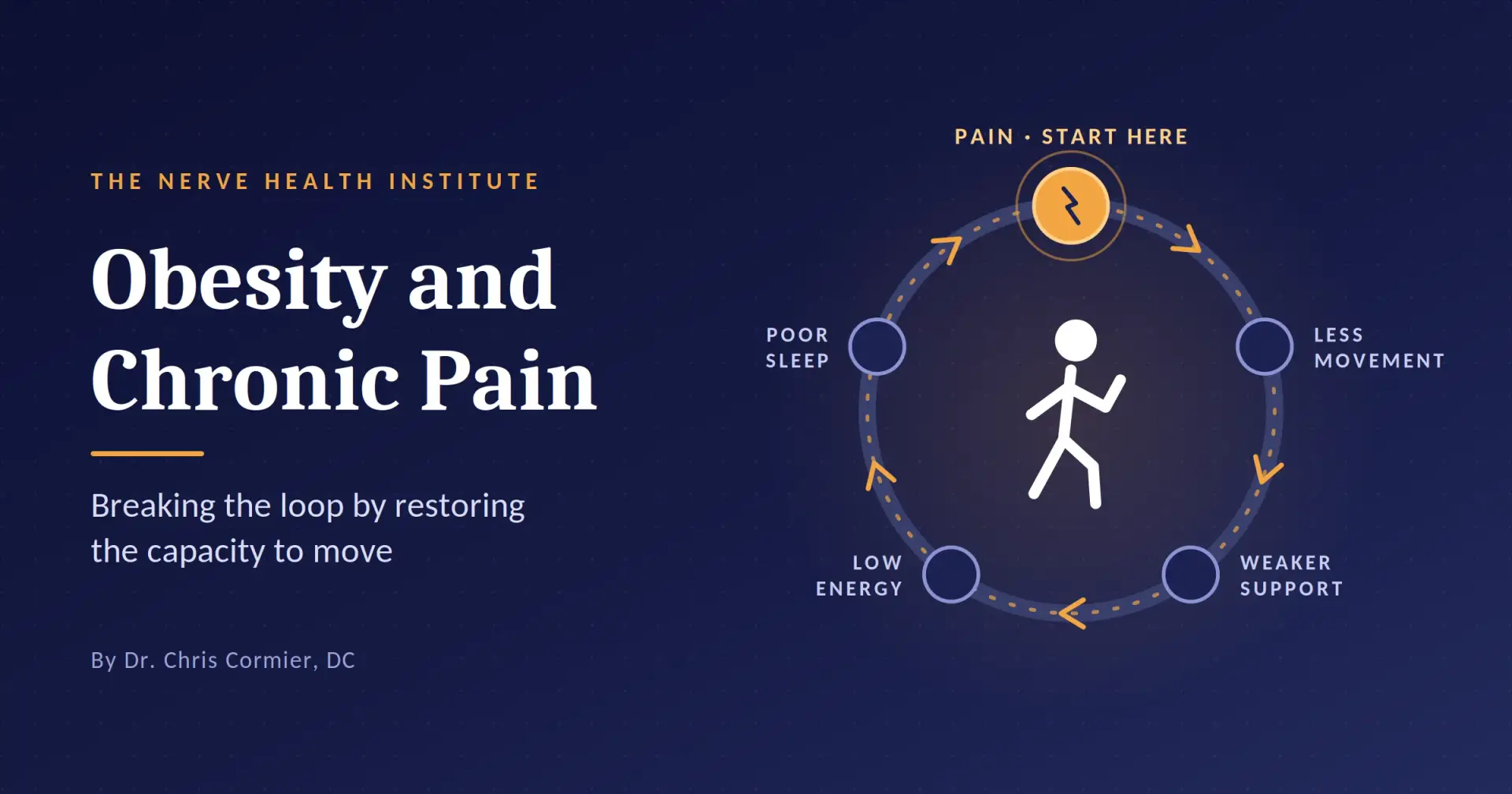
The Loop Nobody Names
It usually runs like this.
Something hurts — a back, a knee, a hip. Movement becomes uncomfortable, so it reduces. Reduced movement means the muscles supporting that joint weaken, and weaker support means the joint takes more load and hurts more. Energy drops. Sleep gets worse, which lowers pain tolerance further. Doing less becomes the reasonable response to how you feel.
Each step in that loop is a sensible reaction to the one before it. Nobody makes a bad decision anywhere in the sequence. And yet the loop tightens, and from the outside it looks like a lack of effort.
The important point is that the entry to this loop is usually pain or fatigue — not appetite. So the place to intervene is usually pain or fatigue too.
This Is Not a Willpower Problem
I want to say this plainly, because the people who reach my clinic have generally heard the opposite for years.
Body weight is regulated by a system involving hormones, sleep, stress physiology, medication effects, genetics and the state of your nervous system. It is not a simple ledger, and treating it as one has never worked well for anyone. If effort alone were sufficient, the people I see — who have usually tried harder and longer than anyone gives them credit for — would not be sitting in front of me.
There is also a growing body of research on endocrine-disrupting chemicals in food packaging, plastics and everyday products, and their potential effects on hormone signalling and metabolism. That work is ongoing rather than settled, but it points in a useful direction: the environment a body is operating in matters, and it is not something anybody chose.
None of that means nothing can be done. It means the useful question is what is actually in the way.
What We Look At
A full history
Not a food diary. The physical events, the injuries that never fully resolved, the sustained emotional load, the illnesses, the environmental exposures, and the point at which energy or sleep changed. People frequently identify the moment things shifted only once they see twenty years laid out in one sequence.
The 88-nerve assessment
Your brain is a power company wired to trillions of cells through 88 major nerves branching off the brain and spinal cord. We test function across all of them and map where power is not arriving — what we call EnergyFlow. It is closer to walking a breaker box than to asking whether the building has power.
Two things matter here particularly. First, the supply to the muscles supporting painful joints — because a muscle that is not being properly driven cannot protect the joint it serves, however much someone tries to strengthen it. Second, the endocrine glands. Hormone production depends on those connections being intact, and hormones run through energy, appetite regulation, sleep and metabolism. See Quantum Neurology.
Capacity, honestly assessed
What you can currently do without paying for it the next day. That number is the starting point for everything, and it is almost always lower than the programme someone has been told to follow.
The OWL Method: What Every Cell Runs On
Everything we do rests on a framework I have built over decades. I call it the OWL Method — Oxygen, Water and Light — because these are not wellness concepts, they are what your cells are physically made of and run on.
Oxygen
The number one ingredient in a cell, and the first to run short. Nobody breathes as well as they think, and chronic pain makes breathing shallower still. Every metabolic process you have runs on oxygen delivery, so this is not a small lever.
Water
You are around 60% water, and every delivery and clearance transaction happens in that medium. Quality matters alongside quantity, and most people are short on both without knowing it.
Light
Your nervous system runs on light energy travelling like fibre optics to every cell. Morning daylight also anchors the rhythm that governs sleep depth — and sleep is one of the most direct influences on appetite-regulating hormones and on how much energy you have to work with the next day.
Alongside those sit frequency, magnetism and nutrients. Almost everyone starts at nutrients and skips the whole hierarchy above.
How We Work on It at the Clinic
Oxygen delivery
HBOT drives oxygen into tissue at concentrations breathing alone cannot reach. EWOT and LiveO2 alternate high-concentration oxygen with a reduced mixture during light exercise, triggering vasodilation so you get the delivery effect as well as the supply. The exercise involved can be genuinely light — which is exactly the point when capacity is the limiting factor.
Light and frequency
Theralight360 delivers full-body red and near-infrared photobiomodulation at therapeutic intensity. BRT Bioresonance works with the resonant tune each tissue carries — thyroid cells are tuned differently from liver cells, like strings on a guitar, and sustained stress pulls tissue out of tune.
Magnetism and circulation
PEMF & Grounding restores a magnetic charge from the earth that shoes and indoor living have removed almost entirely. EBOO Prime circulates blood through a filtration stage and an oxygenation and ozonation stage before returning it — our most direct route to whole-system oxygenation and detoxification support.
Pace is built from where you actually are. Someone whose knees hurt on stairs does not belong in an intensive programme in week one, and putting them there is how people conclude that nothing works for them.
Three Things to Start Today
These cost nothing and they are where I would begin with anyone.
Breathe more deliberately. A few slow breaths, exhale longer than inhale, several times a day. If it makes you lightheaded, slow down. Oxygen is the first ingredient and this is the fastest way to improve delivery.
Start your day with water. Before coffee, before anything. Then keep it steady through the day rather than in bursts.
Get outside in the morning. Most people go from house to car to office and back without meaningful daylight. Morning light anchors your sleep rhythm, and better sleep improves energy, pain tolerance and appetite regulation together.
None of these is about weight. All of them are about giving your body more to work with — which is what makes everything else possible.
Where Medical Care Fits
This section matters, because plenty of places in my field get it wrong.
Obesity is a recognised medical condition, and it deserves proper medical care. The medications now available for it work for many people, bariatric surgery is the right answer for some, and both belong in a conversation with a physician who knows your history. Nothing here is a reason to avoid that conversation or to come off something that is helping you.
We also do not manage the conditions that commonly travel with this one — diabetes, blood pressure, sleep apnoea, thyroid disorders. Those need a doctor, and several of them are the reason someone feels as exhausted as they do. If you have not had recent bloodwork, that is a better first step than anything on this page.
What we contribute is function: nerve supply to the muscles that protect painful joints, the connections supplying the endocrine glands, oxygenation, and the daily capacity that determines whether movement is available to you at all. That is the piece that tends to be missing, and it is the one that makes the rest possible.
What I Would Have You Take From This
The patients I see change most are rarely the ones who set out to lose weight. They are the ones who came in because something hurt, got the pain and the energy addressed, started moving again because moving became possible, and found the rest followed.
When you feel better you move more. When you feel terrible you do not. That is not a character flaw — it is how bodies work, and it is why I start at the pain and the capacity rather than at the scale.
— Dr. Chris Cormier, DC
The Nerve Health Institute, Lafayette, Louisiana. Contact us today.
Frequently Asked Questions
I am in too much pain to exercise. Where do I even start?
Not with exercise. Start with what is generating the pain and what is limiting your capacity — nerve supply to the muscles supporting the painful joint, sleep, oxygenation. Movement becomes available once those improve, and building from there tends to stick in a way that pushing through does not.
Is obesity really connected to chronic pain?
They reinforce each other in both directions. Pain reduces movement, reduced movement weakens the support around joints, weaker support increases load and pain, and lower energy and poorer sleep make everything harder. Because the loop usually starts at pain or fatigue, that is generally where it is most useful to intervene.
Do you offer weight loss treatment?
No, and we do not make weight loss claims. We work on nerve function, pain, oxygenation and daily capacity. Some patients find that weight changes once movement becomes possible again, and some do not — we are not going to promise you an outcome we cannot control.
Should I be taking one of the new weight medications?
That is a conversation for your physician, and a legitimate one. These medications help a lot of people, and we would never advise anyone against a treatment their doctor has recommended. Our work sits alongside medical care rather than in competition with it.
What about endocrine disruptors in food and plastics?
It is an active area of research, with growing evidence around effects on hormone signalling. It is not fully settled, and we would rather describe it accurately than oversell it. Reducing avoidable exposures is reasonable; it is not the whole explanation for anything.
Where does the nervous system actually come into this?
Two places mainly. The muscles that protect painful joints need proper nerve supply to do their job, and no amount of strengthening works well if the signal is not arriving. And your endocrine glands depend on those connections too, which matters for energy, sleep and metabolism.
Do you accept my insurance?
Coverage varies by plan and by service. Call the clinic on +1 (337) 456-6555 for a clear answer for your situation.
Ready To Take Control Of Your Health?
Get Treatment → nervehealth.com/get-treatment/
The Nerve Health Institute
108 Republic Ave. Ste. B, Lafayette, LA 70508
+1 (337) 456-6555