
Healthspan vs Lifespan: The 36,525-Day Question
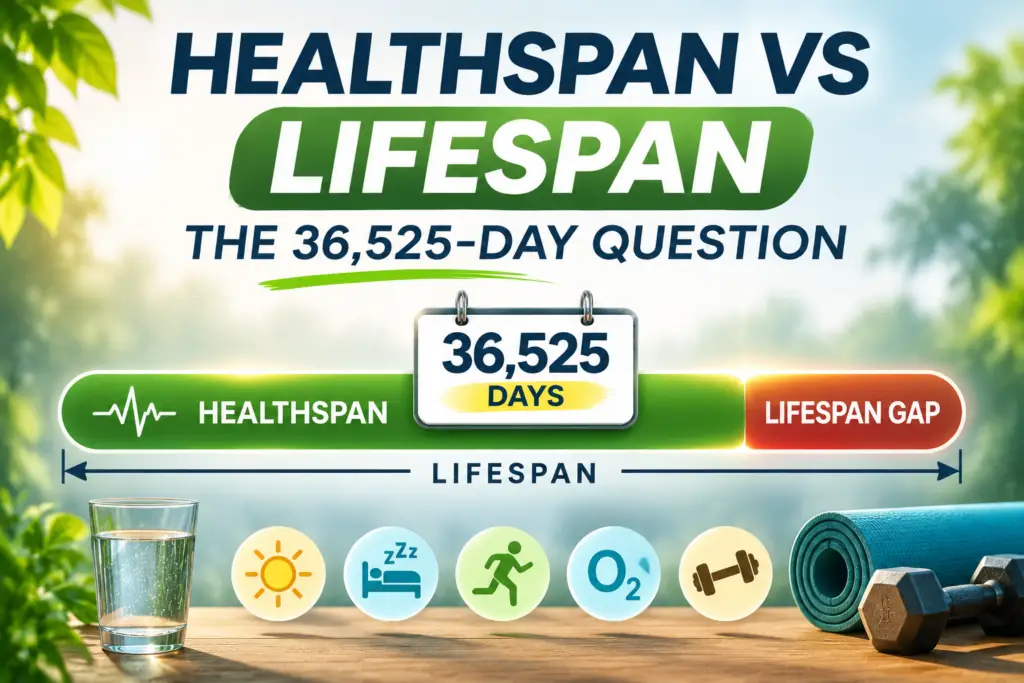
By Dr. Chris Cormier, DC — The Nerve Health Institute, Lafayette, Louisiana A hundred years is 36,525 days. The arithmetic is exact — a hundred years at 365.25 days each, leap years included. It is a strange number to sit with. It sounds enormous until you write it down, at which point it starts to look like something you could count. And it immediately raises the better question, which is not how many days you get, but how many of them are good ones. That question has a name in the research — healthspan vs lifespan — and it is the single most useful idea in longevity. Healthspan vs lifespan: the difference that decides everything Lifespan is how long you live. Healthspan is how long you live in good health — free of significant disease or disability. Researchers measure the second as health-adjusted life expectancy, and the difference between the two has a name: the healthspan-lifespan gap. The numbers are worth knowing, and they are the reason this page exists. Lifespan has been extending faster than healthspan. We have been adding years to life more successfully than we have been adding life to years. That sounds like bad news. It is the most optimistic framing in this entire subject, and here is why. Why the healthspan vs lifespan gap is the modifiable part Nobody can tell you your lifespan. There is no honest way to predict how long any individual will live, and anybody offering you a number is guessing. But the gap is a different proposition. It is driven overwhelmingly by chronic conditions that accumulate over decades — and the things that influence those are, to a substantial degree, things you do every day. The gap is where the available leverage sits. So the goal is not to add years on the end. It is to push the healthy portion as far forward as it will go — to compress those twelve years into something considerably shorter, whatever the total turns out to be. One important nuance, because it is often misunderstood: those years of poor health are not necessarily all stacked at the end. They can be distributed across a life — the years in your fifties spent managing something that began in your forties count too. Which means this is not only a question for the elderly. It is a question for whoever is reading this, today. What actually accumulates The honest mechanism is not dramatic. A hundred years of days, each one adding slightly more good than harm or slightly more harm than good. No single day matters. The direction of the balance, held for decades, is what produces the gap or closes it. That is a frustrating answer for anybody hoping for a single intervention, and it is also why it works. You are not required to be impressive on any given Tuesday. You are required to be pointed in the right direction most of the time. BodyCharger has written on what that looks like week to week in how long does it take to feel healthier. What about genetics? This comes up in every conversation, and it deserves a straight answer. Everybody carries genetic variation. That is not a defect and it is not bad luck — it is simply what a human genome is. Some of that variation affects how readily you develop particular conditions, which is real and worth knowing about, because it changes what should be screened for and when. What it does not do is set a date. Genetics influences the odds; it does not write the schedule. And the practical response to a family history is more attention rather than less — earlier screening, not earlier resignation. Dr. Cormier has written on that at my mother had it too. And one thing we would like to put to rest You may have heard that the way you live is damaging the health of your grandchildren and great-grandchildren through inherited epigenetic changes. We would not say that, because in humans it is not established. Transgenerational epigenetic inheritance has been shown in plants, worms and flies, but its occurrence in humans remains genuinely contested — partly because epigenetic marks are largely erased during reproduction, and partly because what looks inherited is extremely difficult to separate from shared environment and shared behaviour. What you do unquestionably pass on is everything your household does — how it eats, how it moves, how it handles a difficult week, whether it goes to the doctor. That is a real and powerful inheritance, and unlike the other kind it is entirely within reach. It also makes for a better motivation than guilt. Inflammation: the useful version of a much-abused idea Inflammation is blamed for a great deal, often loosely, so it is worth being precise. Acute inflammation is healthy and necessary. It is how tissue repairs itself. A cut that becomes red and warm is a cut that is healing, and without that response you would not recover from anything. What is associated with ageing is different: low-grade inflammation that persists for years without resolving. Researchers call it inflammaging, and it is linked with most of the conditions that drive the healthspan-lifespan gap. The problem is not inflammation. It is inflammation that never finishes. Which makes the useful question not “how do I reduce inflammation” but “why is this not resolving” — and the answers tend to be the unglamorous ones: sleep, circulation, movement, sustained stress, and whether the tissue is well supplied in the first place. Three kinds of stress, not one We talk about stress as a single word, which hides how different its sources are. Physical Posture, repetitive loading, old injuries, hours in a chair. Thirty years of sitting one way is a physical input, even though nobody would describe it as stressful. Emotional Bereavement, work, caring responsibilities, the sustained low-grade kind that has no end date. This is the one most people underestimate, and we have written on the physical signs