By Dr. Chris Cormier, DC — The Nerve Health Institute, Lafayette, Louisiana
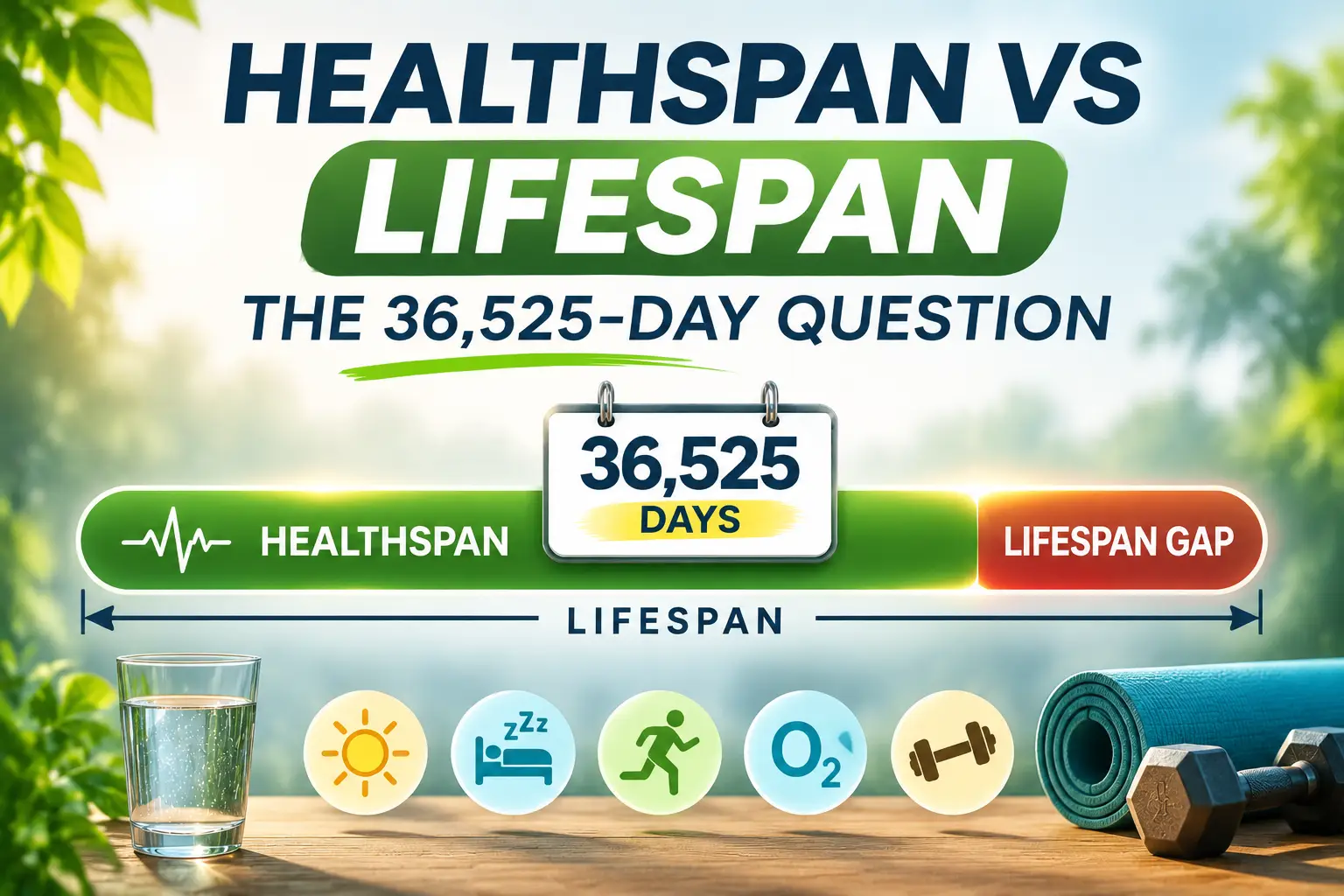
A hundred years is 36,525 days. The arithmetic is exact — a hundred years at 365.25 days each, leap years included.
It is a strange number to sit with. It sounds enormous until you write it down, at which point it starts to look like something you could count. And it immediately raises the better question, which is not how many days you get, but how many of them are good ones.
That question has a name in the research — healthspan vs lifespan — and it is the single most useful idea in longevity.
Healthspan vs lifespan: the difference that decides everything
Lifespan is how long you live. Healthspan is how long you live in good health — free of significant disease or disability. Researchers measure the second as health-adjusted life expectancy, and the difference between the two has a name: the healthspan-lifespan gap.
The numbers are worth knowing, and they are the reason this page exists.
- Globally, the gap averages around 9.6 years — a decade at the end of a life spent managing illness rather than enjoying health.
- It is widening. In 2000 it was about 8.5 years; by 2019 it had reached 9.6, a rise of roughly 13% in two decades.
- And in the United States it is the largest in the world, at about 12.4 years.
Lifespan has been extending faster than healthspan. We have been adding years to life more successfully than we have been adding life to years.
That sounds like bad news. It is the most optimistic framing in this entire subject, and here is why.
Why the healthspan vs lifespan gap is the modifiable part
Nobody can tell you your lifespan. There is no honest way to predict how long any individual will live, and anybody offering you a number is guessing.
But the gap is a different proposition. It is driven overwhelmingly by chronic conditions that accumulate over decades — and the things that influence those are, to a substantial degree, things you do every day. The gap is where the available leverage sits.
So the goal is not to add years on the end. It is to push the healthy portion as far forward as it will go — to compress those twelve years into something considerably shorter, whatever the total turns out to be.
One important nuance, because it is often misunderstood: those years of poor health are not necessarily all stacked at the end. They can be distributed across a life — the years in your fifties spent managing something that began in your forties count too. Which means this is not only a question for the elderly. It is a question for whoever is reading this, today.
What actually accumulates
The honest mechanism is not dramatic.
A hundred years of days, each one adding slightly more good than harm or slightly more harm than good. No single day matters. The direction of the balance, held for decades, is what produces the gap or closes it.
That is a frustrating answer for anybody hoping for a single intervention, and it is also why it works. You are not required to be impressive on any given Tuesday. You are required to be pointed in the right direction most of the time. BodyCharger has written on what that looks like week to week in how long does it take to feel healthier.
What about genetics?
This comes up in every conversation, and it deserves a straight answer.
Everybody carries genetic variation. That is not a defect and it is not bad luck — it is simply what a human genome is. Some of that variation affects how readily you develop particular conditions, which is real and worth knowing about, because it changes what should be screened for and when.
What it does not do is set a date. Genetics influences the odds; it does not write the schedule. And the practical response to a family history is more attention rather than less — earlier screening, not earlier resignation. Dr. Cormier has written on that at my mother had it too.
And one thing we would like to put to rest
You may have heard that the way you live is damaging the health of your grandchildren and great-grandchildren through inherited epigenetic changes.
We would not say that, because in humans it is not established. Transgenerational epigenetic inheritance has been shown in plants, worms and flies, but its occurrence in humans remains genuinely contested — partly because epigenetic marks are largely erased during reproduction, and partly because what looks inherited is extremely difficult to separate from shared environment and shared behaviour.
What you do unquestionably pass on is everything your household does — how it eats, how it moves, how it handles a difficult week, whether it goes to the doctor. That is a real and powerful inheritance, and unlike the other kind it is entirely within reach. It also makes for a better motivation than guilt.
Inflammation: the useful version of a much-abused idea
Inflammation is blamed for a great deal, often loosely, so it is worth being precise.
Acute inflammation is healthy and necessary. It is how tissue repairs itself. A cut that becomes red and warm is a cut that is healing, and without that response you would not recover from anything.
What is associated with ageing is different: low-grade inflammation that persists for years without resolving. Researchers call it inflammaging, and it is linked with most of the conditions that drive the healthspan-lifespan gap. The problem is not inflammation. It is inflammation that never finishes.
Which makes the useful question not “how do I reduce inflammation” but “why is this not resolving” — and the answers tend to be the unglamorous ones: sleep, circulation, movement, sustained stress, and whether the tissue is well supplied in the first place.
Three kinds of stress, not one
We talk about stress as a single word, which hides how different its sources are.
Physical
Posture, repetitive loading, old injuries, hours in a chair. Thirty years of sitting one way is a physical input, even though nobody would describe it as stressful.
Emotional
Bereavement, work, caring responsibilities, the sustained low-grade kind that has no end date. This is the one most people underestimate, and we have written on the physical signs of stress and on getting out of fight or flight.
Environmental
Air quality, pollutants and chemical exposures, indoor environments, light at the wrong times of day. Real, and more manageable than people assume once they are named.
The point of separating them is practical. A person doing well on two of the three and badly on the other is extremely common, and they will get nowhere working on the two they have already sorted out.
Sleep: the repair window
Repair happens continuously, but it is scheduled most heavily during sleep.
The majority of the day’s growth hormone is released during deep, slow-wave sleep, and that pulse drives protein synthesis and tissue repair. Your body does its heaviest maintenance while you are unconscious. Protecting the conditions for it is one of the highest-return things on this page — see our guide to bedroom setup.
If sleep has been poor for a long time, that is worth investigating rather than tolerating. It is rarely a matter of willpower and it is often fixable.
Back to basics: oxygen, water, light
We organise care around the OWL Method — oxygen, water and light — because those three are foundational, universally relevant and largely free. BodyCharger covers the full method at the OWL Method.
Oxygen
Oxygen is the most abundant element in the human body by mass — around 65% of what you weigh — though almost all of it is chemically bound into water and the molecules your tissues are built from. The oxygen you actually run on is the gas you are breathing right now, and you hold only a few minutes’ worth. It is the one input with no reserve, which is why it rewards attention. More at EBOO Prime, and the clinical end of it at intermittent hypoxic-hyperoxic training.
Water
Water makes up somewhere around 50 to 60% of an adult body, varying with age and composition. Quantity and quality both matter, and it is one of the easiest things to improve with no equipment and no expertise.
Light
Daylight, particularly in the morning, is the main signal your body clock runs on. Most of us spend around 90% of our time indoors. Getting outside early, even briefly, is close to free and has effects well beyond mood.
Why a nerve clinic cares about any of this
Because delivery and signalling are two different things.
Every tissue in your body depends on signalling from the brain and spinal cord. Oxygen arriving at a tissue whose nerve supply is not working well is oxygen that is not being put to its best use — and that gap between supply and use widens with age. It is also why strength fades faster than muscle size does, which we covered in muscle loss after 50.
Our 88-nerve assessment maps how signalling is functioning across the body, and Quantum Neurology addresses what it finds. More on the underlying relationship at how the brain controls the body.
There is no magic plant
This is the thing we would most want you to take away, and it is deliberately unexciting.
There is no herb from somewhere distant, no single supplement, no protocol that resolves this. The basics are the intervention, and they are basic because they are what the body actually runs on. Breathing, water, daylight, sleep, movement, strength, and not carrying sustained stress indefinitely.
The reason that sounds disappointing is that it is free, available immediately, and does not require anybody’s permission. Those qualities make for a poor product and an excellent plan.
Dr. Cormier has written about how the losses actually happen — not through giving up, but through a long series of entirely reasonable decisions — in I’m the age of my patients now.
What to do with today
- Take stock honestly. Our piece on how to tell whether you are actually healthy is a five-question version that takes ten minutes.
- Book the check-up you have been putting off. Screening is the unglamorous half and it is the half that catches things early.
- Pick one of the basics and start it. Not six. One — and the easiest entry point is usually breathing or daylight.
- Protect strength. It is the most reversible part of ageing and it underpins independence. Building strength at home after 50 starts with a four-minute session.
- Give it longer than feels reasonable. Days for how you feel, weeks for sleep, months for anything measurable.
Frequently asked questions
What is the difference between healthspan and lifespan?
Lifespan is how long you live. Healthspan is how long you live in good health, free of significant disease or disability. The difference between them is called the healthspan-lifespan gap.
How big is the healthspan-lifespan gap?
Globally it averages around 9.6 years and has widened by roughly 13% since 2000. In the United States it is the largest of any WHO member state, at about 12.4 years.
Can you actually increase your healthspan?
The gap is driven largely by chronic conditions that accumulate over decades, and the factors influencing those are substantially daily ones — sleep, movement, strength, stress load, and routine screening. Nobody can promise you a total, but the healthy portion is the part with real leverage.
How much of longevity is genetic?
Genetics influences the odds rather than setting a schedule. A family history is useful information because it changes what should be screened for and when — it is a reason for more attention, not less.
Is inflammation always bad?
No. Acute inflammation is how tissue repairs itself and is necessary. What is associated with ageing is persistent low-grade inflammation that never resolves — sometimes called inflammaging. The useful question is why it is not resolving.
Where should I start if I want a longer healthspan?
With one basic rather than six: breathing, daylight, water, sleep or movement. Then a check-up with your doctor. The basics are the intervention, and there is no shortcut that replaces them.
36,525 days, and the only number you can move
You will not get all of them, and nobody can tell you your lifespan. What is genuinely within reach is the proportion of them you feel well for — and in a country carrying the widest healthspan gap in the world, that is a target worth taking seriously.
A little more good than harm, on most days. Over 36,525 of them, that is not a small intervention. It is the only one that has ever worked.
If you are in Lafayette or nearby, see what we work with on our conditions page or get in touch. For at-home structure, the 28-Day Cell Sparking Challenge and BodyCharger membership are where our protocols live.
Dr. Chris Cormier, DC
The Nerve Health Institute — Lafayette, Louisiana
Clinic care at nervehealth.com. At-home protocols at bodycharger.com. Circulation and oxygenation at ebooprime.com. Essays at drchriscormier.com.
Spark your cells to optimal longevity.