
The Early Signs of Parkinson’s That Come Before Tremor
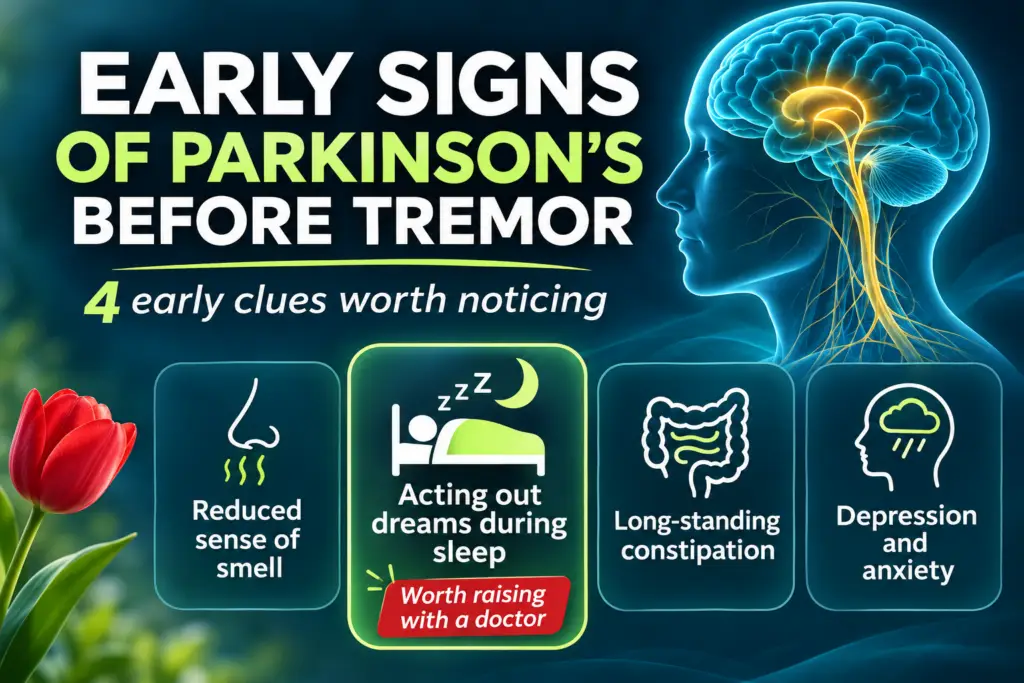
By Dr. Chris Cormier, DC — The Nerve Health Institute World Parkinson’s Day falls on the 11th of April, and its symbol is a red tulip. Say the word Parkinson’s and most people picture one thing: a tremor, a shaking hand, something visible. The story usually begins a long way before that, and much more quietly. Research over the last twenty years has established that the underlying process starts years — sometimes decades — before anybody notices a movement problem, and that it announces itself in ways nobody connects to the brain at the time. This page is about those early signs of Parkinson’s, what they genuinely mean, and — just as importantly — what they do not. There is a reassuring fact further down that we would ask you to read before drawing any conclusions about yourself. Why the quiet part matters By the time somebody meets the clinical criteria for a Parkinson’s diagnosis, a substantial amount of change has already taken place. Research indicates that at least forty per cent of the dopamine-producing neurons in a region of the brain called the substantia nigra have been lost by that point, and that the loss probably began at least five years before slowness of movement became detectable. That is not written to alarm anybody. It is written because it explains why the early signs of Parkinson’s are a subject at all, and why they involve smell, sleep and digestion rather than movement — those systems are affected earlier in the process. The four with the strongest evidence A great many things have been proposed as early signs of Parkinson’s. Four have the best support in the research for actually predicting who goes on to develop it. Reduced sense of smell Olfactory loss is among the most consistently reported early features, and it can precede motor symptoms by many years. People often do not notice it themselves, because it fades gradually; it is frequently a family member who points out that food is being over-seasoned. Acting out dreams during sleep Known as REM sleep behaviour disorder. Normally the body is effectively paralysed during dreaming sleep; in this condition that mechanism does not hold, and people physically act out their dreams — shouting, kicking, punching, sometimes falling out of bed. Of all the early markers, this is the one most strongly associated with later Parkinson’s. Long-standing constipation One of the longest lead times of any marker. Autonomic symptoms of this kind can appear more than twenty years before a diagnosis, which is part of why nobody connects the two. Depression and anxiety Mood changes appear in the research alongside the other three as a recognised early feature, rather than purely as a reaction to being unwell. The lead times vary enormously between markers — from around five years for subtle changes in movement to over twenty years for autonomic symptoms such as constipation. The fact we most want you to take away The large majority of people who have these markers will never develop Parkinson’s. Reduced smell, constipation and low mood are all far more commonly caused by something else entirely. These are signals worth mentioning to a doctor, not grounds for concluding anything about your future. The one notable exception is covered below. We want that stated plainly, because awareness content on this subject is often written in a way that leaves perfectly healthy people frightened. Most people who cannot smell as well as they used to have a nasal or sinus explanation, a past infection, or simply the effect of age. Most people with constipation have a dietary or medication reason. The useful response to any of the early signs of Parkinson’s is to mention it at your next appointment. It is not to start monitoring yourself anxiously, which has a cost of its own and helps nobody. Body Charger wrote a good companion piece on telling the difference between a quirk of your body and something worth raising, in when to see a doctor. The one that genuinely warrants an appointment Acting out dreams is the exception, and it deserves its own paragraph. Unlike the other markers, REM sleep behaviour disorder is strongly predictive. In a large multicentre study, people with the idiopathic form converted to a neurodegenerative condition at a rate of around 6.3 per cent per year, with roughly three quarters having converted by twelve years of follow-up. It also matters for a much more immediate reason: people injure themselves and their partners during these episodes. That alone makes it worth raising with a doctor, entirely separately from anything it might indicate later. A sleep specialist can assess it properly and there are things that help. If somebody tells you that you shout, thrash or punch in your sleep, that is information worth acting on rather than laughing off. A word about smell specifically Because we have written about the olfactory system before, it is worth joining the two up. Smell has a uniquely direct route into the brain — it is the only sense that reaches the memory and emotion centres without being relayed through the thalamus first, which we covered in why smells trigger memories. That directness is part of why olfactory neurons are affected early in this process. It is also why losing your sense of smell is worth mentioning for reasons that have nothing to do with Parkinson’s at all. It affects appetite, enjoyment of food, and the ability to detect smoke or gas. It is a genuine quality-of-life issue in its own right and it is under-reported. How a diagnosis is actually made There is no single blood test or scan that confirms Parkinson’s, and none of the early signs of Parkinson’s described above is diagnostic on its own. Diagnosis is clinical, made by a neurologist or movement disorder specialist based on examination and history, sometimes supported by imaging or by the response to medication. Which means two things. First, nothing you read on a website — this one included