By Dr. Chris Cormier, DC — The Nerve Health Institute
World Parkinson’s Day falls on the 11th of April, and its symbol is a red tulip. Say the word Parkinson’s and most people picture one thing: a tremor, a shaking hand, something visible.
The story usually begins a long way before that, and much more quietly. Research over the last twenty years has established that the underlying process starts years — sometimes decades — before anybody notices a movement problem, and that it announces itself in ways nobody connects to the brain at the time.
This page is about those early signs of Parkinson’s, what they genuinely mean, and — just as importantly — what they do not. There is a reassuring fact further down that we would ask you to read before drawing any conclusions about yourself.
Why the quiet part matters
By the time somebody meets the clinical criteria for a Parkinson’s diagnosis, a substantial amount of change has already taken place. Research indicates that at least forty per cent of the dopamine-producing neurons in a region of the brain called the substantia nigra have been lost by that point, and that the loss probably began at least five years before slowness of movement became detectable.
That is not written to alarm anybody. It is written because it explains why the early signs of Parkinson’s are a subject at all, and why they involve smell, sleep and digestion rather than movement — those systems are affected earlier in the process.
The four with the strongest evidence
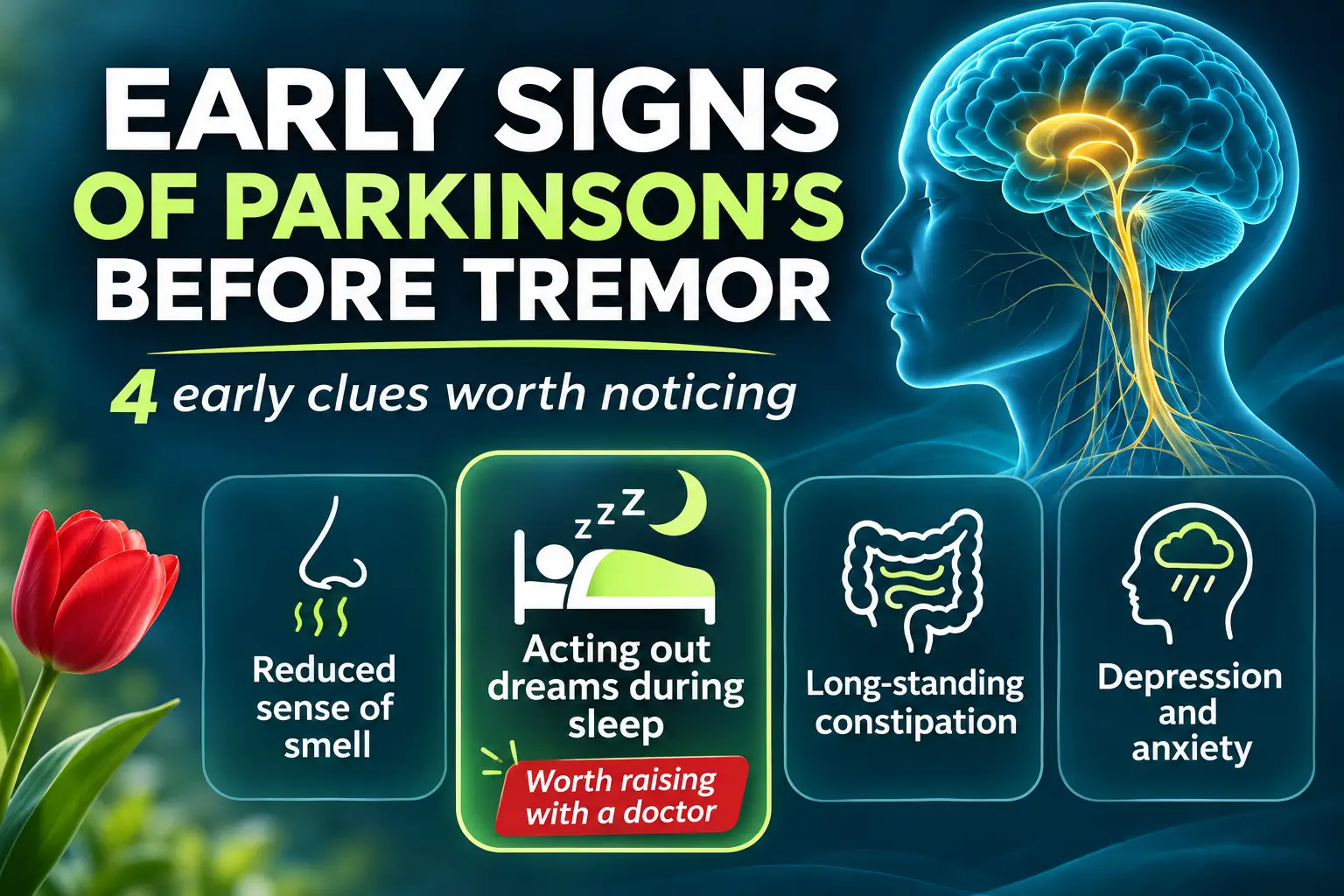
A great many things have been proposed as early signs of Parkinson’s. Four have the best support in the research for actually predicting who goes on to develop it.
Reduced sense of smell
Olfactory loss is among the most consistently reported early features, and it can precede motor symptoms by many years. People often do not notice it themselves, because it fades gradually; it is frequently a family member who points out that food is being over-seasoned.
Acting out dreams during sleep
Known as REM sleep behaviour disorder. Normally the body is effectively paralysed during dreaming sleep; in this condition that mechanism does not hold, and people physically act out their dreams — shouting, kicking, punching, sometimes falling out of bed. Of all the early markers, this is the one most strongly associated with later Parkinson’s.
Long-standing constipation
One of the longest lead times of any marker. Autonomic symptoms of this kind can appear more than twenty years before a diagnosis, which is part of why nobody connects the two.
Depression and anxiety
Mood changes appear in the research alongside the other three as a recognised early feature, rather than purely as a reaction to being unwell.
The lead times vary enormously between markers — from around five years for subtle changes in movement to over twenty years for autonomic symptoms such as constipation.
The fact we most want you to take away
The large majority of people who have these markers will never develop Parkinson’s. Reduced smell, constipation and low mood are all far more commonly caused by something else entirely. These are signals worth mentioning to a doctor, not grounds for concluding anything about your future. The one notable exception is covered below.
We want that stated plainly, because awareness content on this subject is often written in a way that leaves perfectly healthy people frightened. Most people who cannot smell as well as they used to have a nasal or sinus explanation, a past infection, or simply the effect of age. Most people with constipation have a dietary or medication reason.
The useful response to any of the early signs of Parkinson’s is to mention it at your next appointment. It is not to start monitoring yourself anxiously, which has a cost of its own and helps nobody.
Body Charger wrote a good companion piece on telling the difference between a quirk of your body and something worth raising, in when to see a doctor.
The one that genuinely warrants an appointment
Acting out dreams is the exception, and it deserves its own paragraph.
Unlike the other markers, REM sleep behaviour disorder is strongly predictive. In a large multicentre study, people with the idiopathic form converted to a neurodegenerative condition at a rate of around 6.3 per cent per year, with roughly three quarters having converted by twelve years of follow-up.
It also matters for a much more immediate reason: people injure themselves and their partners during these episodes. That alone makes it worth raising with a doctor, entirely separately from anything it might indicate later. A sleep specialist can assess it properly and there are things that help.
If somebody tells you that you shout, thrash or punch in your sleep, that is information worth acting on rather than laughing off.
A word about smell specifically
Because we have written about the olfactory system before, it is worth joining the two up.
Smell has a uniquely direct route into the brain — it is the only sense that reaches the memory and emotion centres without being relayed through the thalamus first, which we covered in why smells trigger memories. That directness is part of why olfactory neurons are affected early in this process.
It is also why losing your sense of smell is worth mentioning for reasons that have nothing to do with Parkinson’s at all. It affects appetite, enjoyment of food, and the ability to detect smoke or gas. It is a genuine quality-of-life issue in its own right and it is under-reported.
How a diagnosis is actually made
There is no single blood test or scan that confirms Parkinson’s, and none of the early signs of Parkinson’s described above is diagnostic on its own. Diagnosis is clinical, made by a neurologist or movement disorder specialist based on examination and history, sometimes supported by imaging or by the response to medication.
Which means two things. First, nothing you read on a website — this one included — can tell you whether you have it. Second, if you are worried, the route is a GP referral, not a checklist.
Where the genuine hope sits
The red tulip is a symbol of hope, and we would rather point at something real than something comforting.
Exercise is the most encouraging thing in this entire field. It is recommended for everybody with Parkinson’s, should be started early and continued throughout, and is one of the few interventions with meaningful support behind it. Observational research indicates that people who exercise vigorously — in the region of thirty to forty-five minutes, three times a week — are less likely to develop Parkinson’s, and that those who do tend to progress more slowly.
We should be straight about the limits of that evidence. One randomised trial of high-intensity exercise alongside standard treatment reported slower progression than standard treatment alone, while an analysis of a large early-Parkinson’s cohort found no effect of physical activity on progression. So the picture on slowing the disease itself is genuinely mixed.
What is not in dispute is that exercise improves strength, balance, mobility and confidence in people with Parkinson’s — and those are the things that determine what a day actually feels like.
Our page on muscle loss after 50 covers why strength matters more as we age, and Body Charger’s how to build strength at home after 50 is the practical at-home version. For anyone with a diagnosis, the right programme comes from a physiotherapist who works with movement disorders — that specificity matters, which is why we would not hand out a generic routine.
What we do, and what we do not
We will set this out directly rather than leave it to be inferred.
Parkinson’s is a progressive neurodegenerative condition. Nothing offered by this clinic reverses it, and nothing here is a substitute for neurological care. Most importantly: never stop, reduce or skip Parkinson’s medication without the instruction of the doctor who prescribed it. Withdrawal effects are well recognised, affecting a meaningful proportion of people who discontinue, and abrupt changes can be genuinely dangerous. Any adjustment is a conversation with your neurologist.
The Nerve Health Institute is not a movement disorder clinic and we do not diagnose or treat Parkinson’s. What we work with is the part of the picture that sits alongside specialist care: strength, balance, movement quality, sleep, and the accumulated load of managing a long-term condition.
That is a real area and we are glad to work in it. It is also a narrower claim than some clinics in our field make, and we think the difference matters. Dr. Cormier wrote about why he has become careful on exactly this point in sometimes there is no deeper why.
Where supportive care fits
Always coordinated with the neurology team, never instead of it.
- Movement, balance and strength work, set by someone who understands the condition.
- Sleep, which is disrupted in a large proportion of people with Parkinson’s and affects everything else. Our guide to the best sleep environment covers the room.
- Stress load and recovery, because managing a long-term condition is itself a continuous task.
- Understanding how control of the body is organised, which we set out in how the brain controls the body.
One practical point about all of that: decide in advance what you are hoping any of it will change, and how you would know. With a progressive condition it is genuinely difficult to judge whether something is helping, because the comparison is not against how you were last year — it is against how you would otherwise have been. EBOO Prime set out a sensible framework for that problem in how do you know if a treatment is working. Agreeing the measure with your neurology team beforehand is worth more than any amount of judging it afterwards by feel.
We take the same position here as we do with other conditions managed by specialists — the approach is described in hemophilia and joint health, and it is the same principle.
The red tulip
The tulip was adopted as the international symbol of Parkinson’s awareness, and the day itself marks the birthday of the physician who first described the condition in 1817.
What it stands for is worth keeping hold of. Awareness of the early signs of Parkinson’s is genuinely useful, not because spotting them changes the course of anything today, but because people who are informed get assessed sooner, get the right specialists involved sooner, and start exercising sooner — and that last one is the part with the best evidence behind it.
It is also worth saying what a day like this is for. Not to make anybody audit themselves, and not to sell a solution to a condition that does not yet have one. It exists so that the people living with it are visible, so that families know what help exists, and so that the research that has made the last twenty years genuinely encouraging keeps being funded. That is a reasonable thing for a tulip to carry.
Frequently asked questions
What are the earliest signs of Parkinson’s?
The four with the strongest research support are reduced sense of smell, acting out dreams during sleep, long-standing constipation, and depression or anxiety. These can precede movement symptoms by anywhere from about five years to more than twenty.
Does losing your sense of smell mean you will get Parkinson’s?
No. The large majority of people with reduced smell never develop Parkinson’s, and most cases have an entirely different cause such as sinus problems, a past infection or age. It is worth mentioning to a doctor, both as a general marker and because loss of smell matters in its own right.
Is acting out dreams serious?
It is the one early marker worth taking to a doctor promptly. REM sleep behaviour disorder is strongly associated with later neurodegenerative conditions, and separately it causes injuries to the sleeper and their partner. A sleep specialist can assess and help with it.
Can Parkinson’s be reversed?
No. Parkinson’s is progressive and current treatments manage symptoms rather than halting or reversing the underlying process. Treatment, exercise and good supportive care can make a substantial difference to how people function and feel, which is a different and genuinely worthwhile claim.
Does exercise help with Parkinson’s?
Yes, and it is recommended for everyone with the condition, started early and continued throughout. The strongest evidence is for strength, balance, mobility and quality of life. Evidence on whether it slows the disease itself is mixed but encouraging, and vigorous exercise in midlife is associated with lower risk of developing it at all.
If something on this page sounded familiar
The first step is your own doctor, and a referral if one is warranted — not us. We would rather say that clearly on an awareness day than quietly imply otherwise.
If you or somebody in your family is already under neurological care and you want support with movement, balance, strength or sleep alongside it, that is work we are glad to do. Contact The Nerve Health Institute to talk it through, or see our conditions page for the range of what we work with.
Spark your cells to optimal longevity.
— Dr. Chris Cormier, DC
The Nerve Health Institute, Lafayette, Louisiana