
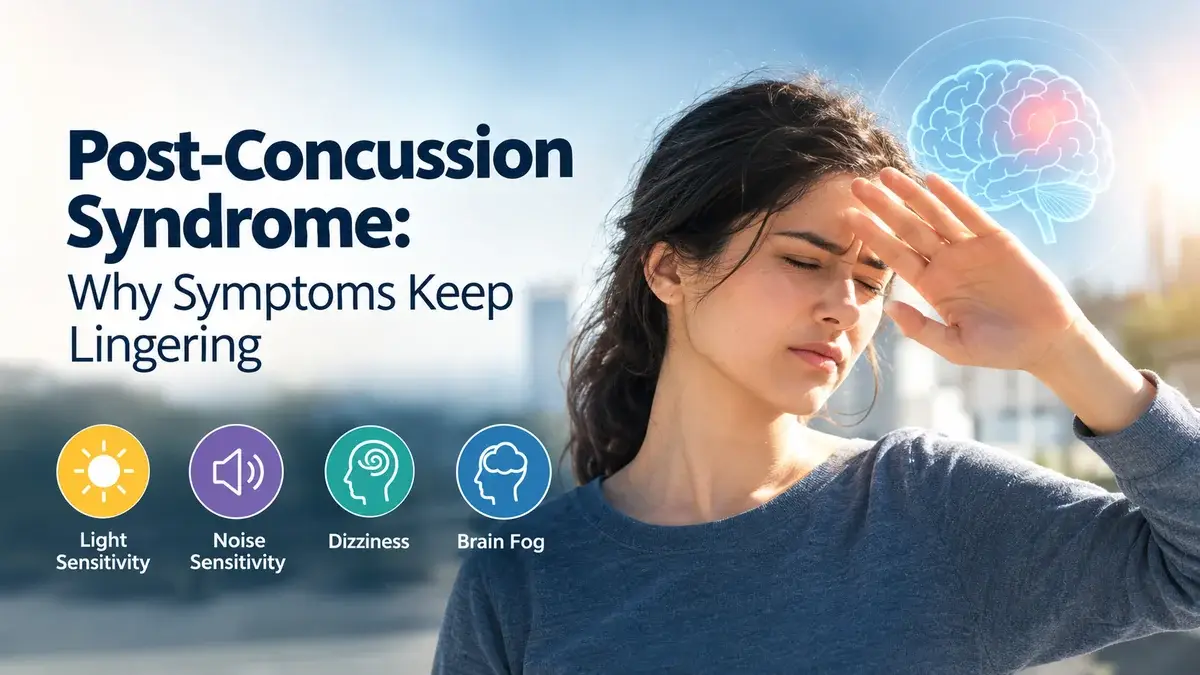
The hit was weeks ago. Possibly months.
You were scanned, and the scan was clear. You were told it would settle in a couple of weeks. And here you are, still unable to sit in a bright supermarket without your head tightening, still losing words mid-sentence, still not quite trusting your balance on stairs. Everyone around you has moved on from the injury, which makes it harder to explain why you have not.
Post-concussion syndrome is remarkably common and remarkably poorly explained to the people living through it. The core of it is this: a concussion is a functional injury, not a structural one — and the tools used to rule out the dangerous things are not designed to find what is actually causing your symptoms.
Why Your Scan Was Normal
A CT or MRI after a head injury is looking for bleeding, swelling, fracture and structural damage. These are the things that can kill you, and ruling them out is exactly the right first job.
But a concussion, by definition, does not produce visible structural damage on standard imaging. It is a disturbance of function — how the brain processes energy, how signal travels, how the systems that keep you balanced and oriented coordinate with each other. A clear scan does not mean nothing happened. It means the dangerous things were excluded, which is genuinely good news and not an explanation.
If you have been made to feel that a normal scan makes your symptoms questionable, that was a misunderstanding of what the scan was for.
You Do Not Have to Hit Your Head, or Lose Consciousness
Two things surprise people, and both matter for getting properly assessed.
Most concussions involve no loss of consciousness at all. Being knocked out is neither required for the diagnosis nor a reliable indicator of severity.
And the head does not have to be struck. Rapid acceleration and deceleration — a fall onto the tailbone, a whiplash-type movement, a body impact that snaps the head around — can produce the same injury. The brain moves inside the skull, and that movement is the mechanism.
This is why a proportion of people with post-concussion syndrome were never diagnosed with a concussion at all. Nobody hit their head, so nobody asked the question.
Why Light, Noise and Busy Places Are So Difficult
Light sensitivity, noise sensitivity, dizziness, nausea and visual difficulty are among the most common persistent symptoms, and they are not vague. They map onto specific systems.
The nerves controlling eye movement coordinate how your eyes track, converge and stabilise an image while your head moves. When that coordination is disrupted, reading, screens and scrolling environments become exhausting, and busy visual spaces — supermarkets, traffic, crowds — become overwhelming rather than merely annoying.
The vestibular system, which handles balance and spatial orientation, is frequently affected in the same injury. Add the neck, which is almost always involved in whatever movement caused the concussion, and you have three systems that are meant to agree with each other now sending slightly conflicting information. The brain works considerably harder to reconcile that, and the cost shows up as headache, fog and fatigue.
None of this is anxiety, although it can produce anxiety. It is a coordination problem between systems, and coordination problems can be assessed and worked on.
The Advice to Rest in a Dark Room Has Changed
For years, the standard instruction after a concussion was complete rest until symptoms resolved. That advice has been formally revised, and anyone still following it is working from an outdated model.
Current international consensus recommends only about 24 to 48 hours of relative rest — ordinary daily activities, reduced screen time — followed by an early return to light physical activity such as walking, provided it does not more than mildly worsen symptoms. Beyond that, sub-symptom-threshold aerobic exercise introduced within roughly two to ten days of injury has been shown to speed recovery and substantially reduce the likelihood of symptoms persisting past a month.
The principle is precision rather than avoidance. A small, brief increase in symptoms during activity — in the region of one or two points on a ten-point scale, settling within an hour — is considered acceptable and not harmful. What is unhelpful is either extreme: prolonged rest on one side, and pushing through significant symptom flares on the other.
Where dizziness, neck pain or headache persist beyond ten days, cervicovestibular rehabilitation is specifically recommended — targeted work on the neck and balance systems rather than continued waiting.
Why “Cleared” Does Not Always Mean Recovered
Clearance protocols check the things that can be checked quickly: symptom report, basic balance, coordination, cognitive screening.
They are far less sensitive to subtler deficits — eye tracking that fatigues after ten minutes rather than ten seconds, balance that holds in a quiet room but not in a crowded one, processing that works fine until two things happen at once. Athletes and workers routinely pass clearance while knowing something is still off, and they are usually right.
That gap matters for a practical reason. Returning to contact or demanding environments while function is still impaired raises the risk of another injury, and prior concussions influence both susceptibility and recovery time for the next one.
What an Evaluation Involves
A full history. The injury itself, but also every previous head or whiplash event including the ones nobody called a concussion, plus what your baseline was like beforehand. Prior injuries change the picture significantly.
A detailed neurological examination. We assess function across the 88 major nerves branching from the brain and spinal cord — including the cranial nerves governing vision, eye movement, balance, hearing and swallowing that account for so much of the persistent symptom picture. We call this layer EnergyFlow, and it is closer to walking a breaker box than to asking whether the building has power.
The neck and the whole chain. Cervical involvement is common and frequently missed, and it can sustain headache and dizziness on its own long after the brain injury itself has settled.
Daily inputs. Sleep in particular — sleep disturbance after concussion is associated with slower recovery, which makes it a clinical priority rather than a side note.
Foundations and Technology
Oxygen, water and light — the OWL foundations — do more here than people expect. Recovering neural tissue is metabolically demanding, hydration supports circulation, and morning daylight anchors the sleep rhythm that recovery depends on.
On top of those, plans at the Lafayette clinic draw from:
- Quantum Neurology — targeted nerve function work
- HBOT — hyperbaric oxygen therapy
- Theralight360 — full-body red light and photobiomodulation
- PEMF & Grounding — pulsed electromagnetic field support
- BRT Bioresonance — frequency-based nervous system support
Exposure is graded deliberately. Someone who cannot tolerate a lit room does not belong in an intensive protocol on day one — that is the equivalent of handing a heavy weight to someone who cannot yet manage a light one. Tolerance is built, then loaded.
Watch: Dr. Chris Cormier on Concussion Recovery
In this conversation, Dr. Chris Cormier, DC explains why he treats concussion as a nervous system injury rather than an isolated brain injury, which cranial nerves account for the most common lingering symptoms, and what he looks for in someone who has been cleared but knows they are not right.
Individual results vary. Cases discussed reflect clinical experience and are not a prediction of outcome for any other person.
When to Go to an Emergency Room Instead
This section is short and it is not optional reading.
Seek emergency care immediately, for yourself or anyone you are with, if after a head injury there is:
- A headache that keeps worsening
- Repeated vomiting
- A seizure
- Unequal pupils, or new vision loss
- Increasing confusion, agitation, or difficulty waking
- Weakness, numbness or loss of coordination
- Slurred speech
- Clear fluid from the nose or ears
- Severe neck pain, or any suspicion of a neck injury
These need a hospital, not a clinic appointment and not a wait-and-see approach. Anyone on blood thinners, and any child, warrants a lower threshold for going. Nothing on this page applies until those possibilities have been excluded.
What This Approach Is — and What It Is Not
We do not manage acute head injury. A fresh injury goes to a physician or an emergency department first, always. Our work begins once the serious possibilities have been ruled out.
We do not clear anyone to return to play or to work. That decision belongs with the physician managing the case, and we share what we find with them rather than working around them.
What this adds is the functional layer: eye movement, balance, neck involvement, autonomic regulation and recovery capacity — the systems that account for most persistent symptoms and that standard imaging was never designed to assess. For people stuck weeks or months past the point they were told they would be fine, that is usually where the answer has been sitting.
Tracking Recovery
Concussion recovery is non-linear, which is why a record helps more than memory does. A daily line covering:
- Headache level, morning and evening
- Light and noise tolerance — where you could go today
- Screen tolerance in minutes before symptoms rise
- Balance and any dizziness
- Sleep quality and hours
- Cognitive load — what you could do before fatigue set in
- Activity, and what it cost you the next day
Two months of this shows a trend that day-to-day experience hides completely, and it gives whoever is managing your care something concrete rather than an impression.
Continuing at Home
BodyChargers by Dr. Chris covers the at-home side — the OWL foundations, breathing, sleep and nervous system regulation, with programmes organised by topic. Between appointments, sleep and graded activity carry most of the recovery.
Key Takeaways
A normal scan after a concussion is reassurance, not an explanation. Concussion is a functional injury, and function is what needs assessing when symptoms persist.
The dark-room advice is outdated. Current guidance supports early light activity and graded aerobic exercise below symptom threshold, and targeted neck and balance rehabilitation where dizziness or headache last beyond ten days.
And if you were cleared but you know you are not right, you are probably not imagining it. Clearance protocols are not sensitive to everything, and the subtler deficits are exactly the ones that make ordinary environments so difficult.
Nerve Health Institute in Lafayette, Louisiana works alongside physicians and rehabilitation teams for local and visiting patients. Contact us today.
This article is educational and is not medical advice. It does not diagnose or treat any condition. Any acute head injury requires immediate medical assessment. Always consult your physician before returning to sport, work or driving.
Frequently Asked Questions
How long should post-concussion syndrome last?
Most concussions settle within two to four weeks, and around a third of people experience symptoms beyond that. Persistent symptoms are common enough to be well recognised, and they are not a sign that something was missed on your scan. They usually reflect systems — eye movement, balance, neck, autonomic regulation — that have not fully recoordinated.
Why is my MRI normal if I still feel unwell?
Because imaging looks for structural damage such as bleeding or swelling, and concussion by definition does not produce those findings. The scan ruled out the dangerous possibilities, which was its job. It was never the test that would show what is causing your symptoms.
Should I be resting in a dark room?
No, not beyond the first day or two. Guidance has moved away from prolonged rest, which is now understood to slow recovery. Current recommendations support around 24 to 48 hours of relative rest with reduced screens, then a return to light activity such as walking, with graded aerobic exercise introduced early under appropriate guidance.
Can I have had a concussion without hitting my head?
Yes. Rapid acceleration or deceleration is enough — a fall onto the tailbone, a whiplash movement, a body impact that snaps the head around. Loss of consciousness is also not required, and most concussions do not involve it.
I was cleared but I know something is wrong. What now?
Take that seriously and say it clearly to your physician. Clearance protocols are not sensitive to subtler deficits such as eye tracking that fatigues over minutes, or balance that fails only in busy environments. A functional assessment looks specifically at those systems.
Is it too late if my concussion was years ago?
Not necessarily. Time since injury matters less than what is currently happening in the systems involved. Cervical and vestibular contributions in particular can persist for years and remain workable, and aerobic exercise has shown benefit even in people with long-standing persistent symptoms.
Do you accept my insurance?
Coverage varies by plan and by service. Call the clinic on +1 (337) 456-6555 for a clear answer for your situation.
Ready To Take Control Of Your Health?
Get Treatment → nervehealth.com/get-treatment/
The Nerve Health Institute
108 Republic Ave. Ste. B, Lafayette, LA 70508 +1 (337) 456-6555

