By Dr. Chris Cormier, DC — The Nerve Health Institute, Lafayette, Louisiana
On 24 March 1882, a physician stood up in Berlin and showed an audience the bacterium that causes tuberculosis.
World TB Day is held on that date every year, and people usually tell the story as a discovery story. I think the more interesting part is what it took away.
What the discovery actually ended
Before that evening, tuberculosis was called consumption, and it was widely believed to be inherited, or brought on by constitution, temperament or the way a person lived. It was written about as if it revealed something about the sufferer.
One demonstration with a microscope ended all of that. Tuberculosis was an infectious disease caused by a specific organism, and the people who had it had simply been exposed to it. Nothing about their character, their discipline or their constitution had invited it in.
That is worth holding onto, because the old framing has a way of creeping back. Nobody gets tuberculosis because they were not healthy enough. People get it because they breathed in bacteria that somebody nearby was carrying — and that is true of the strongest person you know.
Where things stand now
The World Health Organization reports an estimated 10.7 million people fell ill with TB in 2024, and that roughly a quarter of the world’s population has been infected with the bacteria at some point.
In the United States, the CDC recorded 10,347 provisional cases in 2024 — every state reported some. That number tends to surprise people, and the reason it is worth knowing is practical rather than alarming: TB testing and treatment are routine, available and well-organised here, and your local health department handles this as part of its ordinary work.
Infected is not the same as ill
This is the distinction that clears up most of the confusion, and it is the one people most often have backwards.
The CDC separates two states. Inactive TB — also called latent TB infection — means the bacteria are present in the body but dormant. A person with inactive TB feels completely well, has no symptoms, and cannot pass it to anybody. Active TB disease means the bacteria are multiplying, the person feels unwell, and it can spread.
WHO puts the lifetime progression from infection to active disease at roughly five to ten per cent. Which means the overwhelming majority of people who have ever encountered these bacteria never become ill at all — their immune systems hold the line quietly for a lifetime.
If you have reason to think you may have been exposed, there is a blood test and a skin test, and the CDC recommends testing for anyone at increased risk. Treating inactive TB is the best way to stop it ever becoming active disease, so a positive result is useful information, not bad news.
The single most important thing on this page
Tuberculosis is curable. That is WHO’s word for it, and it has been true for decades.
The medication is what cures tuberculosis, and finishing all of it is what makes the cure hold.
Treatment runs daily for four to six months. It is a long course, and it is normal to feel substantially better long before it is finished — which is exactly why WHO is explicit that stopping early or without medical advice can allow resistance to develop. The CDC puts it just as plainly: taking all of the medication as directed is what helps a person recover and keeps them from passing it on.
If you are partway through a course and feeling well, that is the treatment working. Finish it. And if anything about it is difficult — side effects, cost, the sheer length of it — tell the team treating you, because that is a solvable problem and they would far rather hear about it.
What we do, and where we fit
I want to be exact about this, because precision matters more here than anywhere else on this site.
We are not tuberculosis care. We do not diagnose it, we do not treat it, and nothing we offer substitutes for the medication. If you have a cough that has lasted three weeks or more, chest pain, unexplained weight loss, fever or night sweats, the right call is your doctor or your local health department — today, not after trying something else first. That is not a formality. That is the actual best advice anyone can give you.
Where a clinic like ours genuinely fits is afterwards.
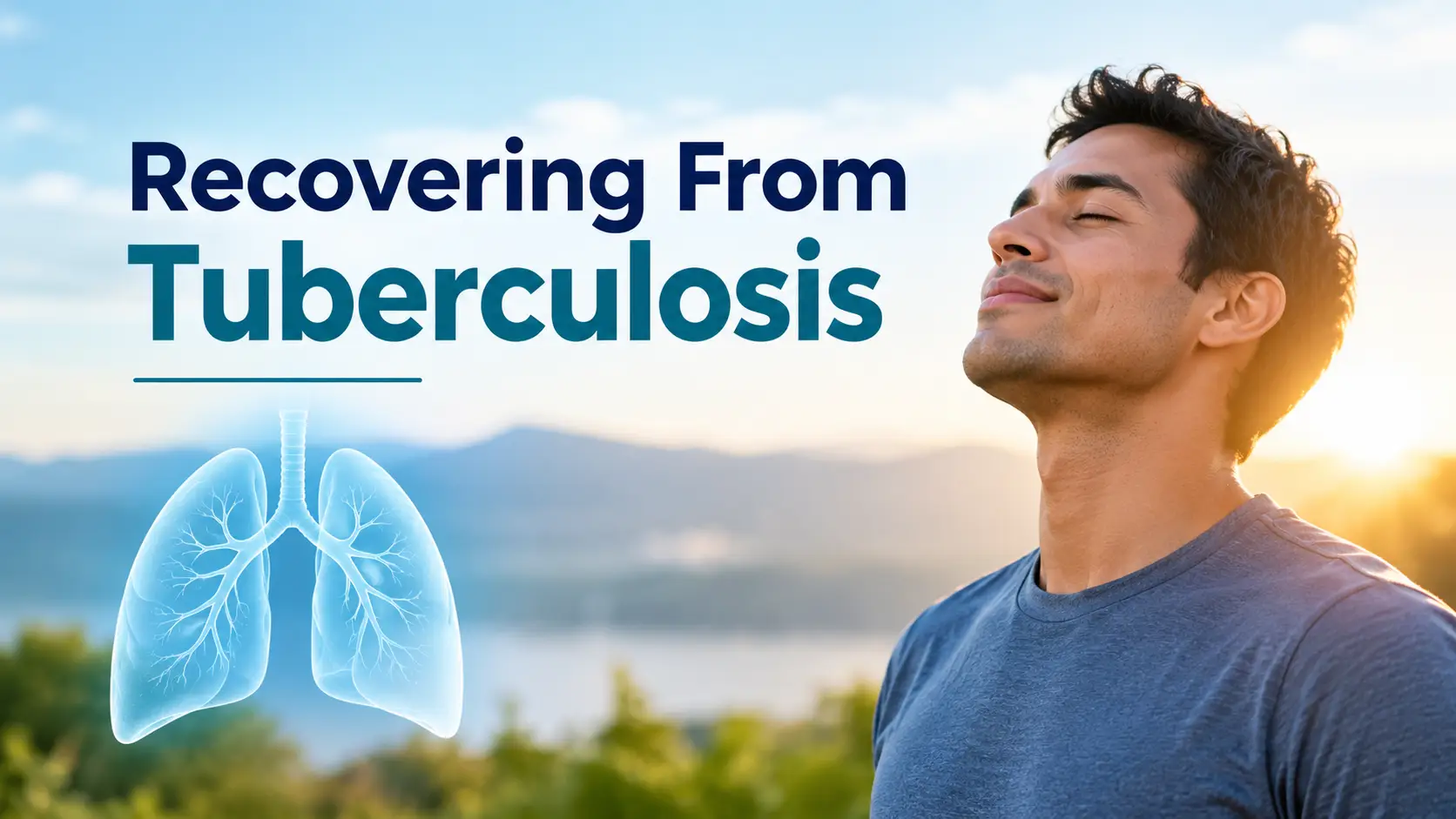
Recovery is its own stretch of road
People are often surprised by how long they feel wrung out once treatment is complete, and they are rarely warned about it.
WHO lists weakness, fatigue and weight loss among the symptoms of the illness itself, and those do not simply switch off the day the last tablet is taken. Months of illness and months of treatment leave a body deconditioned — breathing that has been shallow for a long time, strength that has drained away, sleep that has not been properly restorative in a year, an appetite that is still rebuilding.
None of that is a complication. It is the ordinary aftermath of having been seriously unwell for a long time, and it responds to patient, structured rebuilding rather than to waiting.
What that looks like with us:
- Breathing that has got into a shallow habit. After a long period of coughing, the pattern often stays even once the cause has gone. Retraining it is unglamorous and it makes a real difference to how people feel.
- Sleep that has not recovered. Months of night sweats and broken nights leave habits behind. The environmental side is covered in the best sleep environment.
- A system still stuck on alert. A long illness keeps the body braced. Coming back down is a capacity worth rebuilding deliberately — how to get out of fight-or-flight.
- Strength and conditioning, rebuilt gradually. Starting below where you want to be and climbing, rather than testing where you are and being discouraged.
- Nerve function assessed properly. Our 88-nerve assessment measures rather than estimates, which matters when someone is rebuilding and wants to know what is actually improving.
All of this runs alongside whatever your medical team has in place, and we will happily work with them. We would always rather be the third voice in agreement than the second opinion in competition.
The everyday foundations
Three things I recommend to every patient rebuilding from anything, and they cost nothing.
Breathe more deliberately — through the nose, lower into the ribs, slower than feels natural at first. Drink water early, because everybody wakes dehydrated and most people reach for coffee instead. And get outside in daylight, properly, every day.
Oxygen, water and light are the three inputs we build everything around, which is the OWL Method at BodyCharger. The oxygen side is covered properly at EBOO Prime, and the practical sleep build at BodyCharger. For how the brain governs all of it, how the brain controls the body.
What we do not do
- We do not diagnose or treat tuberculosis. That is medical care, and it works.
- We never advise anyone to stop, pause or shorten a course of treatment. Not for any reason.
- We do not suggest TB is caused by a weak constitution. That idea was retired in 1882 and it deserved to be.
- We do not ask you to choose. Keep every appointment you have.
Frequently asked questions
How long does recovering from tuberculosis take?
Treatment itself runs daily for four to six months according to WHO. Feeling fully back to yourself usually takes longer, because months of illness leave strength, breathing, sleep and appetite to rebuild. That stretch is ordinary rather than a complication, and it responds well to structured, gradual work.
Is tuberculosis curable?
Yes. WHO states plainly that TB is preventable and curable. The medication is what cures it, and taking the full course exactly as directed is what makes the cure hold — stopping early can allow resistance to develop.
What is the difference between inactive and active TB?
The CDC distinguishes them clearly. Inactive TB, or latent infection, means the bacteria are dormant: the person feels well, has no symptoms and cannot spread it. Active TB disease means the bacteria are multiplying, the person feels unwell, and it can be passed on. Treating inactive TB is the best way to prevent it becoming active.
Can a strong immune system prevent tuberculosis?
Nobody gets tuberculosis because they were insufficiently healthy — it comes from breathing in bacteria. What is true is that of everyone who becomes infected, WHO estimates only about five to ten per cent ever develop active disease. If you may have been exposed, get tested; that is the step that actually changes the outcome.
Do you treat tuberculosis at the Nerve Health Institute?
No. We do not diagnose or treat it and nothing we offer replaces the medication. If you have a cough lasting three weeks or more, chest pain, unexplained weight loss, fever or night sweats, see your doctor or local health department. Where we help is the rebuilding afterwards, alongside your medical team.
What should I do if treatment is hard to keep up with?
Tell the team treating you. Side effects, cost and the length of the course are all common and all solvable, and they would far rather hear about it than have someone quietly stop. Finishing the course is what makes the cure hold.
If you are rebuilding
If you have finished treatment and still feel a long way from yourself, that is a normal place to be and it is worth working on properly rather than waiting it out.
You can see what we work with on our conditions page, or get in touch and we will tell you honestly whether we are the right people — and who is, if we are not.
Dr. Chris Cormier, DC
The Nerve Health Institute — Lafayette, Louisiana
At-home protocols at bodycharger.com. Circulation and oxygenation at ebooprime.com. More on how I practise at drchriscormier.com.
Spark your cells to optimal longevity.