
Three in the afternoon. You have eaten, you have slept something like a normal night, and there is nothing in particular wrong. But you are wired and flat at the same time — restless without being able to start anything. The thing you meant to do at two is still not done, and the effort it would take to begin feels wildly out of proportion to the task.
Most people file that under anxiety, or under mood. It is worth considering that underneath it there is a supply problem.
Here is a clear look at what cellular energy has to do with anxiety and low mood, what a daily cell-tending protocol actually asks of you, and how to find out whether this approach fits your situation.
The Power Company Is Fine. The Line to the House Is Down.
Dr. Chris Cormier describes it this way. Your brain is the power company. Your cells are houses on the grid. Over time a few houses drift off the line — the wiring frays, the connection weakens. The house is still standing. The lights are just dim, and nothing inside runs at full brightness.
Scale that up across a system and you get something recognisable: sluggish, unresponsive, hard to motivate. Cells that have lost their charge behave a great deal like the person housing them.
Which points at the work. If the problem is a lost connection, the job is reconnection — and a charge is something you can restore.
Why an Energy Problem Shows Up as Anxiety
Your brain is roughly two per cent of your body weight and consumes around twenty per cent of your energy. Nothing else in the body comes close.
That energy is produced inside your cells by mitochondria, which convert what you eat and breathe into ATP — the fuel every cellular process runs on. Producing serotonin, dopamine and GABA costs ATP. Firing a neuron and resetting it costs ATP. Clearing metabolic waste overnight costs ATP. Switching the stress response back off once a threat has passed costs ATP.
That last one matters more than most people realise. Anxiety is not only about the alarm going off — it is about how quickly it switches back off afterwards. Shutting the stress response down is an active, energy-hungry process, and when the supply is thin the system stays switched on longer than it needs to.
So when cellular energy runs low, none of these systems fails outright. They just get slow. And slow, experienced from the inside, feels a great deal like anxious, flat, foggy, wired, or unmotivated — sometimes several of those at once.
A Protocol Is Not a Cupboard Full of Supplements
This is where most self-directed attempts come apart. People buy things. They take them irregularly, in no particular order, with no sense of what is doing what, and conclude after five weeks that none of it works.
A protocol removes the guesswork. It tells you what to take, when to take it, which device to use and at what point in the day — because timing is not a detail here. Energising inputs land differently in the morning than they do at nine at night, and the same is true of restorative ones.
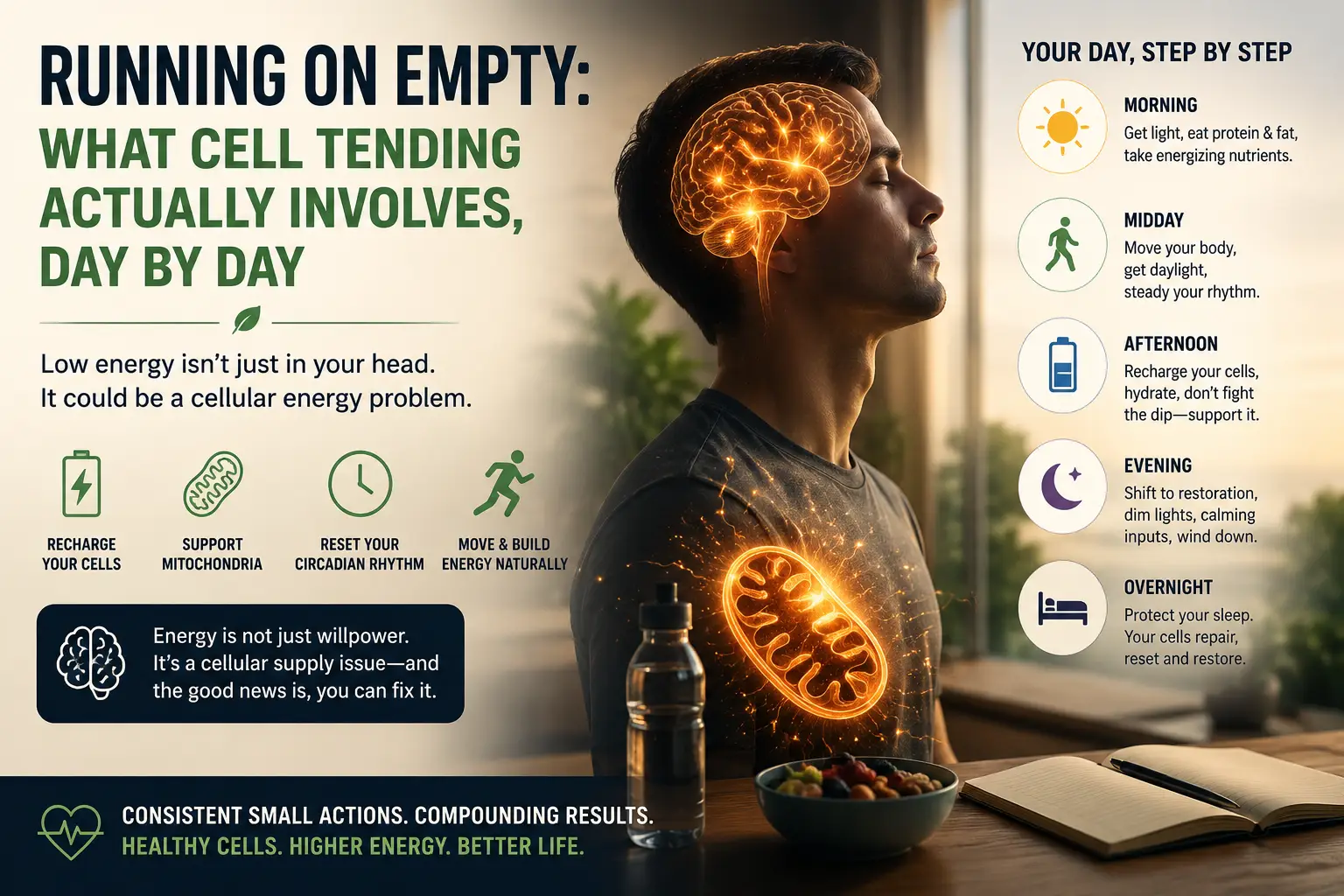
The daily structure covers four things: feeding the mitochondria the raw materials they run on, recharging the cell directly, resetting the circadian rhythm that governs when your cells produce and when they repair, and moving enough to signal your body to build more mitochondria than it started with.
Your Day, Step by Step
Morning. Light first — outside within an hour of waking, five minutes is enough, cloud does not stop the signal reaching you. Then a breakfast built on protein and fat rather than sugar, so the day starts on a smooth curve instead of a spike. This is the window for your energising nutrients, when your body is primed to use them.
Midday. Movement and daylight together if you can pair them. A ten-minute walk after lunch does two jobs at once — steadies blood sugar, reinforces the rhythm you set at sunrise. A lot of people find this single habit does more for the afternoon than anything they would otherwise reach for to push through it.
Afternoon. The dip. This is the natural slot for a cellular recharge session — rather than fighting the slump you are meeting it with what it is actually asking for. Water matters more here than most people expect; mild dehydration measurably affects energy and concentration.
Evening. Shift into restoration. Soften the lighting as the sun goes down, choose the calming inputs rather than the stimulating ones, and keep the wind-down and the bedtime consistent so your body knows what is coming.
Overnight. You do nothing and your cells do everything — repair, consolidation, clearing. Protecting this window is arguably the highest-leverage item on the entire list.
Read that back and notice how much of it is free. That is the nature of working at this level. The inputs are simple. The consistency is the hard part, and the consistency is what produces the result.
What People Notice
Timing varies considerably, and the honest answer is that this builds rather than arrives. The reports that come up most:
- Sleep that holds. Usually the first thing to shift, and often within the first fortnight.
- The afternoon flattening less. Not eliminated — flattened. People describe getting to five without the three o’clock cliff.
- Clearer thinking. Frequently mentioned by people who came in specifically because their head had felt cloudy for months.
- A longer fuse. Something that would normally have rattled them simply does not, and they notice afterwards rather than at the time.
- Settling faster afterwards. The thing people with anxiety tend to value most — not never being triggered, but coming back down in twenty minutes instead of the rest of the day.
- Steadier energy through the day. Not a lift — the absence of a crash, which people tend to find more useful.
Watch: Dr. Chris on Why Cells Lose Their Charge
If you would rather see it than read about it, Dr. Chris walks through the cellular picture himself — what disconnection actually means at the level of the cell, and why the daily work is structured the way it is.
It covers most of what people arrive asking about.
A Marathon, Not a Sprint
Dr. Chris says this often enough that it is worth repeating properly.
Picture someone deciding to become an athlete after years away from it. They do not open with a hundred sprints. If they try, they are injured and discouraged and out within a fortnight. What works is unglamorous — build a base, add gradually, let the body adapt.
Cells rebuild on a biological timeline, not a motivational one. Conditions that accumulated over years do not resolve over a weekend, and anyone telling you otherwise is selling something. The work is to chip away daily, accept that a fair number of days will feel unremarkable, and let the compounding do what compounding does.
Your Physician Stays in Charge
To be clear about what this is: cell tending is a foundation, not a replacement for clinical care.
Anxiety and depression are real conditions and they deserve proper attention. If you are working with a doctor or a therapist, keep working with them. If you are taking something prescribed, any change to it is a conversation with the person who prescribed it — not a decision to make on the back of an article.
The two things answer different questions. One addresses how you are managing now. The other addresses the ground underneath. The people who do best are generally the ones who stop treating it as a choice between them. And if things ever feel genuinely overwhelming, reach out to a professional or a crisis line where you are — that is not a detour from this work.
Questions People Ask Before They Start
How long before I notice anything?
Sleep is usually the first thing to move, often inside the first two weeks. Energy and clarity tend to build over the following months. If someone promises you a week, be sceptical.
How is this different from just taking supplements?
Sequence and timing. A cupboard full of good products taken irregularly does very little. The protocol tells you what, when, and in what order — which is most of the difference between people who see change and people who quit at week five.
Will this help if my anxiety is situational rather than constant?
Often, yes — though in a specific way. Cellular work does not remove the situation. What it tends to change is your capacity to absorb it, and how quickly you settle once the moment has passed.
Do I have to stop what my doctor has me on?
No. Nothing here requires you to change your existing care, and any adjustment to prescribed medication is a conversation with your prescriber, not something to act on after reading an article.
Can I do this without the devices?
Partly. Light, sleep, movement and nutrition are free and they do real work. The devices address the recharging side directly, which is the piece that is hardest to replicate on your own.
What happens if I miss days?
Nothing dramatic. Missing one day changes very little; missing most of them changes everything. Consistency over months beats intensity over a fortnight, every time.
Is this a cure?
No, and we will not describe it as one. This is about supporting your body’s own capacity to function well by addressing the conditions cells need in order to hold a charge. Your physician remains in charge of anything you have been diagnosed with.
Do I need a consultation first?
Yes. The point of it is to work out what is actually depleted in your particular case, and to tell you honestly if we do not think this is the right fit.
Find Out Where to Start
Every protocol begins with understanding your particular picture — what is depleted, what is draining it, and what sequence makes sense for you. Start with a consultation and we will be straight with you about what is likely to help.
ADDRESS · 108 Republic Ave. Ste. B Lafayette, LA 70508
PHONE- +1 (337) 456-6555
BOOKING LINK– BOOKING LINK– https://nervehealth.com/get-treatment/
Spark your cells to optimal longevity.


