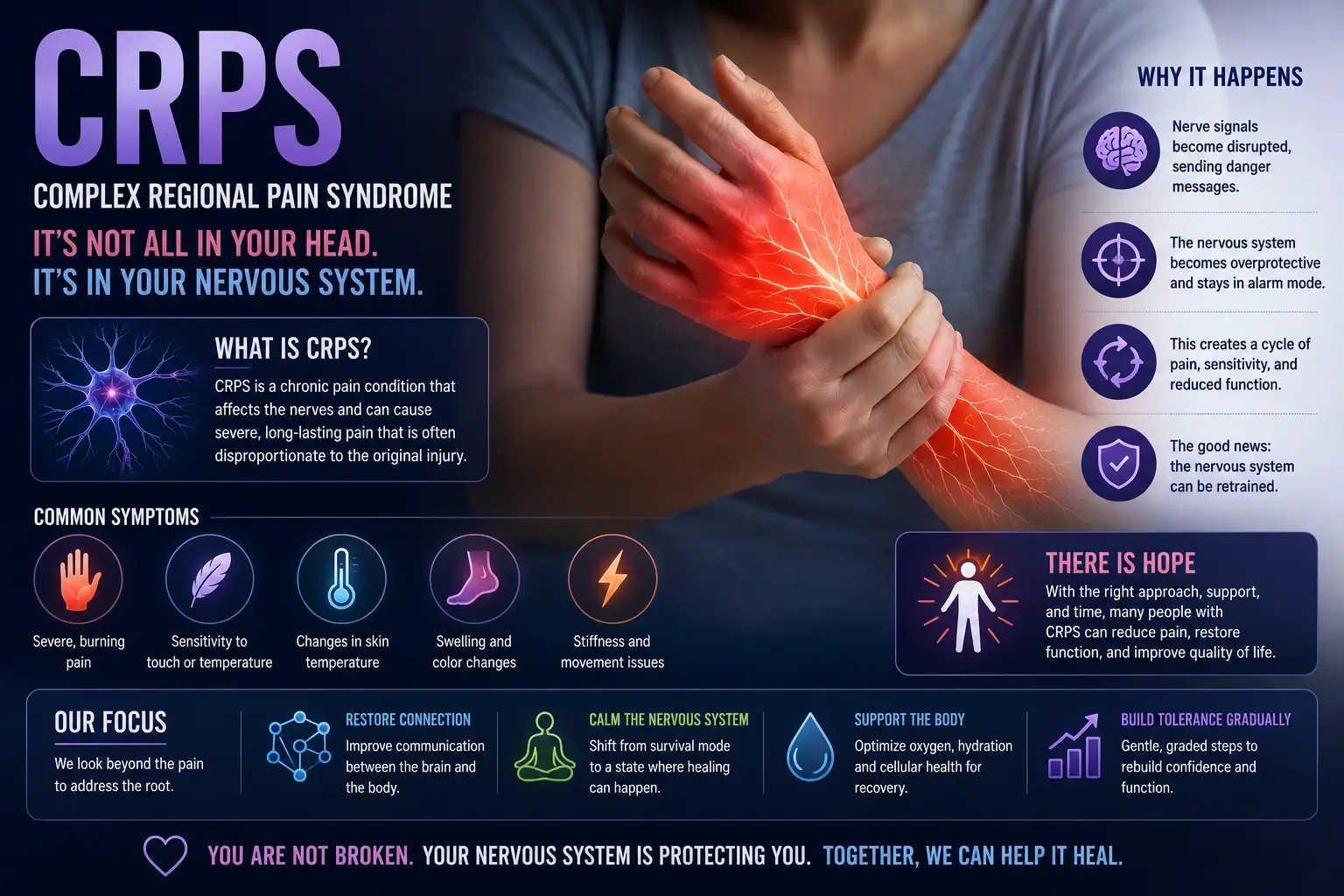
A bedsheet resting on a foot. A sleeve brushing an arm. For most people these do not register at all. For someone living with Complex Regional Pain Syndrome, they can be overwhelming.
That gap — between what is happening and what is being felt — is the whole condition in one image. And it points somewhere more useful than the pain itself.
Here is a clear look at what CRPS is doing at the level of the nervous system, why scans so often come back clear, and what a connection-focused approach examines that a pain-focused one does not.
CRPS Is Not a Pain Problem — It Is a Signalling Problem
CRPS gets filed under pain because pain is the loudest thing about it. But pain is the output. The problem sits upstream, in the communication between the brain and a group of cells.
Dr. Chris Cormier uses an image that makes this concrete. Your brain is the power company. Every cell in your body is a house wired to it, and the nerves are the lines. When a line degrades and a group of cells loses proper connection, those cells do not go quiet. They start signalling that something is wrong — and pain is one of the ways that signal arrives.
Which reframes the objective. The aim is not to shout over the signal. It is to restore the connection that would stop the signal being generated.
CRPS Symptoms: Why Light Touch Registers as Pain
Nerve traffic runs both directions, and CRPS frequently disrupts both.
On the input side, sensation travels from the body to the brain. When that channel is working, something sharp registers as sharp, within milliseconds. When it degrades, the interpretation goes wrong — and it goes wrong in ways that sound implausible until you have seen them. Sharp that is not felt as sharp. Hot registering as cold. Light touch arriving as severe pain.
On the output side, the brain sends signals down a specific nerve to a specific muscle to produce movement. Where that channel degrades, movement becomes difficult or unreliable.
This is why the sensitivity in CRPS is not an emotional reaction to pain, and not an exaggeration. The signal itself is arriving misinterpreted. The nervous system is reporting accurately on faulty information.
Why CRPS Scans Come Back Clear
A great many people with CRPS have been told there is nothing structurally wrong, and have found that this does not settle anything. There is a reason for that.
The common assumption is that a nerve has to be compressed to malfunction. It does not. Plenty of compressed nerves conduct perfectly well, and plenty of uncompressed nerves conduct poorly.
An MRI images the physical structure of a nerve. What it does not show is the quality of the energy flowing through it. So a scan can be entirely clear while the communication running along that pathway is substantially degraded — and the person is left holding a clean result and a body that is plainly not fine.
Both things are true at once. The structure is intact. The signalling is not.
Why CRPS Pain Can Spread — and Where the Opening Is
One of the most common questions about CRPS is why pain can spread rather than settle. The nervous system gives a clear answer, and it starts with its two modes. The parasympathetic side is where repair, digestion and recovery happen. The sympathetic side handles threat — vigilance, survival, alarm.
Repair only really happens on the parasympathetic side. So when someone has been in pain for a long stretch without resolution, the system tilts toward sympathetic dominance and stays there. In that state, repair capacity drops. Less repair means more distressed cells, which means more alarm signalling, which pushes the system further toward threat mode.
That loop explains a great deal. It also points directly at the opening: the tilt itself can be worked on. Identifying which parasympathetic pathways are underactive and bringing them back online gives the repair side of your nervous system room to do what it is designed to do.
Why a Gentle, Graded CRPS Approach Works
People with severe CRPS are often highly sensitised to intervention itself. Respecting that is one of the most important parts of the work — and one of the reasons this approach suits people who have found other routes difficult to tolerate.
Everything is graded. We begin comfortably below your threshold, build tolerance step by step, and give the nervous system every opportunity to learn that input can arrive safely. In practice that means meeting you exactly where you are and moving at the pace your system welcomes — including, when it helps, seeing someone somewhere they already feel at ease.
It is a patient way to work. It is also why it suits people who have found gentler options hard to come by.
Oxygen, Water and Light: Cellular Support in CRPS
Alongside restoring connection, cells need their basic ingredients. Dr. Chris orders them deliberately.
Oxygen. The first ingredient. Most people breathe shallowly, and over time groups of cells operate in a state of relative oxygen debt.
Water. Both quality and quantity. Cellular function depends on hydration in ways that are easy to underestimate.
Light energy. The energy travelling from brain to cell along the nerve — the piece that does not appear on a scan and is central to how this work is structured.
Frequency sits alongside these. The working principle is that every cell has its own resonance, much as each string on a guitar has its own note, and that sustained stress can pull cells out of tune. Frequency-based devices are used to support cells back toward their proper resonance — in clinic, and through portable devices for use at home between visits.
What a CRPS Assessment Actually Looks At
Two parts, and the first one takes time.
A detailed history covering the three categories of stress that weaken cells: emotional, physical, and environmental. That last category is broader than most people expect — it covers what is in the food and water, chemical and pollutant exposure, and the general electromagnetic environment. Most people have never been asked to map these together, and patterns tend to emerge in the process.
Then a neurological examination of the connection itself. There are 88 primary nerves branching off the brain and spinal cord — the major power lines. Because the route and function of each is known, energy flow can be assessed pathway by pathway and expressed as a percentage of full connection. It gives you something specific to work with, and a baseline to measure against.
🎥 Watch the Conversation
Dr. Chris discusses CRPS in full in this conversation — the brain-to-cell connection, why signalling goes wrong, and how the work is approached with people who cannot tolerate being touched.
Straight Answers About What to Expect
You deserve straight answers, so here they are.
Every person is different, and your results will be your own. What we can tell you is that CRPS is approached here as a connection problem rather than purely a pain problem — and that this opens up avenues worth exploring. We will always be honest with you about what we think is achievable in your particular case.
This works alongside the care you already have. Your existing medical team stays in place, and anything to do with prescribed medication remains a conversation with your prescriber. Earlier assessment gives us more to work with — and it is always worth asking, whatever stage you are at.
What Becomes Possible
This is the part worth holding on to. When connection between brain and cells improves, the repair side of the nervous system comes back into play — and it is remarkably good at its job once it has the resources.
Cells that were signalling distress have less to signal about. Sensation begins to be interpreted correctly again, so pressure registers as pressure and warmth as warmth. People describe being able to tolerate touch, then movement, then the ordinary things that had quietly disappeared from their lives.
Your body is designed to repair itself. Think of an everyday cut: given healthy cells, it closes over without you doing a thing. That capacity is built in. The work here is about restoring the conditions that let it operate.
CRPS Questions People Ask
Can CRPS really start from something minor?
Yes. Onset frequently follows a modest injury or a routine procedure. The severity of the trigger and the severity of what follows are not well correlated, which is one of the things that makes the condition so disorienting.
My scans are clear. Does that mean nothing is wrong?
No. Imaging shows the structure of a nerve, not the quality of signalling along it. A clear scan and degraded function regularly coexist.
Is the pain in my head?
No. The pain is real, and it is generated by genuine signalling dysfunction. What is happening is that input is arriving misinterpreted — which is a nervous system problem, not an imagined one.
Why does it spread instead of settling?
Largely because of the loop between poor repair capacity and sympathetic dominance. A system stuck in survival mode has limited capacity to repair, and limited repair keeps it stuck.
I cannot tolerate being touched. Can I still be assessed?
Yes, and this is common. The approach is graded specifically for this — starting well below your threshold and building tolerance from there rather than pushing through it.
Do I have to stop my current treatment?
No. This is not positioned as a replacement for your medical care, and any change to prescribed medication is a conversation with your prescriber.
Can I do anything from home?
Yes. Bodychargers is the online platform covering the methods, tools and daily practice for use at home, and portable frequency devices support the work between clinic visits.
Where to Start With CRPS Support
If you have been cycling through appointments without answers, the useful next step is an assessment that looks at connection rather than at pain alone — and an honest conversation about whether this is a fit for your situation.
Capacity for new CRPS patients is limited each month, so it is worth enquiring early.
Nerve Health Institute —
[ADDRESS] · 108 Republic Ave. Ste. B Lafayette, LA 70508
[PHONE] · +1 (337) 456-6555
[BOOKING LINK]– https://nervehealth.com/get-treatment/
Spark your cells to optimal longevity.