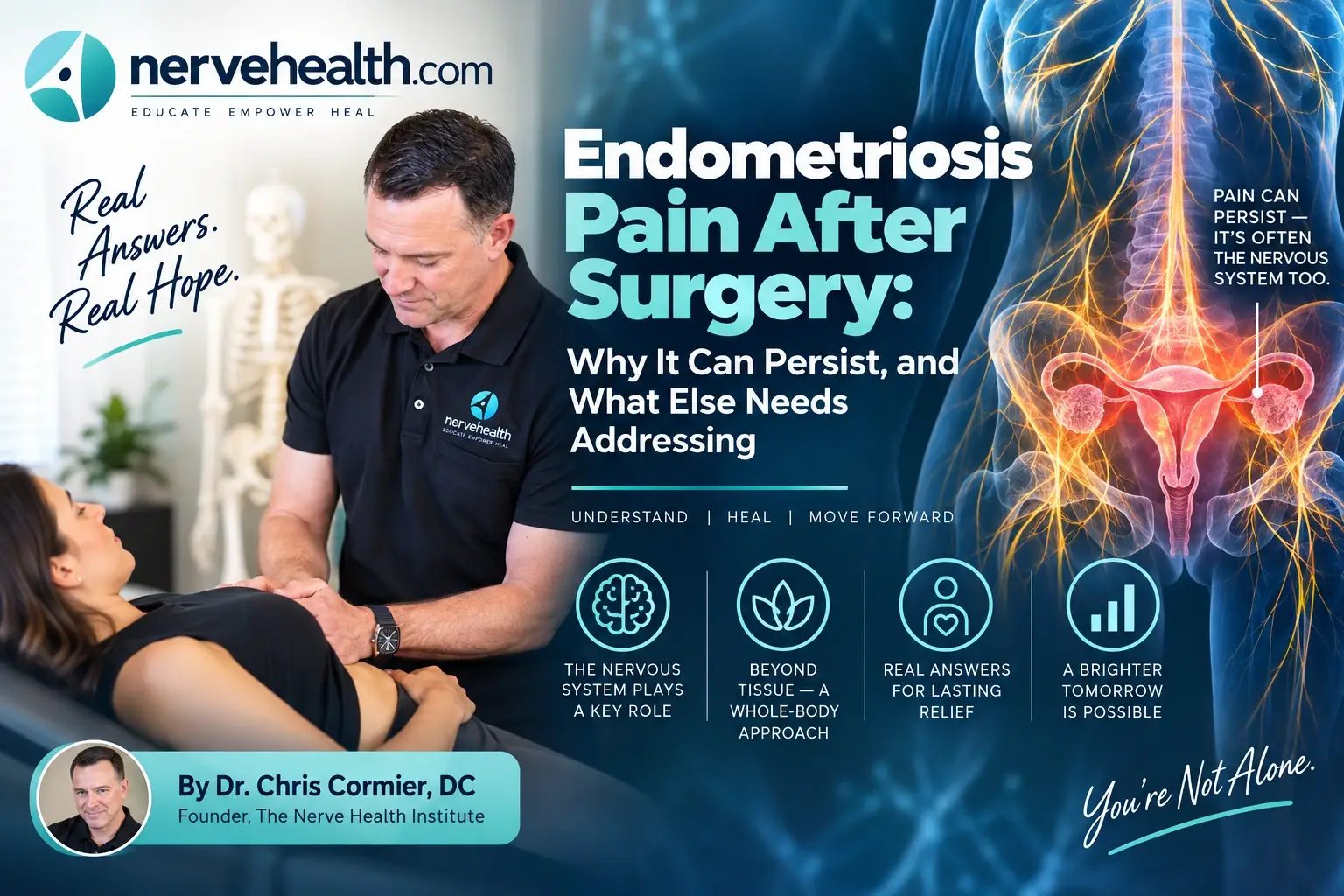
By Dr. Chris Cormier, DC — Founder, The Nerve Health Institute
The surgery went well. The surgeon removed what was there, the operative report reads cleanly, and everyone expected this to be the turning point.
And the pain is still here.
If that is your situation, the first thing worth knowing is how common it is. Around a third of people who have surgery for endometriosis continue to experience chronic pelvic pain afterwards. You are not a rare case, you are not imagining it, and it does not automatically mean the surgery failed or that disease was missed.
It usually means something else was driving the pain alongside the lesions — and that something is the nervous system.
Endometriosis Is a Nerve-Dense Disease
This is the part that reframes everything, and it is now well established rather than a fringe view.
Endometriotic lesions are not inert patches of misplaced tissue. Research has shown that they contain a markedly increased density of small nerve fibres — including the unmyelinated sensory fibres that are the classic carriers of chronic pain. The lesion and the nervous system grow into each other.
What that creates is a persistent pain generator wired directly into your nervous system. It explains something patients report constantly and are rarely given a reason for: why a small amount of visible disease can produce severe pain, and why pain burden so often fails to match what shows up on a scan or in a laparoscopy.
Why the Pain Stops Following Your Cycle
Early on, endometriosis pain is usually cyclical. It tracks your period, it makes sense, and it behaves the way you would expect.
Over months and years of repeated pain signalling, the system carrying those signals changes. The spinal cord and brain become more responsive to input — a process called central sensitization — and the threshold for what registers as pain drops. Sensations that should be neutral start to hurt. Pain that should be local spreads.
Once that shift has occurred, pain becomes acyclical. It no longer waits for your period, and it no longer reflects only what the lesions are doing. Studies find central sensitization in a substantial proportion of people with endometriosis — close to half in some cohorts — and it is independently associated with more severe chronic pelvic pain.
Why “Anatomically Perfect” Surgery Can Leave Pain Behind
Researchers describe this as the surgical paradox, and it is worth understanding before you conclude anything about your own operation.
Excision addresses the lesion. It is the right procedure, performed by a skilled specialist, and it removes the peripheral driver. What it cannot do is reverse a nervous system that has already learned to amplify. If sensitization is established, removing the original input does not switch off the amplification.
The evidence supports this directly: scores on central sensitization questionnaires taken before surgery predict how much pain people have afterwards. The nervous system state going in shapes the outcome coming out.
So persistent pain is not a verdict on your surgeon. It is information about which part of the problem was addressed and which part was not.
And Why It Was Never Only a Reproductive Condition
Women rarely arrive at our clinic with endometriosis alone.
Chronic fatigue, migraine, digestive problems, widespread pain conditions, other autoimmune diagnoses — these cluster with endometriosis far more often than chance explains. When a system has spent years in a state of inflammation and heightened pain signalling, the effects do not stay politely within one speciality.
That clustering is also why treating the pelvis in isolation so often disappoints, and why a whole-system view is not a philosophical preference here. It is what the condition actually requires.
The OWL Method: What Every Cell Runs On
Everything we do is built on a framework I have developed over nearly three decades, and I call it the OWL Method — Oxygen, Water and Light. These are not wellness concepts; they are the ingredients your cells are physically made of and run on.
Oxygen — the number one ingredient
Oxygen is what cellular energy production runs on, and a cell short of it cannot clear waste or repair at the rate it should. Chronic pain and chronic guarding both drive shallow breathing, which keeps the system leaning toward protection rather than repair — exactly the wrong direction when sensitization is the problem.
Water — the medium everything happens in
You are around 60% water, and every delivery and clearance transaction in your body occurs in that medium. Quality matters alongside quantity, and we work on both.
Light — what your nervous system runs on
Your nervous system operates on light energy travelling like fibre optics to every cell. We evolved under a sun that is roughly half near-infrared light and now spend the overwhelming majority of our lives indoors. Restoring that is something we do with specific equipment.
Alongside those sit frequency, magnetism and nutrients. Most people start at nutrients and skip everything above them in the hierarchy.
How We Work on It at the Clinic
The 88-nerve assessment
Your brain is a power company wired to trillions of cells through 88 major nerves branching off the brain and spinal cord. We test function across all of them and map where power is not arriving — what we call EnergyFlow. It is closer to walking a breaker box than to asking whether the building has power.
In women with endometriosis we are looking particularly at the pelvic supply and at the endocrine glands — ovaries, thyroid, pituitary, hypothalamus, adrenals — because hormone production depends on those connections being intact. Where a woman has had tissue removed, we work with what remains. See Quantum Neurology.
Oxygen delivery
HBOT drives oxygen into tissue at concentrations breathing alone cannot reach. EWOT and LiveO2 alternate high-concentration oxygen with a reduced mixture during light exercise, triggering vasodilation so you gain the delivery effect as well as the supply — and the exercise can be genuinely light, which matters when pain limits what you can do.
Light energy
Theralight360 delivers full-body red and near-infrared photobiomodulation at therapeutic intensity — the light people are no longer getting from the sun.
Frequency and magnetism
BRT Bioresonance works with the resonant tune each tissue carries. Uterine cells are tuned differently from ovarian cells, differently again from heart or bone — like guitar strings, each with its own correct pitch — and sustained stress pulls tissue out of tune. PEMF & Grounding addresses the magnetic side; the earth carries a charge we are meant to be in contact with and modern life has removed almost entirely.
Blood and detoxification support
EBOO Prime circulates blood through a filtration stage and an oxygenation and ozonation stage before returning it. Endocrine-disrupting chemical exposure is an active research area in this condition, and supporting the body’s overall detoxification capacity is part of how we approach it.
Pace is set deliberately low at the start. A sensitized nervous system reads intensive input as threat, which is precisely why aggressive protocols so often backfire in exactly the women who most want fast results.
What You Can Start Tracking
Sensitization responds to patterns, and patterns need recording:
- Pain level, and whether it still tracks your cycle or has stopped doing so
- Where the pain is, and whether the area is expanding
- Fatigue through the day, not just at its worst
- Sleep quality and hours
- Digestion and bladder symptoms
- What you did, and what it cost you the next day
Whether your pain has become acyclical is the most useful single observation on that list. It points directly at which mechanism is now dominant, and it is worth raising with your gynaecologist.
Continuing at Home
BodyChargers by Dr. Chris covers the at-home side — the OWL foundations, breathing, sleep, frequency device programmes with settings for the endocrine glands, and the 28-Day Cell Sparking Challenge, which turns the whole framework into one small change a day. For a condition where pain dictates what you can manage on a given day, that consistency carries a lot of the weight.
Where We Stop, and Why I Say It Plainly
Endometriosis requires a gynaecologist, and expert excision surgery remains the gold standard for the disease itself. Nothing we do removes a lesion, and nothing we do prevents tissue from growing where it should not. We are not a substitute for that care, and anyone suggesting otherwise is not being straight with you.
We also do not diagnose it. Diagnostic delay in this condition is already measured in years rather than months, and that delay costs women enormously. If you have symptoms and no diagnosis, a specialist gynaecologist is the right first stop, not us.
What we work on is the nervous system layer: the sensitization that surgery cannot address, the nerve function supplying the pelvis and endocrine glands, and the daily capacity that everything else depends on. That is not an alternative to your surgical and medical care — it is the complement the pain research says is needed alongside it.
And one more thing, because it gets said far too rarely: pain during sex, pain that stops you working, and pain that no one has taken seriously are not things to accept. They are reasons to keep pushing for answers.
— Dr. Chris Cormier, DC
The Nerve Health Institute, Lafayette, Louisiana. Contact us today.
Frequently Asked Questions
Why do I still have pain after endometriosis surgery?
Because lesions are only one of the drivers. Around a third of people continue to have chronic pelvic pain after surgery, largely because central sensitization — heightened pain processing in the spinal cord and brain — has developed alongside the disease. Removing the lesion removes the original input, but it does not reverse amplification that is already established.
Does persistent pain mean my surgery failed?
Not necessarily, and researchers are explicit about this. Persistent pain despite anatomically complete excision is a recognised pattern, and it does not mean the surgeon missed disease or that you are imagining it. It means the neural component of the condition needs addressing in its own right.
What is central sensitization?
A state in which the central nervous system becomes hyperexcitable after prolonged pain signalling, so pain is amplified and perpetuated even when the original source is reduced or removed. It is measurable — there is a validated questionnaire for it — and scores taken before surgery predict pain outcomes afterwards.
Why has my pain stopped following my cycle?
That shift usually indicates the pain has become nociplastic rather than purely inflammatory — driven by the nervous system rather than tracking hormonal changes. It is a meaningful observation and worth raising with your gynaecologist, because it changes which treatments are likely to help.
Why do I have so many other conditions alongside this?
Fatigue, migraine, digestive problems, widespread pain conditions and autoimmune diagnoses cluster with endometriosis more often than chance would explain. Years of inflammation and amplified pain signalling affect systems well beyond the pelvis, which is why a whole-body view tends to outperform treating the pelvis alone.
Can you treat my endometriosis?
No. Endometriosis needs a gynaecologist, and expert excision remains the gold standard for the disease itself. We work on the nervous system layer alongside that care — sensitization, nerve function and daily capacity.
Do you accept my insurance?
Coverage varies by plan and by service. Call the clinic on +1 (337) 456-6555 for a clear answer for your situation.
Ready To Take Control Of Your Health?
Get Treatment → nervehealth.com/get-treatment/
The Nerve Health Institute
108 Republic Ave. Ste. B, Lafayette, LA 70508
+1 (337) 456-6555