By Dr. Chris Cormier, DC — Founder, The Nerve Health Institute
I bought our first red light device around 2007, and for the best part of a decade people looked at me as though I had lost the plot. The same people now ask me which panel they should order.
That shift has been good for the field and bad for the information in it. Red light therapy went from fringe to fashionable without passing through the stage where anyone explained the dosing — which is the part that decides whether it does anything at all.
So this is the explanation I give patients: what the light does to a cell, why more of it is not better, what full body red light therapy adds over a handheld panel, and the honest list of where the evidence thins out.
What the Light Is Doing to a Cell
The technical name for this is photobiomodulation, and the mechanism is reasonably well described.
Inside your cells, mitochondria produce energy through a chain of enzymes. One of them — cytochrome c oxidase — absorbs light in the red and near-infrared range particularly well. When it does, the enzyme works more efficiently, and the cell produces more ATP, which is the currency everything else in your body spends.
Two wavelength ranges matter. Red light, roughly 630 to 660 nanometres, works closer to the surface — skin, superficial tissue. Near-infrared, roughly 810 to 850 nanometres, penetrates considerably deeper, which is why it is the range of interest for muscle, joint and nerve tissue.
Near-infrared is also a useful reminder that light is not only what you can see. Point a night-vision camera at someone in a dark room and they appear, because the body emits and interacts with infrared constantly. That part of the spectrum is not exotic. It is what we evolved under — roughly half of what reaches us from the sun sits in the near-infrared range.
Why I Treat Light as a Nutrient
Everything we do at the clinic is built on a framework I developed over nearly three decades. I call it the OWL Method — Oxygen, Water and Light — because these are not wellness concepts, they are what your cells are physically made of and run on. Frequency, magnetism and nutrients sit alongside them.
Light belongs in that list for a straightforward reason. Your brain and spinal cord, and the 88 major nerves branching off them, run on light energy travelling like fibre optics out to trillions of cells. We evolved outdoors, and we now spend the overwhelming majority of our lives inside, under glass that filters infrared out and clothing that blocks what gets through.
Most people are not short of light because they are unlucky. They are short of it because modern life is built that way.
More Is Not Better: The Part the Industry Does Not Advertise
This is the most important section on this page, and it runs directly against how red light therapy is usually sold.
Photobiomodulation follows what researchers call a biphasic dose response. Too little light does nothing. The right amount produces the effect. And past a certain point the benefit flattens and can reverse — more exposure makes the result worse, not better.
I describe it to patients as a fuel tank. Each cell has one, and the goal is to fill it and keep it topped up. Nobody improves their car by holding the pump open after the tank is full.
Which means the honest version of this therapy is unglamorous: sensible session lengths, sensible frequency, and resisting the logic that if twenty minutes is good then an hour must be better. I use the TheraLight 360 at least once a week, not every day. Any clinic or brand encouraging you toward constant exposure is either unaware of the dose-response literature or choosing to ignore it.
What the TheraLight 360 Is, and What Full Body Red Light Therapy Adds
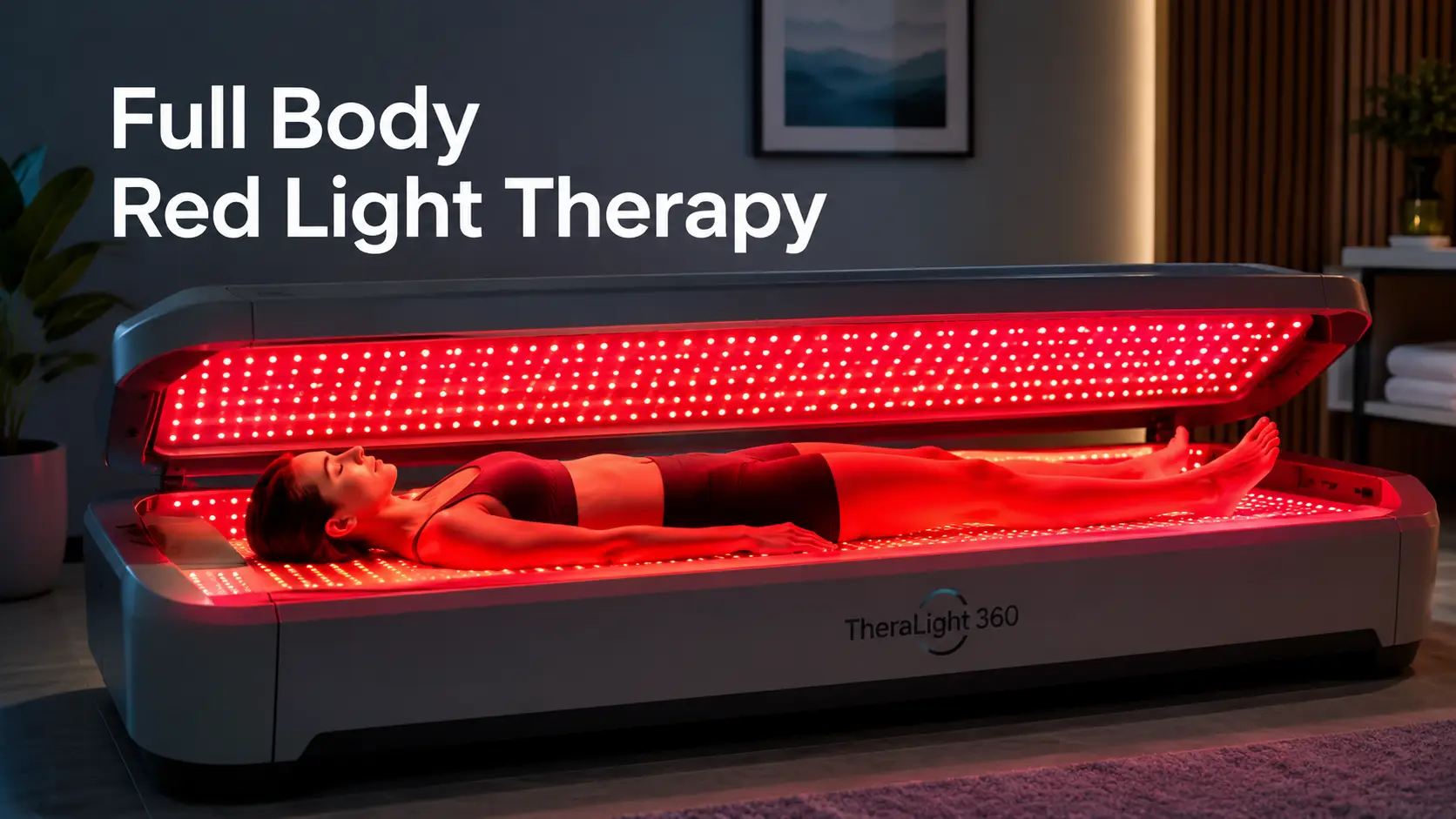
The TheraLight 360 is a full-body bed delivering several wavelengths of red and near-infrared light at once, in a private room. When we acquired ours it was the twelfth unit in the world; they are now in university athletic programmes and professional sports facilities across the country.
It looks like a tanning bed and it is nothing like one. A tanning bed delivers ultraviolet light, which damages skin. This delivers red and near-infrared, which are a different part of the spectrum entirely and carry no UV.
The practical difference with full body red light therapy is coverage and consistency. A handheld panel treats whatever you point it at, for as long as you hold it there, at whatever distance you happen to choose — and distance matters enormously, because the intensity reaching your skin falls away quickly as you move back. A full-body bed delivers a controlled dose to the whole surface at once, in a fixed geometry, in a session short enough that people actually keep doing it.
We also run other light devices for targeted work — clinical lasers and Contour Light pads that wrap around a specific area. The bed is the saturation tool; the others are precision tools.
Why We Test Before We Saturate
Here is where our use of light differs from almost everywhere else offering it.
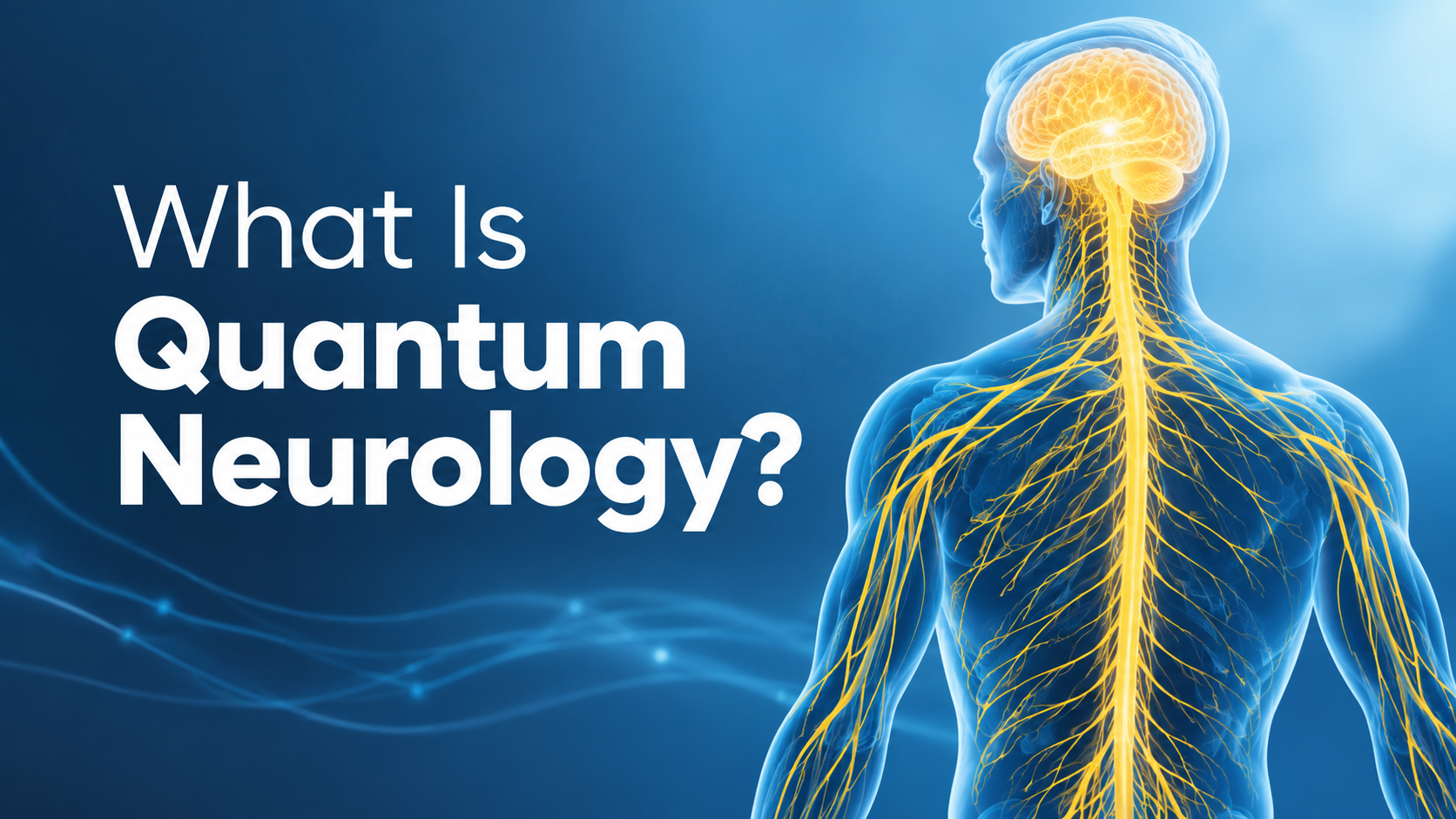
Most places put you in a bed. We assess first. Your brain is a power company wired to trillions of cells through those 88 major nerves, and we test function across all of them to map where the signal is running below capacity — what we call EnergyFlow. It is closer to walking a breaker box than to asking whether the building has power. That work is set out on the Quantum Neurology page.
Once we know which regions are underpowered, we work on those directly, and then use the bed to saturate the whole system. Light as a finishing step on top of a specific plan does more than light as a standalone service — and it means we can tell whether anything changed, rather than asking you how you feel.
Where the Evidence Is Strong, and Where It Is Not
You deserve this broken down honestly rather than lumped together as “clinically proven”.
Reasonably well supported. Wound healing and skin quality, temporary relief of minor muscle and joint pain, and exercise recovery have the most consistent published support. Photobiomodulation also appears in some oncology supportive care guidance for chemotherapy-related oral mucositis, which is one of the better-evidenced applications anywhere in this field.
Promising but unsettled. Nerve-related applications, cognitive and mood effects, thyroid, and most of the systemic wellness claims. There is genuine laboratory rationale and some encouraging small trials. There are not large, consistent, high-quality human trials, and studies vary so widely in wavelength, dose and delivery that comparing them is difficult.
Not established at all. Treating or curing any disease. Red light therapy devices that carry FDA clearance are cleared for narrow indications — things like temporary pain relief, wrinkle reduction or hair growth. Clearance is not the same as approval, and it is certainly not clearance to treat a medical condition.
My own view, after nearly 20 years of using it daily in practice, is that it is one of the most useful tools I have. That is clinical experience, not trial evidence, and I would rather label it correctly than dress it up.
The Safety Conversation, Properly
Red light therapy is well tolerated by most people and does not carry the skin cancer risk associated with ultraviolet exposure. That said, “generally safe” is not “safe for everyone”, and I am not comfortable with how rarely that gets said.
Tell us, and tell any provider, if any of these apply:
- Photosensitising medications — some antibiotics, acne medications, diuretics, certain chemotherapy agents and St John’s Wort among others. This is the most commonly missed item
- A photosensitivity condition such as lupus or porphyria
- An active or suspected skin lesion or tumour in the area — light is not applied over a known or suspected tumour site
- Pregnancy — the abdomen is avoided
- A seizure disorder — relevant where a device pulses or flickers
- Recent cosmetic procedures or injectables — timing matters
Eye protection is used, and it is not optional. These are high-output devices and your eyes are not the target tissue.
If you are in active cancer treatment, light therapy timing is cleared with your oncologist first — that applies here as it does to everything else we offer, and we cover it on the chemotherapy-induced peripheral neuropathy page.
Should You Just Buy a Panel Online?
Patients ask me this constantly, and the answer is not the one you might expect from someone selling sessions.
Yes — and get a good one. Twenty years ago you could barely find a device. Now the market is flooded, and the gap between the best and worst products is enormous. The cheap ones tend to fail in predictable ways: the wrong wavelengths, output far lower than advertised, or an intensity that requires you to sit unrealistically close for unrealistically long.
A decent home panel used consistently beats an excellent clinic bed used occasionally. That is simply how dosing works.
What a home device cannot do is cover your whole body at a controlled dose in ten minutes, and it cannot tell you where your system is actually underpowered. Those are the two things worth coming in for.
We put the devices we actually recommend on BodyChargers by Dr. Chris, our at-home education platform, alongside the rest of the OWL foundations — breathing, hydration, sleep and frequency work. If you only ever use that and never set foot in the clinic, you will still be better off than you were.
Stacking It With Everything Else
Light is one ingredient, and on its own it is the least interesting version of what we do.
In practice we combine it with hyperbaric oxygen and EWOT for oxygen delivery, EBOO Prime where filtration and oxygenation are appropriate — covered in more depth at ebooprime.com — plus PEMF and grounding for magnetism and BRT bioresonance for frequency.
Every person gets a different combination, because the assessment comes first and the plan follows from it. Nobody here is sold a package before they have been examined.
The Honest Limits
You will not find this section on most clinic pages, and it belongs on every one of them.
Red light therapy does not treat or cure disease. It is not a substitute for medical care, and if you have a diagnosed condition, the physician managing it leads. We do not ask anyone to delay, reduce or stop treatment.
It is not a substitute for sunlight, sleep or movement either. Get outside. Morning daylight does something for your circadian rhythm that no device replicates, and no amount of red light compensates for five broken hours of sleep.
The evidence is uneven and I have said where. Strong in some applications, thin in others, and the dosing variability across studies is a real problem that the industry glosses over.
And it does not work for everyone. Some people notice a clear difference in the first few sessions. Some notice nothing. I cannot tell you in advance which you will be, and anyone who claims they can is guessing.
I publish this because the gap between what red light therapy can reasonably do and what it is marketed as doing has become embarrassing. If knowing the limits makes you trust what remains, that is the right outcome.
Key Takeaways
Full body red light therapy works by feeding mitochondria light they can use, in wavelengths most people no longer get enough of. The mechanism is real and reasonably well described.
Dose decides the outcome. More is not better, and the biphasic response is the single most useful thing to understand before you buy a device or book a session.
And light is one ingredient among several. At the Nerve Health Institute we test where your system is underpowered before we saturate it, which is what makes the TheraLight 360 a finishing step rather than a standalone service.
You can read more about how I think about this work at drchriscormier.com, and we welcome local and visiting patients in Lafayette, Louisiana. Contact us today.
— Dr. Chris Cormier, DC
Founder, The Nerve Health Institute and BodyChargers by Dr. Chris
Frequently Asked Questions
What does full body red light therapy actually do?
Red and near-infrared wavelengths are absorbed by cytochrome c oxidase in your mitochondria, which improves how efficiently the cell produces ATP. A full-body bed such as the TheraLight 360 delivers that dose across your whole surface at once in a controlled geometry, rather than to whatever area a handheld panel happens to be pointed at.
How often should I use red light therapy?
Less than most people assume. Photobiomodulation has a biphasic dose response, meaning the benefit rises to a point and then flattens or reverses with more exposure. I use the TheraLight 360 at least once a week rather than daily. Session length and frequency should be set for you, not copied from a marketing page.
Is red light therapy the same as a tanning bed?
No. Tanning beds emit ultraviolet light, which damages skin and raises cancer risk. Red and near-infrared light sit in a different part of the spectrum and carry no UV. The devices can look similar; what comes out of them is not comparable.
Are there side effects or people who should avoid it?
It is well tolerated by most people, but it is not for everyone. Photosensitising medications are the most commonly missed issue — some antibiotics, acne medications, diuretics and certain chemotherapy agents among them. Photosensitivity conditions, pregnancy, seizure disorders and any suspected lesion in the treatment area all need discussing first, and eye protection is always used.
Does red light therapy treat medical conditions?
No, and devices with FDA clearance are cleared for narrow indications such as temporary minor pain relief, wrinkle reduction or hair growth — not for treating disease. Our work supports cellular function and nervous system health alongside your medical care, never instead of it.
Should I buy a home device instead of coming in?
Buy a good one and use it consistently — that genuinely beats occasional clinic visits, and we list what we recommend on BodyChargers. What a home panel cannot do is deliver a controlled whole-body dose in ten minutes, or tell you where your nervous system is actually running below capacity. That assessment is the reason to come in.
How soon would I notice anything?
It varies, and I will not pretend otherwise. Some people report a difference within a few sessions; others notice nothing. Recovery, sleep quality and how an area feels under load are usually the first things people mention, and a short daily note is more reliable than memory.
Do you accept my insurance?
Coverage varies by plan and by service. Call the clinic on +1 (337) 456-6555 for a clear answer for your situation.
Ready To Take Control Of Your Health?
Assessment first, then a plan built around it — with the TheraLight 360 as the finishing step rather than the starting point.
Get Treatment → nervehealth.com/get-treatment/
The Nerve Health Institute
108 Republic Ave. Ste. B, Lafayette, LA 70508
+1 (337) 456-6555