By Dr. Chris Cormier, DC — The Nerve Health Institute, Lafayette, Louisiana
You wake up at two in the morning to go to the bathroom. Maybe again at four. You have stopped trusting yourself on a trampoline, or during a sneeze, or on a long drive without knowing where the next rest stop is. And somewhere along the line, someone told you this is just what happens as you get older.
It is common. It is not something you simply have to live with.
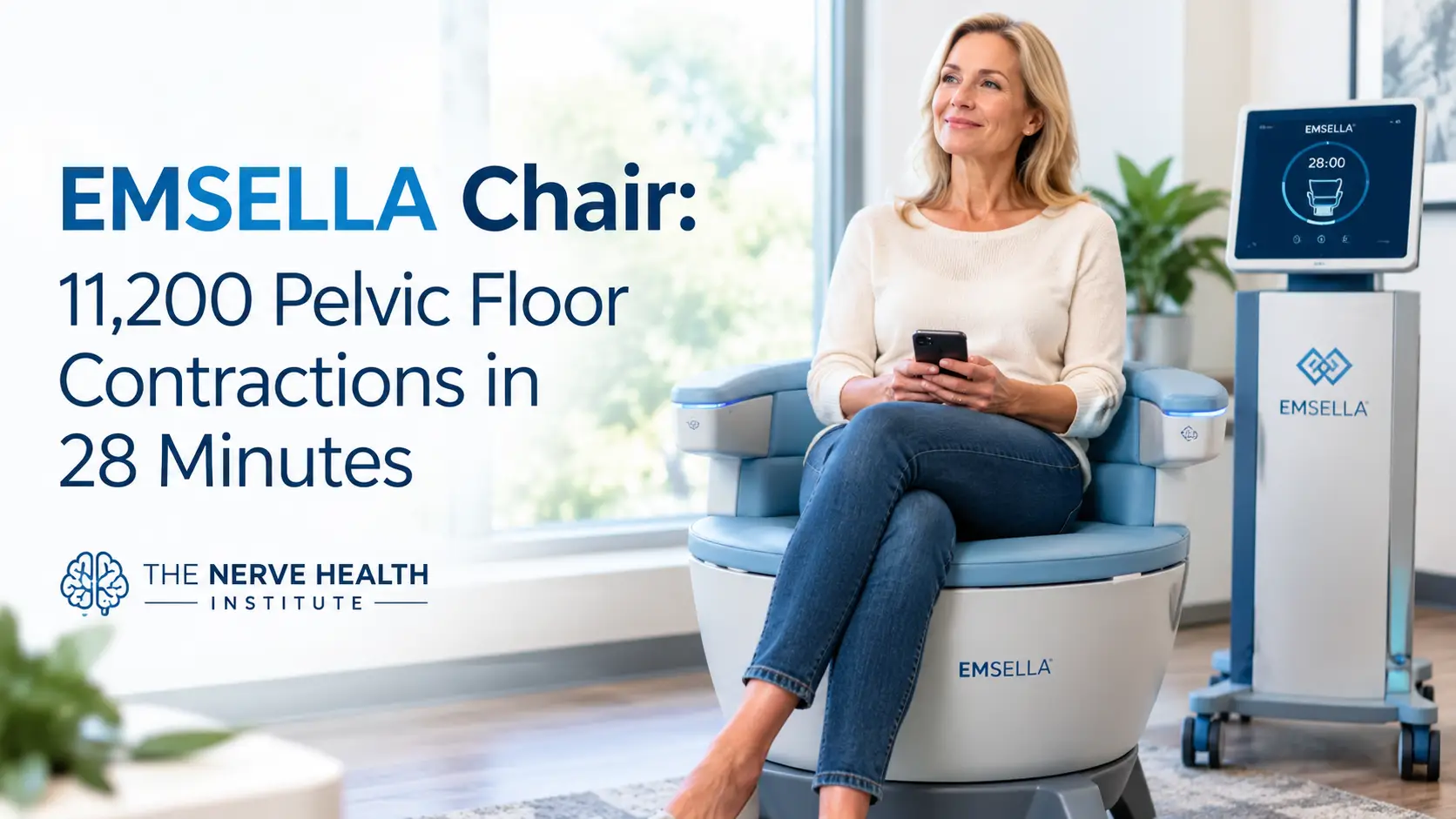
At The Nerve Health Institute we use the EMSELLA chair — a device that triggers 11,200 full pelvic floor contractions in a single 28-minute session while you sit fully clothed and read your phone. We have had it in the clinic for over a year and a half, and it has become one of the treatments patients talk about most. Here is exactly what it is and how it works.
What the EMSELLA chair actually does
The EMSELLA chair is built by BTL, a Czech medical technology company whose engineering teams develop the device platform. It uses HIFEM technology — high-intensity focused electromagnetic energy — delivered through the seat of the chair.
You sit down fully dressed. The chair is switched on, and a focused electromagnetic field passes through the pelvic floor, causing the entire muscle group to contract. Not a partial squeeze — a complete, supramaximal contraction of the whole pelvic floor, repeated 11,200 times across 28 minutes. You can feel each wave, and you can hear the device clicking as it cycles.
There is no surgery, no needles, no undressing and no recovery time. Patients walk out and drive themselves home or back to work.
Why 11,200 contractions matters
Most people know Kegels. The instruction is simple enough — squeeze the muscles you would use to stop the flow of urine — and there are apps that will coach you through sets at home.
The challenge is volume and quality. A dedicated home routine might produce a few hundred voluntary contractions a week, and many people are not fully activating the right muscles to begin with. One EMSELLA session produces 11,200 complete contractions in less than half an hour — a training stimulus the pelvic floor simply cannot be given voluntarily.
What patients often notice afterwards is that Kegels themselves become easier. The chair reconnects the muscle group and makes the home work more effective, which is a large part of why we pair the two.
What the clinical research shows
The strongest published study on this technology is a prospective, multicentre trial of 75 women published in Lasers in Surgery and Medicine, with a mean participant age of 55. Participants received six sessions, twice weekly. The results:
- 81.33% of participants reported significant symptom reduction after the six-session course.
- Pad use fell by 53.68% at three-month follow-up — from an average of 2.47 pads per day to 1.19.
- Nearly 70% of regular pad users had reduced their pad use at follow-up.
- Symptom scores improved 64.42% at three months on the standard ICIQ-SF questionnaire, with over a third of participants scoring zero.
- No treatment-related adverse events were recorded. The only effect reported was mild muscle fatigue, which is what you would expect after a workout.
Improvements were seen across stress incontinence, urge incontinence and mixed presentations. Supporting studies using the same protocol have reported quality-of-life gains sustained at six months, and these were small single-arm studies rather than large randomised trials — which is worth knowing when you compare it against other options, and which matches what we see in the clinic.
Who we see benefit most
Women after pregnancy and through menopause
Pregnancy and delivery place enormous demand on the pelvic floor, and hormonal change through menopause affects tissue quality. Many women accept leaking during a sneeze, a laugh or a workout as permanent. It generally is not — the muscles are usually still there and still connected, they have simply lost strength and coordination. That is exactly what this technology is designed to address.
Men, including after prostate treatment
Men have a pelvic floor too, and almost nobody trains it. We have seen strong results in men dealing with urinary control issues, including men who have been through prostate treatment. The device is cleared for urinary incontinence in both men and women, and men sit in exactly the same chair, fully clothed, for the same 28 minutes.
Anyone whose core has quietly gone offline
The pelvic floor is part of your deep core. When it weakens, the effects can show up in core stability, posture and lower back comfort — which is why some patients come to us for one thing and notice improvements in another. Our conditions library covers the presentations we see most often.
The nervous system connection — and why this fits the OWL Method
This is the part that makes EMSELLA more than a muscle treatment in our clinic, and it is the reason it sits comfortably inside how we practise.
Your nervous system has two broad modes. The sympathetic side is the surviving side — alert, braced, ready for threat. The parasympathetic side is the healing side — the state in which your body digests, repairs and sleeps properly. The parasympathetic system runs partly through the vagus nerve and partly through the sacral nerves, which supply the pelvic floor and bladder.
So when we strengthen and reconnect the pelvic floor, we are working directly in sacral parasympathetic territory. Patients frequently report that the benefits are not limited to bladder control — they describe feeling calmer and sleeping better through a course of treatment.
How it maps onto oxygen, water and light
Our framework is the OWL Method — oxygen, water and light, supported by frequency, magnetism and nutrients. Oxygen is the first ingredient in every one of your roughly 30 trillion cells. Water quality determines what those cells are working with. And light energy is how the nervous system communicates: every muscle cell in your body is wired back to the brain, and that signalling traffic is what keeps tissue alive and responsive.
Every one of those 11,200 contractions is a signal travelling to and from the brain. The chair is not only training muscle — it is reigniting the connection to it. That is the same principle behind our full-body red light therapy, applied to a different system.
About waking up at night
Getting a full night without a bathroom trip is one of the most common reasons people come in, and it is worth understanding so you get the best possible result.
Nocturia affects roughly 40% of adults and becomes more common with age. Pelvic floor strength and bladder control are one meaningful driver — and they are the part most people have never had assessed or treated. Other contributors can include fluid timing in the evening, an enlarged prostate, sleep quality, and some common medications.
This is why we assess rather than assume. When we identify what is actually driving your nights, the treatment plan works — and for a great many of our patients, pelvic floor strength is exactly where the win is. It also means that if something in your history needs your physician’s input, we will say so and work alongside them. Sleep timing matters here too, and we cover that in how to fix your sleep schedule.
Is EMSELLA right for you?
The great majority of people who come in are suitable, and the consultation is quick. There are some clear situations where we would use a different approach, and we check these before your first session so your course runs smoothly:
- Metal or electronic implants — joint replacements, surgical plates, rods or screws, pacemakers, defibrillators, neurostimulators, or a copper IUD.
- Pregnancy, possible pregnancy or breastfeeding.
- Active cancer or current cancer treatment.
- Seizure disorders, bleeding disorders or blood-thinning medication, or an active fever or infection.
- Recent pelvic, abdominal or spinal surgery — we wait for surgical clearance first.
Bring a list of your implants and medications to your consultation and we will confirm everything in a few minutes. On the day, you will be asked to remove metal items — jewellery, watches, belts, phone and cards — and to avoid clothing with metal zips or underwiring.
What a course of treatment looks like
A standard course is six sessions, scheduled twice weekly over about three weeks. Each session is 28 minutes. You stay fully clothed, seated, and you can read or answer emails throughout.
Most people begin noticing changes partway through the course, with results continuing to build in the weeks afterwards as the pelvic floor consolidates its new strength. Many patients choose periodic maintenance sessions once they have the result they want.
And on the question nobody wants to ask: this is handled privately. You keep your clothes on, nobody announces why you are here, and the whole thing is simply an appointment in your day.
Keeping the gains between sessions
We cannot be with you every day, so we built a platform for the other 23 hours. BodyCharger is our at-home education system, covering oxygen uptake, water quality, light energy, frequency, magnetism and grounding, plus nutrients — including dedicated male and female health sections.
Used alongside your in-clinic sessions, it is how patients keep momentum between appointments and hold onto their results afterwards. For patients where systemic circulation and oxygenation are part of the wider picture, we also offer EBOO therapy, which we cover at ebooprime.com.
Frequently asked questions
Does the EMSELLA chair hurt?
No. You feel a strong tingling and the pelvic floor muscles contracting rhythmically — unusual at first, but not painful. Intensity is adjusted to your comfort and increased as you adapt. The most common after-effect is mild muscle fatigue, like any good workout.
How many EMSELLA sessions will I need?
The standard protocol is six sessions over roughly three weeks, twice a week, which is the schedule used in the published research. Many patients then move to occasional maintenance sessions to hold their results.
Do I need to undress for the treatment?
No. You remain fully clothed throughout. You will only be asked to remove metal items such as jewellery, belts, keys and phone, and to avoid clothing with metal zips or underwiring.
Can men use the EMSELLA chair?
Yes. The device is cleared for urinary incontinence in men as well as women, and we treat men regularly — including men managing urinary control after prostate treatment. The session is identical: seated, clothed, 28 minutes.
Will it stop me waking up at night to urinate?
Pelvic floor strength and bladder control are a significant factor in night-time urination for many people, and it is the factor most often left untreated. We assess what is driving your particular pattern at the consultation so your plan targets the right thing — and for many of our patients, this is exactly the treatment that changes their nights.
Is EMSELLA available in Lafayette, Louisiana?
Yes — we have the EMSELLA chair at The Nerve Health Institute in Lafayette, and we treat patients from across Acadiana. Contact the clinic to book a consultation.
Book your consultation
If you are planning your day around bathrooms, or waking up more than once a night, there is a straightforward option that involves no surgery and no downtime. Contact The Nerve Health Institute and we will walk you through whether EMSELLA is the right fit.
Dr. Chris Cormier, DC
Founder, The Nerve Health Institute — Lafayette, Louisiana
More on how and why we practise this way at drchriscormier.com, and our at-home programme at bodycharger.com.
Spark your cells to optimal longevity.