By Dr. Chris Cormier, DC — The Nerve Health Institute, Lafayette, Louisiana
I say that line to patients more than any other, because it settles an argument before it starts.
You can do without a great many things in the human body. You cannot do without the brain.
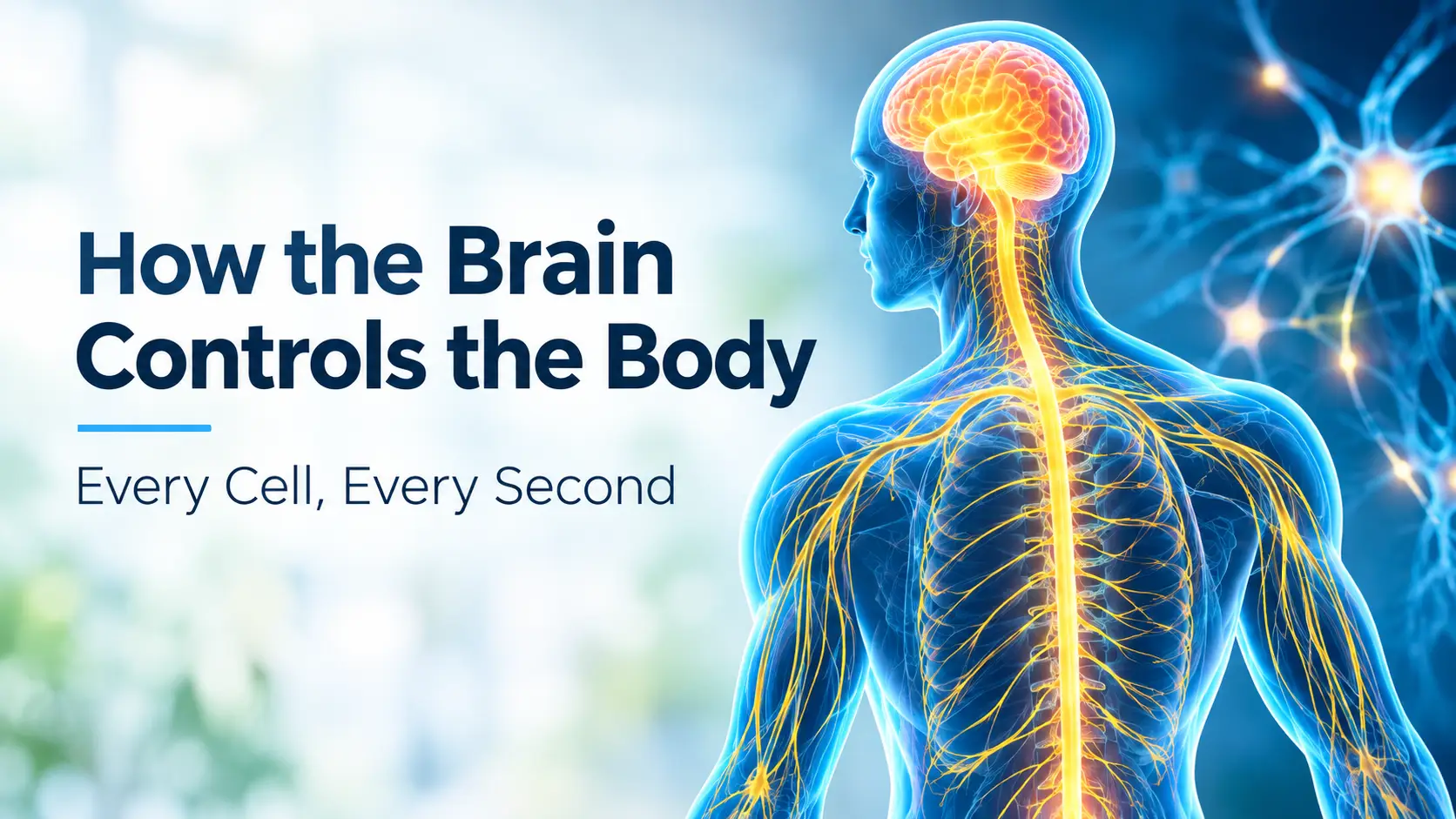
People accept that immediately when it is about thinking. Where it gets interesting is when you follow the wire out — because your brain is not only running your thoughts. It is running the power company for roughly 30 trillion cells, and every one of them is on the grid.
That is what I want to lay out here: how the brain controls the body, what the line actually carries, and what keeps it open.
Power out: nothing moves without a signal first
Take something as ordinary as flexing your bicep.
One side of your brain sends a signal down through a nerve in your neck, out along a specific pathway, into that specific muscle. That is the only way it happens. The bicep is just a muscle — it does not act on its own and it never has. It works because a line is open between it and your brain.
As the National Institute of Neurological Disorders and Stroke puts it, “all sensations, movements, thoughts, memories, and feelings are the result of signals that pass through neurons.” That is a remarkable sentence when you sit with it. Everything on that list is the same mechanism — a signal reaching a cell that is waiting for it.
Signal in: the line runs both directions
The other half matters just as much, and it gets far less attention.
Put your hand on something hot. For you to pull it away, that cell has to get a message back up to the brain in milliseconds, and the brain has to send one back down. Out and in, constantly, all day, with no conscious involvement from you at all.
That two-way traffic is the whole job. Power out so the body can act, signal in so the brain knows what is happening. When I assess someone, I am interested in both directions — a line that carries well in one direction and poorly in the other is still a line worth improving.
Everything is on the grid, not just the parts you move
Here is where most people are genuinely surprised.
Muscle cells are wired to the brain. So are bone cells. So is your skin. And so are your organs and your glands — the parts you have never once consciously instructed and never will.
That is the autonomic side of the system, and it is doing an extraordinary amount of work quietly. The National Library of Medicine describes it as controlling “blood pressure, heart rate, sweating, bowel and bladder emptying, and digestion,” carrying information “to the heart, blood vessels, bladder, intestines, sweat glands, and pupils.”
None of that is on your to-do list. All of it depends on the connection being good.
It is also why the things we see in clinic range much wider than people expect when they first walk in — our conditions library gives a sense of the spread. Once you understand that organs and glands are on the same grid as muscles, that range stops being surprising and starts making sense.
The 88 major nerves, and the three things that load them
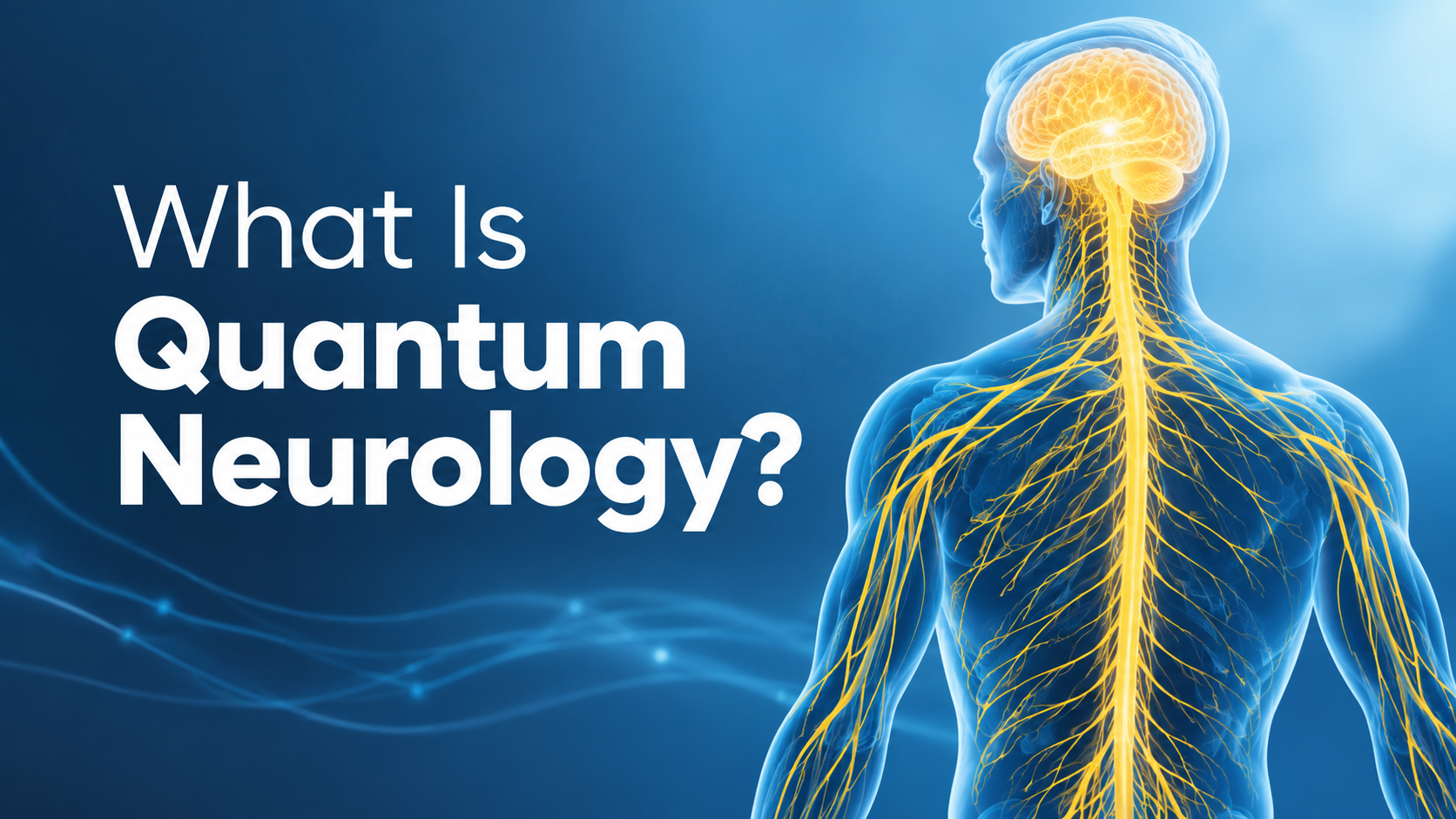
I describe the spine and spinal cord as the breaker box, with 88 major nerves running out of it like power lines to every part of you. It is a simple picture and it holds up well in conversation, which is why I keep using it.
And like any electrical system, the load on it comes from somewhere. In my experience it comes from three directions, and almost everyone can place themselves in one of them within about five seconds:
- Physical. Posture, old injuries, how you sit, how you lift, how you sleep, how much you move.
- Emotional. Workload, pressure, the state your nervous system spends most of the day in.
- Environmental. Air, water, light, what you eat, what you are exposed to day after day.
Everything you do sits in one of those three columns, and everything in those columns has a consequence — which is far better news than it sounds. Three columns is a manageable number. Nobody is perfect in all three and nobody needs to be. The goal is simply to be ahead: more going in the good column each day than the other, and a little further ahead each month.
The six ingredients: the OWL Method
If the brain is the power company, the next question is what the system actually runs on. I teach it as six ingredients in order of how fundamental they are, and the first three give the method its name.
O — Oxygen
The top ingredient in the entire human body. You can go without a great many things; you cannot go without breathing, and almost everybody knows that in principle while doing very little about it in practice.
Most people simply do not breathe enough, and many have lost track of where they are breathing from. That is correctable, and it is free. It is also why oxygenation runs through everything we do — including EBOO Prime, where circulation and oxygenation are the entire focus.
W — Water
Second most prevalent ingredient in the body, and there are two separate questions in it. Quantity — are you drinking enough? And quality — is what you are drinking being used well?
Plenty of people are drinking a reasonable amount and still not getting the benefit of it. Filtration, minerals and timing all matter, which is a whole subject of its own and one we go into in our article on kidney health.
L — Light
Light energy is how the system communicates. I think of the nervous system as fiber optic — and if that sounds like a stretch, consider that your body is explicitly built to run on a light cycle: bright morning light, dark night, and a rhythm that sets everything from hormone release to repair.
That is why light is both something to get right at home — covered in our piece on the best sleep environment — and something we deliver at a controlled dose in clinic through full-body red light therapy.
Then: frequency
Fourth in order, and the one people find most interesting.
The way I explain it: imagine every one of those trillions of cells has its own guitar string, and every string is meant to stay in tune. I am not a musician, but a good one can touch a string, hear that it is out, and know exactly what to do about it. That is the idea behind the frequency work — supporting cells in holding their tune rather than drifting.
What has changed is the access. The devices we use for this are now small enough to carry in a pocket, which means this is no longer something that only happens in a clinic room. The at-home side of it lives on BodyCharger.
Then: magnetism. Then: nutrients.
Magnetism sits fifth, and nutrients and supplements sit sixth — deliberately.
People sometimes arrive having assembled an impressive collection of supplements, and I understand exactly how that happens. Search for what will help you and you get an overwhelming amount of conflicting information, so you buy things. It is a reasonable response to a genuinely confusing situation.
My approach is simply to work in order. Oxygen, water and light are the higher-level ingredients, they are largely free, and they change how everything downstream performs. Get those running well and supplements do more for you, not less — you are adding them to a system that can actually use them.
Why I aim at 85 percent
When I describe the goal to patients, I do not say a hundred percent. I say eighty-five.
That is not modesty, it is accuracy about the world we live in. There is more interference between brain and cells now than at any point in history — more input, more load, more going on in all three stress columns at once. Chasing a perfect number would set people up to feel like they are failing at something nobody achieves.
Eighty-five percent is a target you can actually hit and then hold. And the gap between where most people are and eighty-five is where the entire difference in how they feel lives.
Three things to start today
None of these cost anything, and these are the three I give people first:
- Breathe more, on purpose. A few minutes of deliberate breathing, a few times a day. The simplest possible intervention on the single most important ingredient.
- Drink water in the morning. Before coffee, before anything. Most people start the day already behind and never catch up.
- Get morning sunlight. Outside, early, even briefly. This is the lever that sets the whole day’s rhythm, and almost nobody pulls it.
If you want these built into a structure rather than a list, that is exactly what the 28-Day Cell Sparking Challenge is — the daily version of everything above, laid out so you are not deciding each morning what to do.
How we work at The Nerve Health Institute
The 88-nerve assessment
We map nerve function across those 88 major pathways, so instead of guessing where the load is, we can see it. That is the starting point for everything that follows, and it is what makes a plan a plan rather than a list of good ideas.
Reset, adjust, optimize
Reset what is loaded. Adjust what is out of position. Then optimize — which is the part most people have never had access to, and the part that holds the gains.
Clinic and home together
My favourite patients are the ones doing both. They come in for the corrective work and they are BodyCharger members at home, which means they need me less over time — they have learned how to manage their own body. Teaching someone to be their own mechanic is the best outcome in this job, and it is the whole reason the at-home platform exists.
More on how I came to practise this way is at drchriscormier.com, and the full framework is set out on the OWL Method page.
Frequently asked questions
How does the brain control the body?
Through signals travelling along nerves, in both directions. The brain sends signals out so muscles, organs and glands can act, and those cells send information back so the brain knows what is happening. Every sensation, movement, thought and feeling is the result of signals passing through neurons.
Does the brain really control organs and glands too?
Yes — that is the autonomic side of the nervous system, which regulates blood pressure, heart rate, sweating, digestion, and bowel and bladder emptying, carrying information to the heart, blood vessels, bladder, intestines, sweat glands and pupils. None of it is conscious, and all of it depends on the connection.
What is the OWL Method?
Oxygen, water and light — the three most fundamental ingredients in the human body — supported by frequency, magnetism and then nutrients. It is an order of operations: work on the foundational ingredients first, because everything downstream performs better once they are right.
What are the 88 nerves?
The 88 major nerve pathways running out from the spine to the rest of the body — the main power lines. Mapping function across all 88 is how we find where the load is sitting rather than guessing.
What can I do today to support my brain and nervous system?
Breathe deliberately, drink water first thing in the morning, and get outside into morning light. All three are free, all three act on the foundational ingredients, and people who do them consistently notice the difference.
Should I start at home or come into the clinic?
Either works, and together works best. Plenty of people start at home with the 28-day challenge and feel a significant difference from that alone. If you want the assessment and the corrective work, come and see us — and keep doing the home practices alongside it.
Book an assessment
If you want to know where your connection actually stands rather than guess at it, that is what the 88-nerve assessment is for. Contact The Nerve Health Institute and we will map it out with you.
Dr. Chris Cormier, DC
Founder, The Nerve Health Institute — Lafayette, Louisiana
At-home programmes at bodycharger.com. Circulation and oxygenation at ebooprime.com.
Spark your cells to optimal longevity.