By Dr. Chris Cormier, DC — The Nerve Health Institute, Lafayette, Louisiana
Two numbers explain why this article exists.
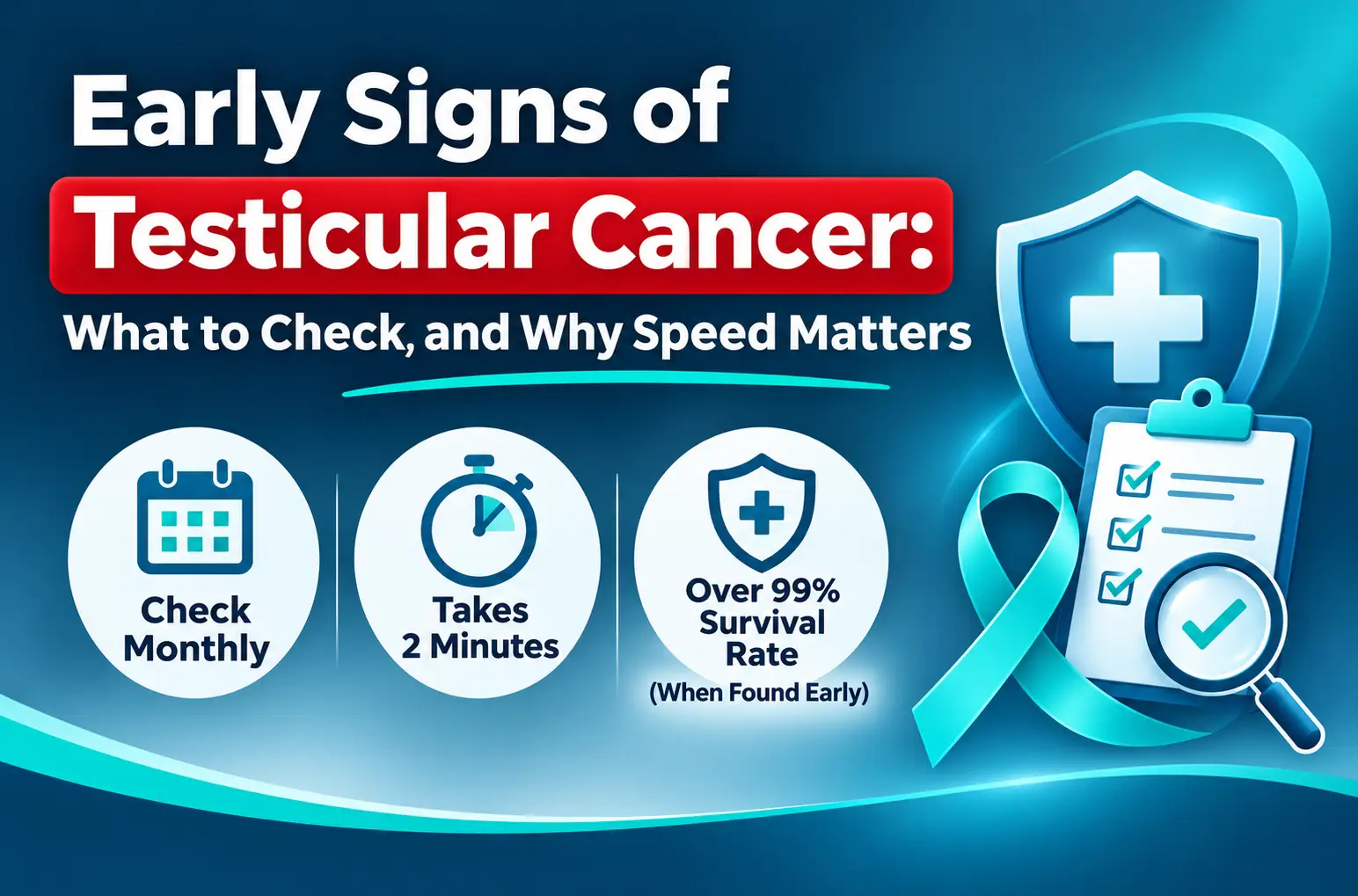
The first is that testicular cancer is one of the most curable cancers there is. When it is found while still confined to the testicle, the five-year survival rate is above 99%. That is as good as oncology gets.
The second is that around half of men diagnosed with it do not seek medical attention until after it has already spread beyond the testicle.
The gap between those two numbers is not a medical problem. It is a conversation problem — and that is a far easier thing to fix.
So this page is a practical one. What to look for, how to check, what is perfectly normal, and what to do if something has changed. It takes about two minutes to read the important part.
The early signs to know
Testicular cancer is most common in men between roughly 15 and 40, with the highest rates in the 15 to 35 range — which is exactly the age group least likely to be seeing a doctor regularly.
The signs to be aware of:
- A lump or swelling in a testicle. This is the most common first sign, and it is usually painless. It may be as small as a pea.
- A change in size, shape or firmness. One testicle becoming larger, or feeling harder or heavier than it used to.
- A feeling of heaviness in the scrotum. Often described as a dragging sensation rather than pain.
- A dull ache in the lower abdomen or groin. Low-grade and persistent rather than sharp.
- Tenderness or growth of breast tissue. Less commonly known, and worth knowing: some testicular tumours produce hormones that can cause this.
- A sudden collection of fluid in the scrotum.
The single most important word in that list is painless. A great many men assume that if it does not hurt, it can wait. With this particular condition the opposite is closer to the truth — the most common presentation is a lump that causes no pain at all.
How to check: two minutes, once a month
Most testicular cancers are found by men themselves, which makes this worth knowing how to do properly. The best time is during or just after a warm shower, when the scrotum is relaxed.
Step 1: Check one testicle at a time
Stand up. Cup one testicle with both hands, using the fingers underneath and the thumbs on top. There is no need to hurry.
Step 2: Roll it gently between thumb and fingers
Using light pressure, roll the testicle slowly between your thumbs and fingers so that you feel the whole surface. You are feeling for anything firm, hard or raised — the surface should feel smooth and even throughout.
Step 3: Find the epididymis, so you know what it is
At the back and top of each testicle you will feel a soft, slightly tubular structure. That is the epididymis, and it is meant to be there. It is the single most common thing men mistake for a lump, so finding it deliberately once means you will not be alarmed by it later.
Step 4: Repeat on the other side, and note anything different
Compare the two. You are not looking for them to be identical — they are not meant to be — but for a change from how yours usually feel. Doing this monthly is what makes a change obvious.
A note on what the guidance says, because we would rather you had the full picture: major bodies including the American Cancer Society do not currently make a formal recommendation either way on routine monthly self-examination, because it has not been studied enough to know whether it lowers deaths. What they do advise unambiguously is to see a doctor straight away if you find a lump. Many urologists recommend the monthly check anyway, on the simple grounds that knowing your own body makes a change easier to notice. We think that is sensible.
What is completely normal
This part matters, because unnecessary worry causes delay just as surely as a lack of awareness does.
- One testicle hanging lower than the other. Usually the left. Entirely normal.
- One being slightly larger. Also normal, and very common.
- The epididymis. The soft tube-like structure at the back and top, described above.
- Small veins. Sometimes described as feeling like a small bag of worms above the testicle.
- A slight difference in temperature or sensitivity. Normal variation.
And one more piece of reassurance that is worth stating plainly: most lumps and changes turn out not to be cancer. Cysts, infections, fluid collections and varicose veins in the scrotum are all far more common. Finding out which it is usually takes one appointment and a scrotal ultrasound, which is quick, painless and uses no radiation.
If something has changed
Make an appointment with your doctor. Not next month — this week.
The examination is brief, the ultrasound is straightforward, and in the great majority of cases you will leave reassured. In the minority of cases where something is found, you will have found it at the stage where the outcomes are outstanding. There is no version of this where going quickly is the wrong choice.
If the idea of the conversation itself is the obstacle, you are in extremely ordinary company. Dr. Cormier has written about the symptoms people save until the very end of an appointment in the thing people tell me last. The short version: say it first, not last. Writing it on your phone and handing the phone over is a perfectly legitimate way to start.
The one that cannot wait: sudden severe pain
Sudden, severe pain in one testicle is a medical emergency. Go to an emergency department immediately — do not wait for a morning appointment, and do not wait to see if it settles.
This is usually not cancer. It is most often testicular torsion, where the cord supplying the testicle twists and cuts off its blood supply. It is most common in teenagers and young men, and it often comes on suddenly, sometimes waking someone from sleep, frequently with nausea or vomiting and pain spreading into the lower abdomen.
Torsion is treatable and the outcomes are excellent — provided it is treated quickly. Surgical salvage rates are around 90% or better when treatment happens within about six hours of the pain starting, and they fall steeply after that. Emergency departments know this and treat it as the urgent case it is.
If you take one thing from this page other than the self-check, take this: sudden severe testicular pain is an emergency room visit, tonight. Being wrong about it costs you an evening. Being right about it and waiting costs considerably more.
What causes it — and what does not
We want to be straightforward here, because there is a great deal of unhelpful material on the internet about this.
The honest position is that the exact cause of testicular cancer is not known, and a great many men who develop it have no identifiable risk factor at all. The factors that are recognised include an undescended testicle at birth, a family or personal history of the condition, and age. None of those are things anybody chooses.
What that means in practice is the part we would most want you to hear. If this has happened to you, it is not the result of something you did or failed to do. It was not caused by how hard you trained, what you ate, an old sports injury, or not looking after yourself well enough. Anyone suggesting otherwise is guessing, and guessing unkindly.
Research into environmental and hormonal influences on male reproductive health is genuinely active and genuinely interesting, and it is also, at this stage, a set of open questions rather than settled answers. We will tell you when that changes.
What we do here — and what we do not
We should be completely clear about this, because clarity serves you better than enthusiasm.
The Nerve Health Institute is not a cancer clinic. We do not treat, prevent, cure or mitigate cancer, and we make no claim to. If you have found something, the people you need are your doctor and, if required, an oncology team. Nothing on this page is an alternative to that, and we would think considerably less of ourselves if it were.
What we do is supportive care, alongside medical treatment and with your medical team’s knowledge. For men going through or recovering from cancer treatment, that can include:
- Support with fatigue and deconditioning during and after treatment, at whatever pace suits the week you are having.
- Sleep. Treatment and worry both disrupt it, and sleep is one of the more responsive things to work on. Our guide to bedroom setup is a practical starting point.
- Nervous system support. A diagnosis puts most people into a sustained stress response. We have written on the physical signs of stress and on getting out of fight or flight.
- General wellbeing and function, using our 88-nerve assessment and Quantum Neurology to look at how signalling is working across the body. More on that relationship at how the brain controls the body.
- Rebuilding afterwards. Capacity takes a knock and comes back gradually. BodyCharger has a practical guide to recovering from a long illness.
None of that affects the cancer. It is aimed at the person having the treatment — how well they sleep, how they feel day to day, how quickly they get their strength back. That is a real job, and it is one we are good at. It is simply not the same job as oncology, and the two should never be confused.
Life after treatment
Worth saying, because men ask and often do not know who to ask.
Most men who have a testicle removed go on to have normal testosterone levels and normal fertility, because the remaining testicle generally compensates. Sex life, hormone levels and the ability to father children are usually unaffected. Many men also choose a prosthesis, which is a routine option worth asking about.
If you are facing treatment and children are a possibility for you in the future, ask your oncology team about sperm banking before treatment begins. It is a standard conversation, it is time-sensitive, and it is much easier to have had it than to wish you had. Your team will raise it, but there is no harm in being the one who does.
Frequently asked questions
What are the early signs of testicular cancer?
Most commonly a painless lump or swelling in a testicle. Other signs include a change in size, shape or firmness, a feeling of heaviness in the scrotum, a dull ache in the lower abdomen or groin, and occasionally tenderness or growth of breast tissue.
Does testicular cancer hurt?
Usually not in its early stages, which is why waiting for pain is the wrong approach. The most common first sign is a lump that causes no pain at all.
How do I check my testicles?
During or after a warm shower, cup one testicle at a time in both hands and roll it gently between thumbs and fingers, feeling the whole surface for anything firm or raised. Learn where your epididymis is at the back and top so you do not mistake it for a lump. Repeat on the other side, once a month.
Most lumps are not cancer, so should I still get it checked?
Yes. Most lumps are cysts, infections or fluid collections — but telling them apart requires an examination and usually an ultrasound, which is quick and painless. One appointment resolves the question.
How quickly should I see someone?
Within days for a lump or change. Immediately, at an emergency department, for sudden severe pain in one testicle, which may be testicular torsion and is time-critical.
Can I still have children after testicular cancer treatment?
Most men can. The remaining testicle usually compensates for both hormones and fertility. If future children matter to you, ask your oncology team about sperm banking before treatment starts.
Can The Nerve Health Institute treat testicular cancer?
No. We are not a cancer clinic and we do not treat, prevent, cure or mitigate cancer. We offer supportive care alongside medical treatment — fatigue, sleep, nervous system support and rebuilding strength afterwards — and we work with, never instead of, your medical team.
If you read nothing else
Check once a month. Know what your own normal feels like. If something changes, book this week. If pain comes on suddenly and severely, go tonight.
This is a cancer that modern medicine beats, routinely and overwhelmingly, when it is found in time. The outcome rests almost entirely on something within your control — how quickly you act. That is a genuinely good position to be in.
Share this with the men in your life. It is the kind of thing nobody brings up, which is exactly why someone has to.
For support alongside your medical care, see what we work with on our conditions page or get in touch. For practical day-to-day habits at home, BodyCharger is where our at-home programmes live, including sleep.
Dr. Chris Cormier, DC
The Nerve Health Institute — Lafayette, Louisiana
Clinic care at nervehealth.com. At-home protocols at bodycharger.com. Circulation and oxygenation at ebooprime.com. Essays at drchriscormier.com.
Spark your cells to optimal longevity.