By Dr. Chris Cormier, DC — The Nerve Health Institute, Lafayette, Louisiana
Every Purple Day, the same number gets quoted: around fifty million people worldwide live with epilepsy.
It is a true number and it is worth knowing. But it is not the most important one, and leading with it misses what is genuinely good news.
The number I would lead with instead
The World Health Organization states that up to 70% of people living with epilepsy could become seizure free with the appropriate use of anti-seizure medicines.
Seven in ten. That is not a hopeful projection — it is what the treatment achieves when people get it and stay on it.
WHO notes that in low-income countries about three quarters of people with epilepsy may not get the treatment they need, and that is where most of the gap between fifty million and seven in ten actually lives. It is an access problem far more than a medicine problem. If you are reading this with a prescription in your hand, you are already on the right side of that gap.
What epilepsy is, briefly
Epilepsy is a brain condition characterised by recurrent seizures. WHO puts the cause as unknown in roughly half of cases worldwide; identified causes include birth-related brain damage, congenital or genetic conditions, severe head injury, stroke, brain infections such as meningitis, certain genetic syndromes and brain tumours.
Diagnosis and treatment belong with a neurologist. Nothing on this page is an alternative explanation of epilepsy, and we would be wary of anyone offering one.
The most important trigger is the one people do not call a trigger
Look at any clinical list of seizure triggers and notice what sits at the top of it.
Missed medication. Not stress, not flashing lights — missed doses. It is the single most common and most preventable trigger there is, and it usually happens for ordinary reasons: a late night, a changed routine, a holiday, a run of good weeks that made it feel less necessary.
So the most useful thing on this page is also the dullest. Take every dose, on time, including when you have been seizure free for a long stretch — especially then. A long seizure-free run is the treatment working, not evidence that it has finished.
And if something about the medication is difficult — side effects, cost, timing, the sheer grind of it — that is a conversation for your neurologist, not a reason to quietly adjust it yourself. Those are solvable problems and they would far rather hear about it. WHO notes that people with epilepsy face up to three times the risk of early death compared with the general population, and seizure control is the thing that most directly addresses that. It is worth the phone call.
The rest of the list
Triggers vary enormously between people. Some have clear ones, some have none at all, and your list will not be somebody else’s.
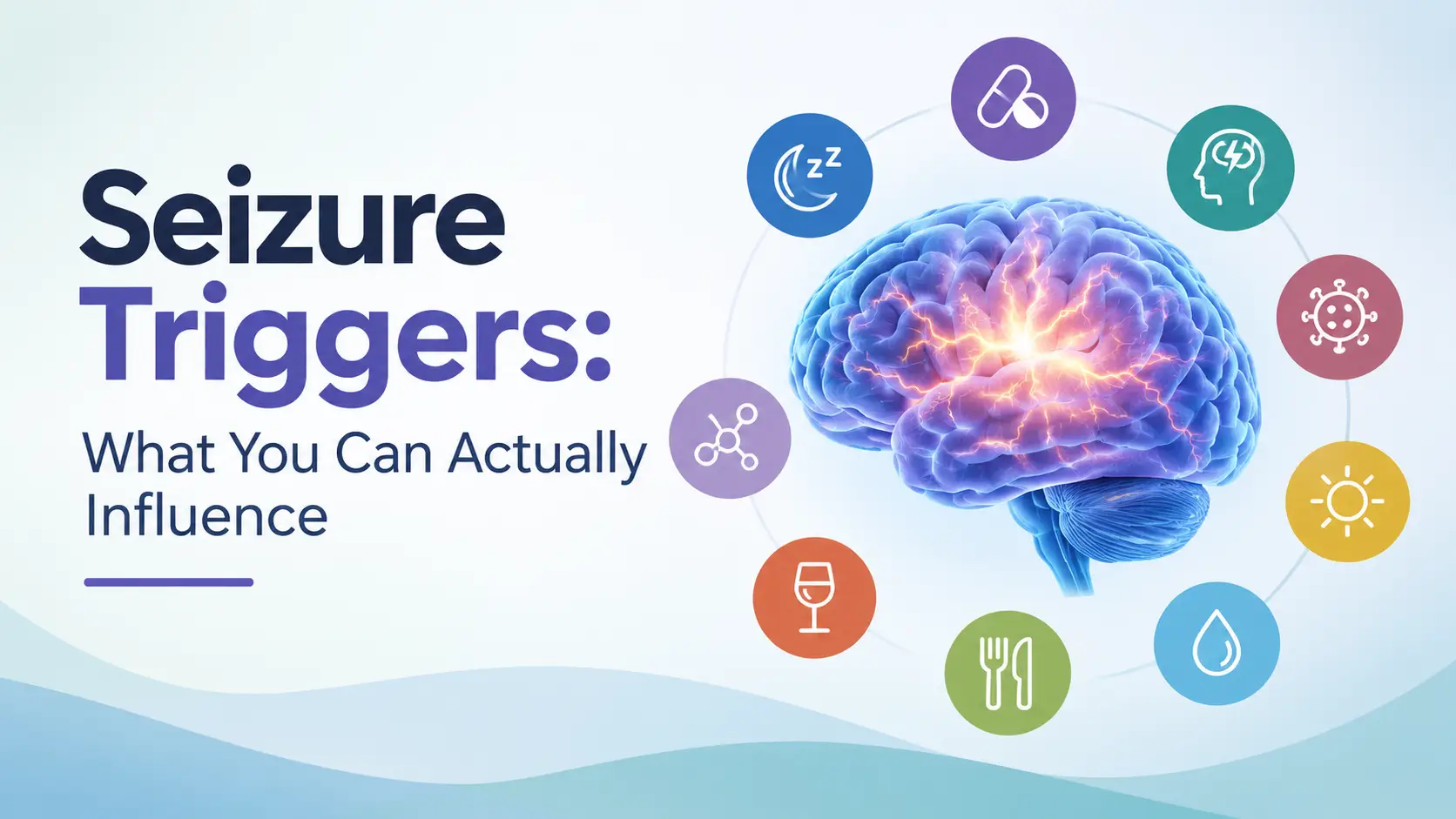
The commonly identified triggers are:
- Missed medication — as above, the big one.
- Sleep deprivation — being overtired, not sleeping enough, or sleeping badly.
- Stress.
- Infection or illness.
- Hormonal changes — puberty, menstruation, menopause.
- Dehydration.
- Low blood sugar.
- Alcohol or recreational drug use.
- Certain other medications.
- Bright, flashing or flickering lights — which affects some people and not others.
Look at that list again and notice how many are things you have some influence over. That is the genuinely encouraging part — and it is where a clinic like ours can be useful.
Sleep, because it sits second for a reason
Of everything you can influence without a prescription, this is the biggest, and it is also the one most often left to chance.
Most of what helps is environmental rather than a matter of willpower: a cool room at around 65 to 68°F, properly dark — most bedrooms are not, and a sleep mask settles it in one night — with air actually moving, lights down an hour before bed, and the same wind-down in the same order every night.
Consistency of timing matters as much as duration here. A regular schedule is doing real work, not just making you feel organised. The full environmental build is in the best sleep environment, with the practical seven-night version at BodyCharger.
Stress, and the capacity to come back down
Stress appears on every trigger list, and “reduce your stress” is famously useless advice on its own.
The version that is actually actionable is about building the capacity to settle. Your nervous system has an alert side and a calming side, and what you want is both working well — able to rev up when life demands it and able to come all the way back down afterwards. That second part is a trainable capacity rather than a personality trait.
The practical core is small: cover the eyes, control the sound, and breathe with the out-breath longer than the in-breath for a couple of minutes. More in how to get out of fight-or-flight and how to relax when your mind will not switch off.
Keep a seizure diary — it is the highest-value thing you can do
If you take one practical action from this page besides the medication point, make it this.
Record when seizures happen — time of day or night, what you were doing beforehand, and how you were feeling. Patterns that are invisible in memory become obvious on paper over a few months.
Then bring it to your neurologist. A diary turns “I think stress might set them off” into something a clinician can actually work with, and it is the difference between guessing at your triggers and knowing them. Note sleep, missed doses, illness and alcohol alongside the seizures themselves — the useful pattern is often in the days before, not the hour before.
Seizure first aid: please read this part even if you do not have epilepsy
This is the most useful thing on this page for the general reader, and most people get at least one step wrong.
The CDC’s seizure first aid is:
- Stay calm, and keep others calm. Stay with the person.
- Move objects that could cause injury.
- Check for a medical bracelet.
- If they are lying down, gently roll them onto their side to keep the airway clear.
- Time the seizure.
- Afterwards, help them sit somewhere safe to recover, and once they are alert, reassure them and explain what happened.
- Offer to have someone help them get home safely.
For a generalised seizure, also ease them to the ground if they are falling, clear the area, put something soft and flat under the head, remove glasses, and loosen anything tight around the neck.
What not to do
- Do not hold them down or try to stop their movements.
- Do not put anything in their mouth. This is the most common mistake and it causes injuries.
- Do not give mouth-to-mouth during the seizure — breathing usually resumes on its own.
- Do not offer food or water until they are fully alert.
When to call 911
The CDC says call if: the seizure lasts longer than five minutes; another follows soon after; they have trouble breathing or do not wake up; they are injured; it happens in water; it is their first known seizure; they have diabetes and lose consciousness; or they are pregnant.
Worth knowing before you need it.
Where we fit, and what we do not do
Plainly, because this matters more than anywhere else on our site.
- We do not diagnose or treat epilepsy. That is neurology, and it works — seven in ten, per WHO.
- We never advise anyone to stop, reduce or change anti-seizure medication. Not for any reason, ever. That conversation belongs with your neurologist.
- We do not offer an alternative theory of what causes seizures. Anyone who does should be treated with real caution.
- We do not ask you to choose. Keep every appointment you have.
What we can help with is the modifiable end of the trigger list — sleep, stress load, and the general condition you are in — alongside your neurologist and in communication with them if you would like that. We would always rather be the third voice in agreement than the second opinion in competition.
If you want nerve function measured rather than estimated, that is our 88-nerve assessment — and to be exact about it, that is an assessment of nerve function, not a test for epilepsy or an explanation of it. More on how we think about the nervous system generally is in how the brain controls the body and ADHD and the nervous system, which takes a similar approach.
Frequently asked questions
What are the most common seizure triggers?
Missed medication sits at the top of the list, followed by sleep deprivation, stress, infection or illness, hormonal changes, dehydration, low blood sugar, alcohol or recreational drugs, certain other medications, and bright or flashing lights. Triggers vary a great deal between individuals, and some people have none.
Can epilepsy be controlled?
For most people, yes. WHO states that up to 70% of people living with epilepsy could become seizure free with appropriate use of anti-seizure medicines. The gap between that figure and reality is largely an access problem, particularly in low-income countries.
Should I stop my medication if I have been seizure free for a long time?
Never change anti-seizure medication without your neurologist. A long seizure-free run is the treatment working rather than evidence it is no longer needed, and missed doses are the most common trigger there is. If anything about the medication is difficult, tell the team treating you — that is a solvable conversation.
How do I find out what my triggers are?
Keep a seizure diary: when seizures happen, what you were doing beforehand, how you were feeling, plus sleep, missed doses, illness and alcohol. Patterns invisible in memory become clear on paper over a few months. Bring it to your neurologist — it turns a hunch into something clinically useful.
What should I do if someone has a seizure?
Stay with them, move dangerous objects, roll them onto their side if they are lying down, put something soft under the head, and time it. Do not hold them down or put anything in their mouth. Call 911 if it lasts over five minutes, another follows, they do not wake up, they are injured, it is in water, it is a first seizure, or they are pregnant.
Do you treat epilepsy at the Nerve Health Institute?
No. We do not diagnose or treat it, and we never advise changing anti-seizure medication. Where we can help is the modifiable part of the trigger list — sleep and stress load in particular — alongside your neurologist.
If you want help with the modifiable part
Sleep and stress are not small levers, and they are two of the few on the list you can genuinely work on. If you would like help doing that properly alongside your existing care, we are glad to.
See what we work with on our conditions page, or get in touch.
Dr. Chris Cormier, DC
The Nerve Health Institute — Lafayette, Louisiana
At-home protocols at bodycharger.com. Circulation and oxygenation at ebooprime.com. More on how I practise at drchriscormier.com.
Spark your cells to optimal longevity.