By Dr. Chris Cormier, DC — The Nerve Health Institute, Lafayette, Louisiana
I am in my fifties, so I have a personal interest in this one.
Of everything that changes in a body after 50, muscle loss after 50 is the part people are most resigned about — and the part that responds best to being worked on. The decline is real. Its steepness is not fixed — one review described the slope of that decline as among the most modifiable numbers in all of preventive medicine, which is an unusually optimistic sentence for a research paper.
It is also, and this is the part almost nobody is told, substantially a nervous system story. Which is why a nerve clinic has something useful to say about it.
What muscle loss after 50 actually looks like
The broad picture is well established. Adults who do not train lose roughly 3 to 8% of muscle mass per decade from around their thirties, and the rate picks up with age. After 50, estimates put mass decline at somewhere around 0.5 to 1% a year.
That is slow enough that almost nobody notices it happening, because ordinary daily life rarely asks for maximum strength. You do not feel a 1% change. You feel the fifteenth one — usually as a stair that has become a decision, or a suitcase into an overhead locker that used to be nothing.
The detail that matters more: strength goes faster than size
This is the finding I would most like people over 50 to know, and it is rarely mentioned outside the research.
Muscle strength declines considerably faster than muscle size. Studies measuring both in the same people report strength falling two to five times faster than mass — roughly 1.5 to 3% a year after 50, against 0.5 to 1% for mass. Power, meaning how quickly you can produce force, declines faster still.
Which means the mirror is the wrong instrument. Somebody can look much as they always did and have lost a great deal of what they could do.
And loss of strength is a more consistent predictor of disability, hospitalisation and mortality than loss of muscle size. The number that matters is not how much muscle you have. It is what it will do when you ask it.
Why muscle loss after 50 is a wiring problem
Here is the part that makes this our territory rather than simply a fitness topic.
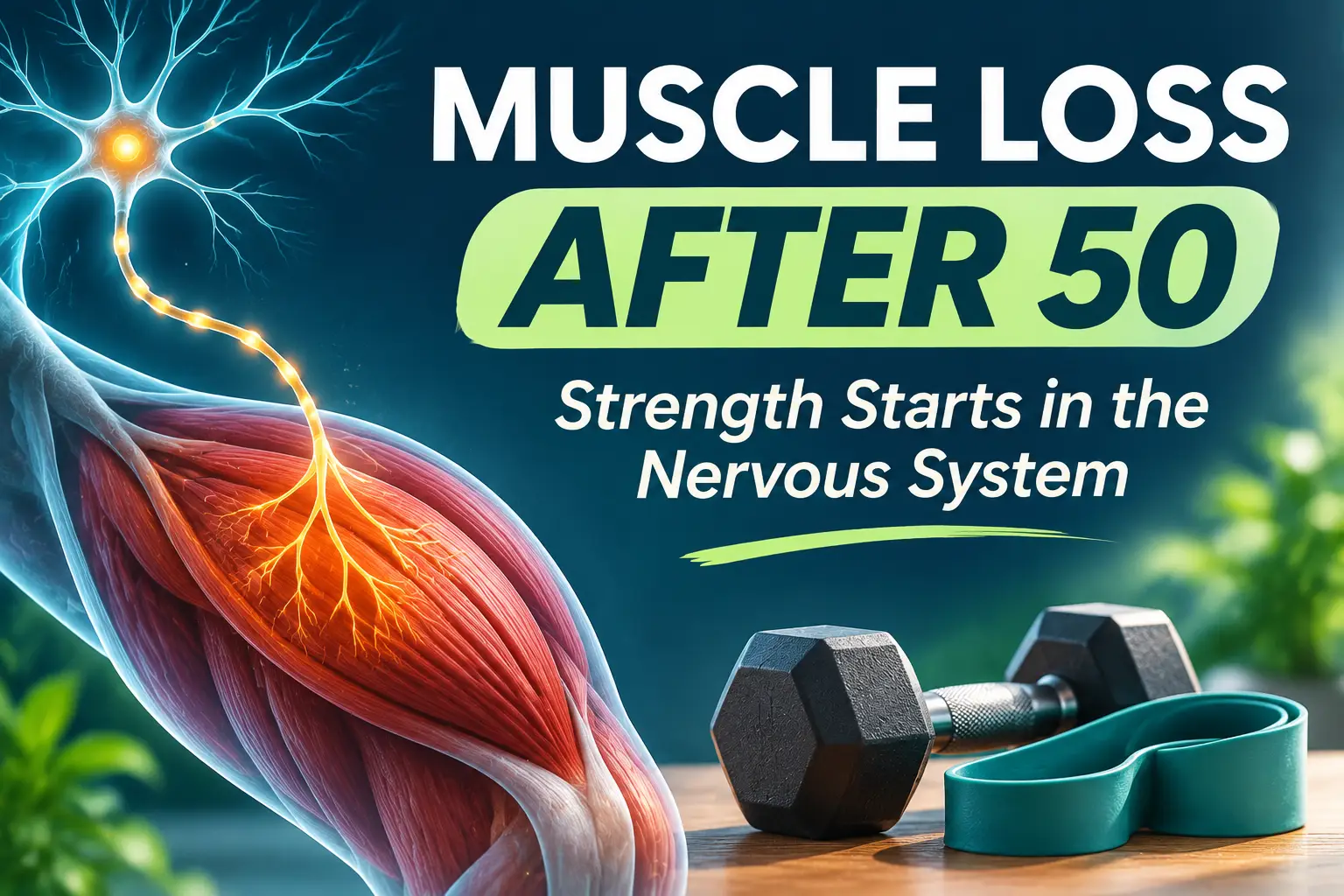
Muscle is organised into motor units — a single nerve cell and all the muscle fibres it commands. The nerve tells the fibres what to do. With age, motor units are progressively lost, and fibres that have lost their nerve supply either get adopted by a neighbouring unit or waste away.
That is why strength and power fall faster than size. A fibre that is still present but poorly commanded still shows up on a scan. It simply does not contribute when you need it. Muscle loss after 50 begins in the nervous system long before anything is visible in the mirror — it is, as one review puts it plainly, not really a muscle problem but a wiring problem.
That reframing changes what is worth paying attention to. Delivery and signalling are two different things, and attending to one without the other gets you about half the result — a theme we return to constantly, and which is covered in how the brain controls the body.
Why that is genuinely good news
Because the nervous system adapts quickly.
Anyone who has started strength work knows that the first few weeks produce gains out of all proportion to any visible change. That early progress is largely neural — better recruitment, better coordination, better signalling to muscle that was already there. The tissue catches up later.
So the first thing to come back is the thing that was lost first, and it comes back faster than it went. For somebody in their fifties who has not trained in twenty years, meaningful improvement is a matter of weeks rather than years. BodyCharger has written on realistic expectations in how long does it take to feel healthier.
What muscle is actually protecting
It is worth being clear that none of this is about appearance.
- Balance and falls. Power — the ability to produce force quickly — is what catches you when you stumble, and it is the first thing to go.
- Independence. Getting out of a chair unaided, carrying shopping, managing stairs. These are strength tasks, and they are the ones that decide how later decades go.
- Metabolic health. Muscle is where most glucose is taken up. Protecting it is cardiovascular and metabolic care under another name.
- Bone. Loaded muscle pulls on bone, which is how bone is signalled to stay dense.
- Recovery. Muscle is the body’s protein reserve. People with more of it come through illness, surgery and hospital stays better — see recovering from a long illness.
One more worth knowing, because it is topical: weight loss without resistance work can mean a quarter or more of what is lost is muscle. If you are losing weight by any method, this is the moment strength work matters most, not least.
What actually reverses muscle loss after 50
Resistance work, two or three times a week
Non-consecutive days, working the major muscle groups, with the load increasing gradually over time. The progression is the active ingredient — muscle adapts to a demand slightly greater than the one it is used to, and stops adapting when the demand stops rising.
It does not need to be a gym. Bands, bodyweight, a pair of dumbbells and a chair will do a great deal. What it does need is to get harder.
Something quick, as well as something heavy
Since power declines faster than strength and predicts falls particularly well, it is worth including movements performed briskly — standing up from a chair at speed, for instance. Trained deliberately, under supervision at first, this is one of the highest-value things an older adult can do.
Enough protein, spread across the day
Older bodies respond less efficiently to protein than younger ones, so the standard adult allowance of 0.8 g per kilogram of body weight is widely considered too low after 65. Expert groups generally suggest at least 1.0 to 1.2 g per kilogram per day, and trials pairing resistance training with higher intakes have found better results than training alone.
Spreading it across three or four meals works better than one large serving. And there is an encouraging finding here: older adults who do resistance training respond to protein much as younger adults do. Training appears to restore the sensitivity that inactivity costs.
Please check protein targets with your doctor before changing your diet, particularly if you have any kidney condition, where protein intake needs to be individually set. And have a word before starting resistance training if you have a heart or circulatory condition, uncontrolled blood pressure, or have been largely inactive for a long period. In nearly every case the answer is yes, with guidance on how to begin.
It works at any age
This is the finding that should be better known than it is.
Resistance training has been shown to slow and in many cases reverse muscle loss in people in their eighties and nineties. Muscle remains adaptable throughout life. There is no age at which the tissue stops responding to being asked for something.
So the common view that it is too late to start is simply not supported. The best time was twenty years ago. The second best is this month, and the gap between those two is much smaller than people assume.
Where we come in
For most people reading this, the answer is straightforward: start resistance training, eat enough protein, and keep at it. You do not need a clinic for that, and we would rather say so.
Where we are useful is more specific.
Some people cannot start conventionally. Pain, a previous injury, deconditioning after illness, balance that does not feel reliable — and the deeper that goes, the harder it becomes to do the very thing that would improve it. That loop is the problem worth catching early, and it is where an assessment earns its keep.
Our 88-nerve assessment maps how signalling is functioning across the body, which is directly relevant when the limiting factor is recruitment rather than tissue. Quantum Neurology addresses what the assessment finds. Alongside that, our oxygen work — exercise with oxygen therapy and intermittent hypoxic-hyperoxic training — lets people work at a useful intensity when conventional exercise is not yet available to them. EBOO Prime has written honestly on what oxygen can and cannot do for performance at does oxygen improve athletic performance.
None of that replaces strength work. It is how we get people to the point where strength work is possible, which for a certain group is the whole battle.
Sleep, stress and the rest of it
Muscle is built during recovery rather than during the session, so the conditions for recovery matter as much as the training.
Deep sleep is when the largest release of growth hormone occurs, and that pulse drives tissue repair — our guide to bedroom setup is the practical version. Sustained stress works against the same processes; see the physical signs of stress. And if you are unsure how to pitch effort, BodyCharger’s how hard should I be exercising is a sensible starting point.
If your parents had this too
A great many people over 50 have already decided how this goes, because they watched it happen to somebody.
Family history is real information and worth telling your doctor. But a parent’s decline reflects their genes and their activity, their era, their diet and what was understood at the time. Deciding in advance that you will get your mother’s knees tends to produce exactly the reduction in movement that makes it likelier. Dr. Cormier has written about that pattern in my mother had it too.
What to do this week
- Find your baseline. Time how long it takes to stand up from a dining chair five times without using your hands. Write it down. That one number tracks the thing that matters.
- Pick two days. Put them in the diary like appointments, not intentions.
- Start lighter than you think. The first job is turning up. Load comes later and it comes quickly.
- Add protein to breakfast. For most people it is the meal with least, and spreading intake works better than one large serving.
- Book the conversation if anything above gave you pause.
Frequently asked questions
How much muscle do you lose after 50?
Adults who do not strength train lose roughly 3 to 8% of muscle mass per decade, which after 50 works out at around 0.5 to 1% a year. Strength declines considerably faster — typically 1.5 to 3% a year.
Why does strength decline faster than muscle size?
Because age-related decline begins in the nervous system. Muscle works in motor units — a nerve and the fibres it commands — and motor units are progressively lost with age. A fibre that is still present but poorly commanded shows on a scan but does not contribute when you need it.
Is it too late to build muscle after 50?
No. Resistance training has been shown to slow and often reverse age-related muscle changes in people in their eighties and nineties. Muscle remains adaptable throughout life.
How often should I strength train after 50?
Two to three non-consecutive days a week, working the major muscle groups, with the load increasing gradually. The progression is what produces the adaptation.
How much protein do I need after 50?
Expert groups generally suggest at least 1.0 to 1.2 g per kilogram of body weight daily for older adults — more than the standard 0.8 g — spread across meals. Check with your doctor first, particularly if you have any kidney condition.
What if I cannot exercise because of pain or deconditioning?
That is exactly the loop worth interrupting early, and it is what an assessment is for. There are usually ways to work at a useful level while the limiting factor is addressed.
The short version
So: muscle loss after 50 is real, it is measurable, and its steepness is largely up to you. Strength goes before size, the process starts in the nerves, and the nerves respond quickly — which is why the first weeks of doing something about it feel better than they have any right to.
Two days a week. Enough protein. Something that gets gradually harder. And it is not too late, at any age anybody reading this is likely to be.
If you are in Lafayette or nearby and are not sure where to start — or the starting is the part that is difficult — see our conditions page or get in touch. For at-home structure, the 28-Day Cell Sparking Challenge at BodyCharger is built for exactly that, and how to tell whether you are actually healthy is a good place to take stock first.
Dr. Chris Cormier, DC
The Nerve Health Institute — Lafayette, Louisiana
Clinic care at nervehealth.com. At-home protocols at bodycharger.com. Circulation and oxygenation at ebooprime.com. Essays at drchriscormier.com.
Spark your cells to optimal longevity.