By Dr. Chris Cormier, DC — The Nerve Health Institute
April 17th is World Hemophilia Day, and the honest way to mark it is to lead with the genuinely remarkable news, because there is some.
Until the 1960s, median life expectancy for someone with severe hemophilia was around thirty years. Today, with modern treatment, a person with hemophilia can expect a virtually normal life expectancy and quality of life. That is one of the clearer success stories in modern medicine, and it was achieved by hematology rather than by anything else.
What has not been entirely solved is joints. That is where this page concentrates, because hemophilia joint health is the area where day-to-day supportive care genuinely has something to contribute alongside specialist treatment.
What hemophilia is, plainly
Hemophilia is an inherited bleeding disorder. People with it do not produce enough of one of the proteins the blood needs in order to clot — factor VIII in hemophilia A, factor IX in hemophilia B. It affects more than a million people worldwide.
It is graded by how much clotting factor is present. Severe hemophilia means less than one per cent of normal factor activity, moderate is one to five per cent, and mild is five to forty per cent. That grading matters because it shapes both the bleeding pattern and the treatment plan.
It is caused by a change in a specific gene. We want to be direct about that on a clinic website, because it determines what can honestly be offered to anybody living with it, and we would rather be clear than encouraging.
Hemophilia is a genetic condition. It is managed with specialist hematology care, and clotting factor replacement and related therapies are the treatment. Nothing on this page, and nothing offered by this clinic, changes the underlying condition or substitutes for that treatment in any way. If you or your child has hemophilia, your hemophilia treatment centre is the most important relationship you have.
Why the outlook has changed so much
The transformation came from preventing bleeds rather than only treating them once they happen.
- Prophylaxis — giving clotting factor on a schedule to keep levels up, rather than only after a bleed starts. This is the change that did most of the work.
- Extended half-life factor products, which stay active longer and so allow less frequent infusions and more flexible, individualised schedules.
- Non-factor therapies given by subcutaneous injection, which have improved both protection and how manageable treatment is day to day.
- Gene therapy, now approved for some patients, offering the possibility of extended protection after a single treatment — currently available to a small number of people and an active area of development.
Alongside better life expectancy, the research describes substantially improved quality of life and participation — in sport, work and school. The modern aim is explicitly for people with hemophilia to live alongside everybody else rather than around the condition.
It is worth adding, because it is true and it is why awareness days exist, that in places where access to these medicines is limited, preventable bleeding and permanent joint damage are still common. The science is solved considerably further than the distribution is.
Why joints are the part that lingers
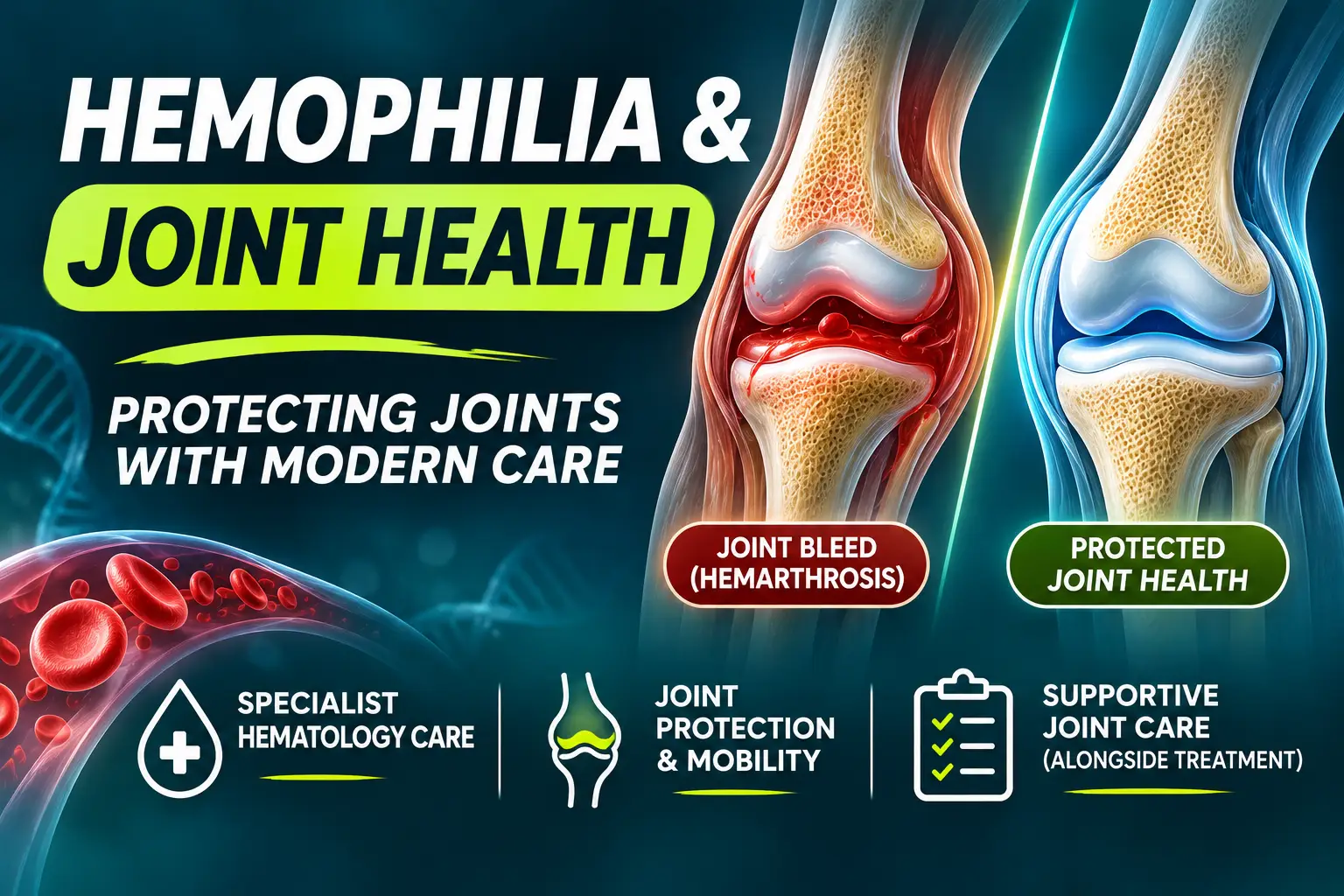
Bleeding into a joint is called hemarthrosis, and in hemophilia it can follow minor trauma or occur with no apparent cause at all. Knees, ankles and elbows are the usual sites.
A joint has limited capacity to repair itself at the best of times, and repeated bleeding into the same joint overwhelms it. Blood in the joint space drives inflammation, the lining thickens, cartilage is damaged, and over time this produces hemophilic arthropathy — a progressive and genuinely disabling joint condition that brings pain, stiffness and lost range of movement.
Three things about hemophilia joint health are worth knowing, because none of them is obvious:
- Some joint bleeding is subclinical. It happens without being noticed, and that unrecognised bleeding is thought to contribute to joint damage over time.
- Mild and moderate hemophilia are not exempt. People with higher factor levels bleed less often, but a meaningful proportion still experience bleeds and can develop joint damage.
- Once joint damage is established, it can progress even when further bleeds are well controlled.
Which is why the single most protective thing for hemophilia joint health is early, sustained prophylaxis — preventing the bleeds in the first place. Everything else, including everything we do, sits downstream of that.
Signs worth taking to a doctor
Awareness is the part of this where a page like ours can be most useful, because a number of people reach adulthood without a diagnosis, and mild hemophilia in particular can go unrecognised until surgery or a significant injury.
- Bruising that is unusually large, appears easily, or takes a very long time to fade.
- Bleeding that continues for longer than expected after a cut, a dental procedure or an injury.
- A joint that becomes swollen, warm, tight or painful without a clear reason, or that a child begins to protect or stop using.
- Nosebleeds that are frequent or hard to stop, or heavy menstrual bleeding.
- A family history of a bleeding disorder, which is worth mentioning to a doctor even in the absence of symptoms.
People often normalise these things — bruising easily becomes “just how I am” rather than a question worth asking. Diagnosis is straightforward: a doctor orders blood tests that measure clotting and factor levels. It is not something to work out from a website, including this one.
What we do, and what we do not
We would rather set this out plainly than leave it to be inferred.
The Nerve Health Institute is not a hemophilia treatment centre. We do not diagnose hemophilia, we do not treat it, and we do not offer anything that alters a genetic condition or reduces anybody’s need for clotting factor. Any suggestion that supportive care could take the place of that would be both wrong and dangerous, and we will not make it.
If you have hemophilia, your hematology team is the treatment. Everything else, ours included, is support around the edges of a life — which is worth having, and is not the same thing.
What we work with sits alongside that: the musculoskeletal and nervous system side of living with a long-term condition, and hemophilia joint health in particular: joints that have been through a lot, movement that has become guarded, sleep that is disrupted by pain, and the accumulated load of managing something for years. That is a real area and we are glad to work in it. It is a different claim from the one some clinics in our field make, and the difference matters.
Where supportive care genuinely helps
Always in coordination with the hemophilia team, and never as a substitute for a treatment plan.
Movement, with specialist guidance
Physical activity has moved from being discouraged to being actively recommended in modern hemophilia care, because strong muscle support around a joint protects it. Which activities, and at what intensity, is a question for a physiotherapist who works with bleeding disorders — that specificity is the whole point, and it is why we would not hand out a generic programme. Our page on muscle loss after 50 covers why muscle support around joints matters more with age.
Sleep
Repair happens during sleep, and chronic joint pain is one of the more reliable ways to lose it. Protecting sleep is one of the few things entirely within reach at home. Our guide to the best sleep environment covers the room, and Body Charger’s how to sleep better naturally covers the routine.
Stress load and recovery
Living with a bleeding disorder carries a continuous management burden that rarely gets named, and it is worth addressing on its own terms. How to get out of fight or flight sets out the practical version.
Understanding inflammation
Joint damage in hemophilia involves inflammation that does not resolve. Our colleagues at EBOO Prime wrote about why resolution is an active process rather than something that simply switches off in chronic inflammation — useful background, not a treatment.
For parents
If your child has been diagnosed, the most useful thing we can say is that the modern approach is not about wrapping them in cotton wool.
Children on prophylaxis today participate in school, in activity and in a great deal of sport, with guidance about which activities suit them. That guidance comes from the hemophilia treatment centre and it is specific to your child’s factor levels, joint history and age. A blanket “no” is no longer the standard advice, and nor is a blanket yes.
The practical things that help: know the early signs of a joint bleed, agree a plan with the school, keep the treatment centre’s contact details somewhere everybody can find them, and ask about a physiotherapist who works with bleeding disorders. Body Charger wrote about managing the long haul of a condition at home in how to recover from a long illness.
And ask your questions at appointments, including the ones that feel too small to mention. Dr. Cormier wrote about how often the most useful detail arrives at the very end of a consultation in the thing people tell me last.
The royal disease
Hemophilia acquired its nickname through Queen Victoria, who carried the gene for hemophilia B and passed it into several European royal houses through her daughters. It appeared in the Spanish, German and Russian royal families, and the best-known case is the Tsarevich Alexei of Russia.
It is a genuinely interesting piece of medical history, and it illustrates something the science has since made precise: hemophilia follows an inherited pattern through families. The history is also a reminder of how much has changed — within living memory this was a condition with a short life expectancy, and it is now one where a normal lifespan is the expectation.
Frequently asked questions
Can hemophilia be cured or reversed?
Hemophilia is caused by a genetic change and is not reversible through diet, lifestyle, supplements or any form of manual or alternative therapy. Gene therapy, approved for some patients, is the only approach that addresses the underlying genetics, and it is a specialist medical treatment delivered through hematology services. Be cautious of anyone suggesting otherwise.
What causes joint damage in hemophilia?
Repeated bleeding into a joint. Blood in the joint space drives inflammation and damages cartilage, producing hemophilic arthropathy over time. Some of this bleeding goes unnoticed, and joint damage can progress even when later bleeds are well controlled, which is why early prophylaxis matters so much.
Should people with hemophilia exercise?
Generally yes, and modern care encourages it, because strong muscles support and protect joints. The important part is which activities and how much, which should be set with a physiotherapist experienced in bleeding disorders and your hemophilia treatment centre.
What are the early signs of hemophilia?
Unusually easy or large bruising, bleeding that lasts longer than expected after cuts or dental work, joints that swell or become painful without clear cause, frequent nosebleeds, heavy menstrual bleeding, and a family history of bleeding problems. Diagnosis is made by blood tests through a doctor.
Does mild hemophilia still affect joints?
It can. People with mild or moderate hemophilia bleed less often than those with severe disease, but a meaningful proportion still experience bleeds and can develop joint damage, so hemophilia joint health is worth attention across all severities.
Where to start
If you suspect a bleeding disorder in yourself or your child, the first step is your doctor and a blood test — not us, and we would rather say so clearly on a day dedicated to awareness.
If you are already under a hemophilia team and want support with joints, movement, sleep or the general load of managing a long-term condition, that is work we are glad to do alongside them. Contact The Nerve Health Institute to talk it through, or see our conditions page for the range of what we work with.
Spark your cells to optimal longevity.
— Dr. Chris Cormier, DC
The Nerve Health Institute, Lafayette, Louisiana