By Dr. Chris Cormier, DC — The Nerve Health Institute, Lafayette, Louisiana
In nearly three decades of practice, I have heard the word lazy used about ADHD many times. Almost never by a teacher, and only occasionally by a parent.
Overwhelmingly, it is used by the person themselves.
They arrive having already reached a verdict, usually years earlier, and the verdict is that they are the problem. They sat through enough reports saying “could do better if he applied himself” to accept it as a description of their character. Adults diagnosed in their forties often describe the diagnosis as the first time anybody offered them an alternative explanation.
So this page is about evidence rather than encouragement. ADHD is not laziness, and the reason is not that it would be unkind to say so. The reason is that brain imaging, developmental research and decades of executive function studies all describe something quite different from a person choosing not to try.
What the brain scans actually showed
The clearest single piece of evidence came from a study at the National Institute of Mental Health, published in 2007. Researchers analysed 824 MRI scans from 223 children with ADHD and 223 children without, tracking them repeatedly over several years rather than taking a single snapshot.
They measured when each part of the cortex reached its peak thickness, which is a recognised marker of brain maturation.
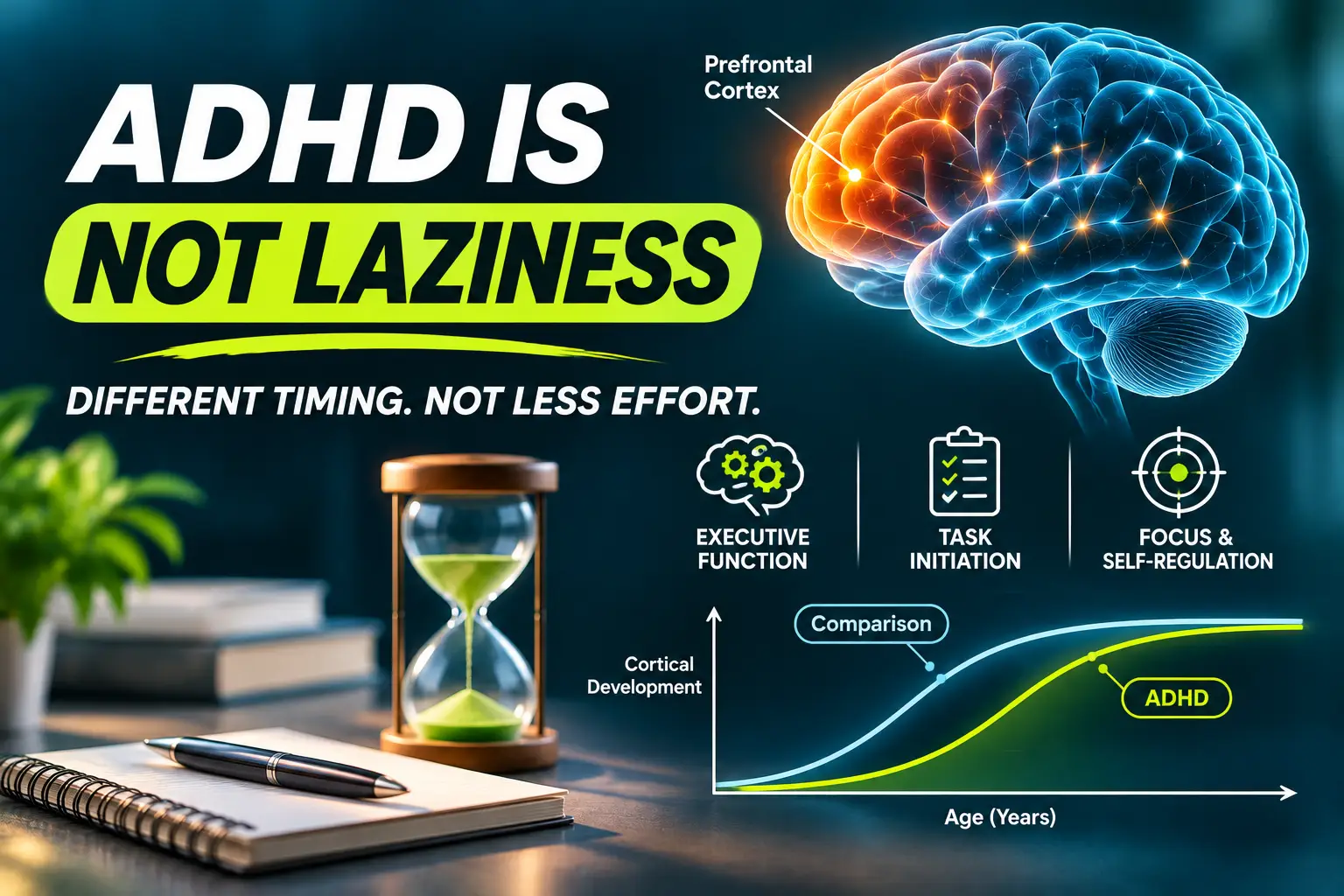
The median age at which half of cortical points reached peak thickness was around seven and a half years in the children without ADHD, and around ten and a half years in the children with it. A delay of roughly three years. Across regions, the delay ran at about two to three years depending on the area.
And the delay was most pronounced in the lateral prefrontal cortex — the region responsible for suppressing inappropriate responses, holding a plan in mind, and exercising exactly the kind of control that the word lazy is usually reaching for.
Delay, not deviance
The finding that matters most is not the number of years. It is the word the researchers used.
They described ADHD as characterised by delay rather than deviance in cortical maturation. The developmental curves in almost every cortical region ran lower than the comparison group but still ran parallel to them. Same sequence, same pattern, different timetable.
The brain was not following a broken path. It was following the ordinary path, later.
That distinction is worth sitting with, particularly for a parent. It also explains something families notice and struggle to articulate: a child who is plainly bright, plainly capable, and plainly unable to do the thing being asked at the moment it is being asked.
One researcher put it as asking a ten-year-old to do the executive work of a thirteen-year-old. That is not a child refusing. That is a demand arriving before the machinery for it has finished arriving.
This is the clearest reason ADHD is not laziness in any sense the word is normally used. A timetable is not a temperament.
What executive function actually means
Executive function is an umbrella term, and it covers more than most people assume. It includes planning, working memory, attention, inhibition, self-monitoring, self-regulation and task initiation.
Task initiation is the one worth highlighting, because it is the one most often mistaken for a character flaw. The gap between knowing you need to start and being able to start is not a gap in willingness. It is a distinct cognitive function, and it can be weak while every other faculty a person has is perfectly intact.
A large meta-analysis published in 2024 found executive function delay to be a feature running across neurodevelopmental conditions generally, with a moderate effect size of around 0.56 compared with control groups. This is a measurable, replicated, well-described difference — not a figure of speech.
If you would like the wider picture of how the brain governs the rest of the body, we cover it in how the brain controls the body, and the ADHD-specific version in ADHD and the nervous system.
Why “just try harder” is the wrong instruction
I use an analogy in clinic that patients tend to remember, so I will use it here.
Imagine somebody who has never lifted a weight in their life. You hand them an eighty-pound dumbbell and ask for ten repetitions. They will fail. Not because they are not trying — they may be trying far harder than the person next to them who manages it easily. The demand simply exceeds the current capacity, and no amount of exhortation changes that.
Now tell somebody who cannot sustain attention that they must read a chapter in twenty minutes. It is the same request. And when they cannot, the thing they learn is not how to concentrate. The thing they learn is that they are the sort of person who fails at this.
Saying ADHD is not laziness is not an argument for expecting less of anybody. It is an argument for sizing the request correctly, which is a different thing and usually produces more, not less.
Scale the demand and the picture changes immediately. Three focused blocks of seven minutes is a different task from one block of twenty, even though the arithmetic is almost identical. The capacity is trainable and the demand is adjustable, and progress generally comes from moving both.
Why effort is the wrong thing to measure
Here is the part that tends to land hardest with adults who have spent years assuming the worst about themselves.
People with ADHD do not expend less mental energy than everybody else. Research on error monitoring suggests they expend significantly more — more effort spent noticing and correcting mistakes, for an outcome that often looks the same or worse from the outside.
So the common experience of working twice as hard for half the result is not a self-pitying story people tell themselves. It is a reasonable description of what the measurements show. If you only remember one line from this page, let it be that one: ADHD is not laziness, and the effort was never the thing that was missing.
The other half of the picture concerns how tasks get started at all. Sustained effort on dull, slow-payoff work depends on the brain generating a reliable sense that the reward is coming. Current models propose that in ADHD the anticipatory signalling behind that sense is less reliable, which would make effort harder to maintain when nothing immediate is arriving. These are models rather than settled facts, and I would not present them as more certain than they are. What is clear and well-replicated is the pattern they are trying to explain: performance improves markedly when a task is novel, interesting, urgent or immediately rewarding, and collapses when it is none of those.
Which is why the same person can concentrate for six hours on something that grips them and cannot manage six minutes on a form. That is not inconsistency of character. It is the system behaving exactly as described.
Why people are exhausted even when things look fine
This is the question I am asked most often by adults, and it rarely appears in anything written for families.
Somebody whose symptoms look well managed from the outside is frequently running an enormous amount of compensation underneath: the lists, the alarms, the rehearsed sentences, the double-checking, the constant low-level monitoring of whether they have missed something. All of that works. All of it costs.
It is also where the misunderstanding does the most damage, because this is the point at which an exhausted person is most likely to be called unmotivated. ADHD is not laziness at the best of times, and it is furthest from laziness in somebody who has been compensating all morning.
The result is a person who appears to be coping and is quietly shattered by early afternoon — and who, because the coping is invisible and the fatigue is not, often gets described as unmotivated at precisely the point where they have been working hardest.
Sustained stress makes everything on this page harder, and that is one area where there is genuinely useful work to do. We cover it in how to get out of fight or flight and the physical signs of stress.
Why correction lands so heavily
A child with ADHD receives an extraordinary volume of corrective feedback. Sit still. Pay attention. You are not listening. Why haven’t you started. Most of it is well intentioned and a good deal of it is necessary.
The cumulative effect is not neutral. By adolescence many have constructed a fairly settled account of themselves as the difficult one, and that account tends to outlive the symptoms by decades. It is why a forty-year-old with a new diagnosis so often cries in the appointment — not about the diagnosis, but about the twenty-five years of explanation they did not have.
Dr. Cormier has written about the broader version of this, the way people apologise for the fact of being unwell, in the patient who apologised for being ill.
What actually helps
Having removed the blame, it would be unhelpful to leave nothing in its place.
A proper assessment
If ADHD has not been formally assessed, that is the first and most useful step by a wide margin, for adults as much as for children. Established treatment for ADHD is among the better-supported interventions in the field, and a person who has spent years assuming they were lazy deserves to know what is actually available to them.
Scaled demands and external structure
Shorter blocks, visible timers, one instruction at a time, written rather than spoken sequences, and immediate feedback rather than delayed. None of this is lowering a standard. It is removing an obstacle that has nothing to do with the standard.
Movement, sleep and the ordinary foundations
Exercise, consistent sleep and stable meals will not treat ADHD and nobody should claim otherwise. They do reliably affect how well anybody’s attention and emotional regulation hold up, and that margin matters more when the margin is already narrow. The practical versions are at how to support your nervous system naturally and the best sleep environment.
Changing the language
The least technical item here and the one with the longest reach. “You are not lazy, this task is badly sized for you, let us resize it” produces a different child, and a different adult, from “you could do better if you applied yourself.”
For parents, our at-home site has a full guide to how to support a child with ADHD at home.
Where this clinic honestly fits
I want to be precise about this, because ADHD is a field where families are often promised a great deal.
The Nerve Health Institute does not treat ADHD, does not cure it and does not reverse it. ADHD is a neurodevelopmental condition, diagnosis belongs with a qualified assessor, and treatment belongs with the clinicians who are trained and licensed to provide it. Anybody who tells you that ADHD can be reversed is making a claim that the evidence does not support, and you are entitled to ask them to show you the evidence.
What we work on is narrower and we are happy to say so plainly: stress physiology, sleep quality, posture, movement and general nervous system support. Those affect how anybody functions, including people with ADHD, and they are worth attending to on their own merits. They are not a substitute for assessment or treatment and should never be sold as one.
One rule that has no exceptions. Nobody outside the prescribing clinician makes decisions about ADHD medication — not a practitioner, not a well-meaning relative, and not us. If any clinic, including this one, suggests you reduce or stop a prescribed medication, that is the moment to stop listening and speak to your prescriber instead.
Frequently asked questions
Is ADHD just an excuse for laziness?
No. ADHD is not laziness, and the distinction is measurable rather than diplomatic. It is a recognised neurodevelopmental condition affecting an estimated three to five per cent of school-aged children, and imaging research shows a measurable delay in the maturation of the brain regions that handle self-control and planning. Laziness is a choice not to try; ADHD describes difficulty converting trying into doing.
Why can someone with ADHD focus for hours on some things?
Because attention in ADHD is strongly driven by interest, novelty, urgency and immediate reward rather than by importance. Engagement is not absent, it is unevenly available — and the unevenness is itself one of the recognised features, not evidence against the condition.
Do children grow out of ADHD?
The brain regions involved do continue to mature, and for some people the picture changes considerably with age, particularly the visible restlessness. Many adults continue to experience the attention and executive side and benefit from support for it. Improvement with time is common; disappearance should not be assumed.
Does ADHD get worse with stress?
Sustained stress makes attention, working memory and emotional regulation harder for everybody, and that effect is more noticeable when those systems are already under strain. Managing stress does not treat ADHD, but it does protect the capacity a person has.
Can you be diagnosed with ADHD as an adult?
Yes, and a great many people are. Adults frequently describe assessment as the first explanation they have been offered that fits, after years of assuming the issue was effort or character.
If you would like to talk
If you have read this far because somebody called you lazy once and it stuck, the useful conclusion is simply that ADHD is not laziness and never was, and that there is a great deal more available to you than you have probably been told.
If you are weighing up assessment, the honest first step is a qualified assessor rather than a clinic like ours, and that is the advice this page ends on.
If you have already been assessed and want support with the stress, sleep and nervous-system side alongside your existing care, we are glad to have a straightforward conversation about whether we can help — including when the answer is that we cannot. You can see the conditions we work with or get in touch. The focus question from the other side is covered at why can’t I focus.
Spark your cells to optimal longevity.
— Dr. Chris Cormier, DCThe Nerve Health Institute, Lafayette, Louisiana