By Dr. Chris Cormier, DC — The Nerve Health Institute, Lafayette, Louisiana
Most oxygen therapies work on one principle: give the body more oxygen and let it do the rest. That principle is sound, and a good deal of what we offer rests on it.
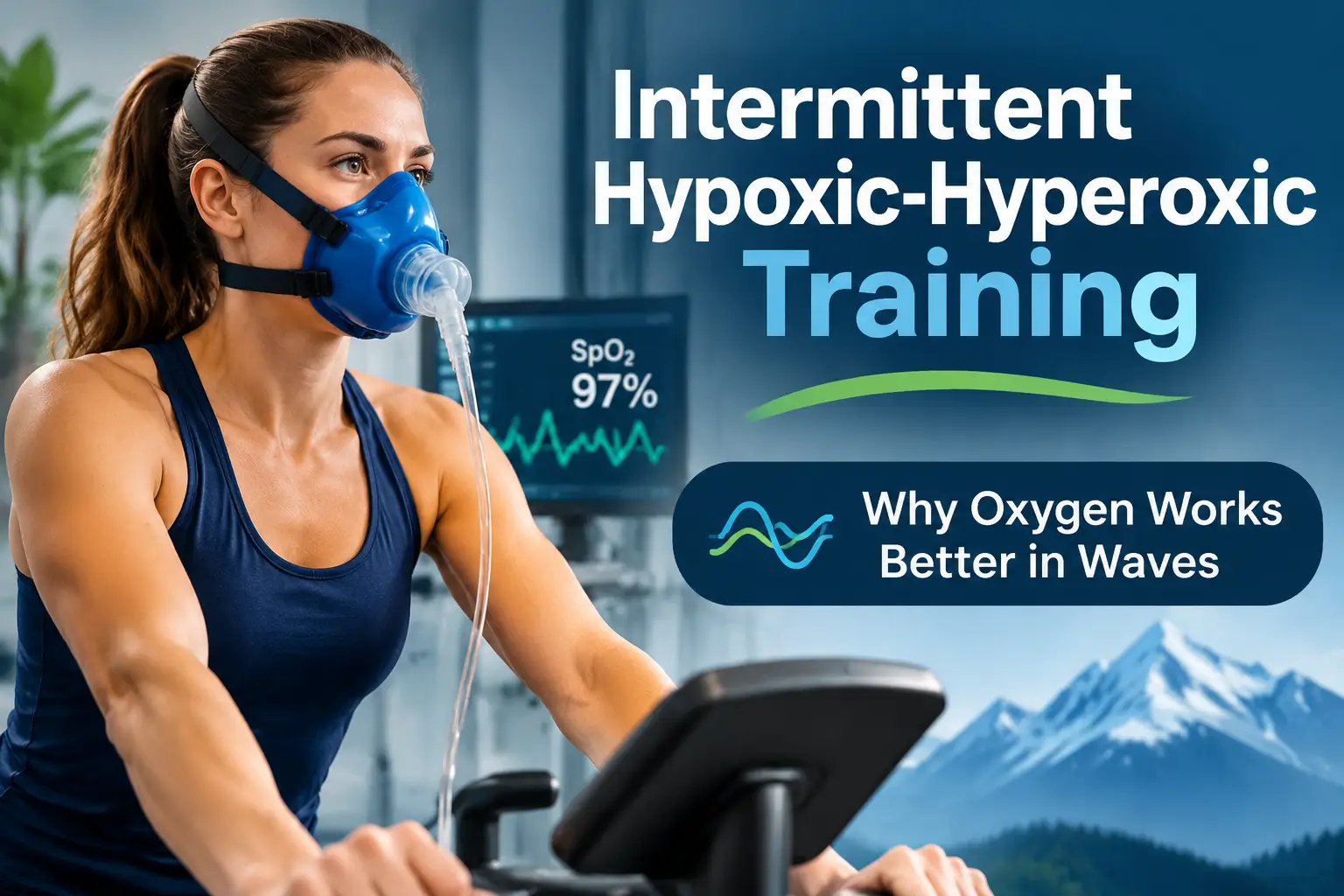
Intermittent hypoxic-hyperoxic training works on a different one. Instead of delivering oxygen steadily, it delivers it in waves — a period of oxygen-rich air, then a short period of oxygen-thin air, then oxygen-rich again, repeated across a session while you are moving. The aim is not simply to top you up. The aim is to make your body better at the job of extracting and using oxygen in the first place.
It is one of the more interesting things we do, and one of the most misunderstood. Here is what it is, who it suits, and how we run it.
What intermittent hypoxic-hyperoxic training actually involves
In the research literature the method is called intermittent hypoxic-hyperoxic training, often shortened to IHHT. Clinically you will also hear contrast oxygen training, or adaptive contrast. Same idea. Three numbers make it clear.
- Ordinary air is about 21% oxygen — the baseline everything else is measured against.
- In the oxygen-rich phase you breathe a much higher concentration through a sealed mask, well above 90%, while exercising at a comfortable pace.
- In the oxygen-thin phase the supply switches to roughly 14% oxygen — broadly what the air feels like at high altitude. The equipment holds both mixtures and switches between them.
Throughout, we monitor blood oxygen saturation with a pulse oximeter on the finger. That reading is the dial we steer by — it is why the session is adjusted to the person in front of us rather than run to a fixed script.
Why contrast, rather than a steady supply
When the oxygen supply thins briefly, the body notices. Blood vessels respond by widening — vasodilation — the circulatory system’s way of improving delivery when delivery looks like it is about to matter. Then the oxygen-rich phase arrives into vessels that have just opened up.
A steady supply asks the body to receive. A changing supply asks the body to adapt. Those are different requests, and they produce different responses.
That adaptive response is the whole point. Systematic reviews of hypoxic conditioning — the broad family this method belongs to — report that structured cycles of lower and higher oxygen are well tolerated and show promise for exercise capacity and cardiometabolic measures, while consistently calling for larger trials to settle the optimal protocol. Encouraging and still developing is the honest summary, and we would rather you heard it from us.
What we can say from the clinic floor is more specific: over a course of sessions, people become visibly more efficient with oxygen. Some reach the point where they can exercise on the thin mixture with barely any movement in their saturation reading at all — their cells have simply got better at the job.
Oxygen is the one input you cannot stockpile
One figure gets quoted a great deal, and the precise version is more interesting than the loose one. Oxygen is the most abundant element in the human body by mass — roughly 65% of what you weigh. But almost all of it is chemically bound: locked into the water that makes up most of your body, and into the proteins, fats and carbohydrates your tissues are built from. It is structural, not available to burn.
The oxygen your cells actually run on is the gas you are breathing right now, and you hold only a few minutes’ worth at any moment. You can go a long time without food and a considerable time without water. Breathing is the one input with no reserve tank, which is precisely why it rewards attention.
More on oxygen’s role in the body at EBOO Prime, and on raising it through everyday habits at BodyChargers.
What a healthy oxygen level looks like
Patients often arrive expecting to be told their oxygen is low. Usually the news is better than that. For most healthy adults at rest, blood oxygen saturation sits between 95% and 100%. If a finger clip at a check-up never raised an eyebrow, yours was almost certainly in that range — and we say so plainly to everybody who asks.
So what is contrast training for, if saturation is already healthy? Saturation measures how fully your blood is carrying oxygen. It does not measure how well that oxygen reaches tissue, how efficiently your cells use it once it arrives, or how your system copes when demand rises sharply. A normal reading at rest is a starting point, not a ceiling.
The circulation story: where the real work happens
Picture the circulatory system as two very different things sharing one name. There are the large vessels — the arteries and veins, the motorways most people picture. And then there is the microcirculation: arterioles, venules and above all capillaries. Capillaries are the most numerous blood vessels in the body by an enormous margin — on the order of ten billion, each fine enough that red blood cells pass through in single file.
That network is where the job actually gets done. Essentially all gas exchange between blood and tissue happens across capillary walls, and the reason it works is surface area — spread across billions of tiny vessels, the exchange surface is vast in a way a few large vessels could never be.
So the interesting question in circulation is rarely about the motorways. It is about the last few millimetres — whether blood is reaching the fine network at the ends, and whether that network is open and working. Vasodilation during contrast training acts on exactly that territory. If that side interests you, EBOO therapy approaches the same system from a different direction.
How this differs from our other oxygen services
We offer several oxygen modalities, and people reasonably ask which does what.
- Exercise with oxygen therapy: movement while breathing oxygen-enriched air at a steady high concentration. The demand comes from the exercise; the supply stays constant. Full detail on our exercise with oxygen therapy page.
- Intermittent hypoxic-hyperoxic training: the same exercise element, but the supply itself alternates between oxygen-rich and oxygen-thin. The contrast is the active ingredient. This page.
- Hyperbaric oxygen therapy: oxygen delivered at increased pressure while you rest, changing how much dissolves into the plasma. A different mechanism entirely — see hyperbaric oxygen therapy and hyperbaric chamber alternatives.
These are complements rather than competitors, and part of what a consultation does is work out which combination suits you. On whether more is always better, we have answered honestly at EBOO Prime — oxygen is dose-dependent like anything else, which is exactly why protocols and monitoring matter.
Who tends to do well with contrast training
Athletes and active people
Athletes take to this quickly: they start from a well-conditioned baseline, so the session has something to build on, and sessions are short enough to fit a training schedule. More on what oxygen can and cannot do for performance at EBOO Prime, and on setting intensity at BodyChargers.
People rebuilding after illness, or living with ongoing fatigue
A long illness takes conditioning with it, and ordinary exercise can feel out of reach when stamina has dropped. A short, supervised, monitored session with the effort level set deliberately low is often a workable way back in. Some people respond quickly; others need the protocol softened considerably at the start. That is a judgement we make together after assessment, not something anybody should decide from a web page.
A careful word on post-viral recovery
Post-COVID condition — widely called long COVID — is a recognised clinical picture in which symptoms persist well beyond the original infection. The mechanisms are still being actively researched, and anybody who tells you the science is settled is ahead of the evidence.
What we have observed is worth sharing carefully. Some people in this group show an unusual pattern on the monitor — saturation behaving differently from what the protocol would normally produce. When we see that, we slow down: the protocol is adjusted, the session shortened, and we often do nervous-system work alongside rather than pressing on with oxygen alone.
Early clinical research into structured hypoxic-hyperoxic protocols in post-COVID rehabilitation has shown encouraging signals on exercise capacity. It is a small and developing evidence base, and we present it as that — a promising direction rather than a settled answer. We have seen people in this group do genuinely well. We also work patiently, and we say so at the outset.
Where it fits in the OWL Method
The OWL Method organises our care around three foundations: oxygen, water and light. Oxygen comes first, and contrast training is one of the more sophisticated tools in that first pillar.
But a pillar is not a protocol. What makes the work effective is that oxygen delivery is paired with the nervous system’s ability to use it. Our 88-nerve assessment maps how signalling is functioning across the body, and Quantum Neurology addresses what it finds. Oxygen arriving at a tissue whose nerve supply is not working well is oxygen not put to its best use. Delivery plus signalling is why we assess before we prescribe — more on that at how the brain controls the body.
Screening: how we decide it is right for you
Contrast training includes a deliberate low-oxygen phase, performed during exercise. That is what makes it effective, and it is also why a proper screening conversation comes first. Before your first session we will want to know about:
- Heart and circulatory conditions, including blood pressure that is currently being managed
- Lung and respiratory conditions, including asthma and anything affecting oxygen uptake
- Pregnancy, now or planned
- Seizure history
- Anaemia and conditions affecting oxygen carriage
- Current medications, particularly anything affecting heart rate or blood pressure
- Recent surgery, hospital admission or acute illness
None of these is automatically a reason to say no. Most simply shape the protocol — a gentler contrast, a shorter session, a slower progression, or starting elsewhere and introducing this later. The screening exists so that we can say yes safely and confidently. If you take regular medication, keeping your prescribing doctor informed is always the right call.
Why this one stays in the clinic
We are enthusiastic advocates of at-home health technology — an entire community is built around it at BodyChargers. This is not one of those things, and it is worth being direct about why.
Contrast training means exercising on a deliberately oxygen-thin mixture, with the switch between mixtures timed against a live saturation reading. The monitoring is not an accessory to the protocol — it is the protocol. Without someone watching the numbers in real time you have the stimulus without the steering. High-concentration oxygen equipment also carries handling and fire-safety requirements that belong in a supervised setting.
So: supervised sessions here, with a trained person reading the monitor. We would rather tell you honestly where the line is than sell you something to take home. A related thought on the limits of measurement is in Dr. Cormier’s writing.
One thing you can start today, for free
When people ask what they can do immediately to improve their oxygen efficiency, the answer is pleasingly simple: breathe more deeply, and from the right place. Most of us shallow-breathe through the upper chest for much of the day, particularly at a desk. Diaphragmatic breathing — belly breathing — uses the full capacity available to you, and takes about a minute to learn.
How to practise diaphragmatic breathing
1. Put one hand on your chest and the other on your belly. Sit or lie comfortably. The hands are feedback, so you can feel what is moving.
2. Breathe in slowly through your nose and let your belly rise. Your diaphragm is drawing downward, so the lower ribs expand outward like an inner tube inflating. The hand on your chest should stay relatively still.
3. Breathe out slowly and let the belly fall. Unhurried, with the out-breath a little longer than the in-breath. Repeat for six to ten breaths.
Do that a few times a day — at a red light, before a meeting, while the kettle boils — and most people notice a difference within a week. It costs nothing, needs no equipment, and is the foundation everything else in the oxygen pillar sits on.
Worth remembering too that most of us spend around 90% of our time indoors. Opening a window and stepping outside deliberately once or twice a day are two more habits that cost nothing.
Frequently asked questions
What is intermittent hypoxic-hyperoxic training?
A supervised therapy in which you exercise gently while breathing air that alternates between a high oxygen concentration and a low one, with blood oxygen saturation monitored throughout. The alternation prompts an adaptive response, improving how efficiently your body takes up and uses oxygen.
Is the low-oxygen phase safe?
In a screened, supervised setting with live pulse oximetry, yes. The hypoxic phase is brief, mild and continuously monitored — comparable to a short period at altitude — and the screening conversation beforehand is what lets us set it appropriately for each person.
How is it different from exercise with oxygen therapy?
Exercise with oxygen therapy keeps the concentration high and constant. Contrast training alternates between high and low. Both are valuable, they work on different mechanisms, and some people use both.
How many sessions will I need?
It depends on your starting point and your goal, and we would rather assess than guess. Most people follow a course over several weeks, with progress tracked on saturation readings and on how you feel.
Can I do this at home?
We do not recommend it. The live monitoring is central to how the protocol works, and the equipment carries handling requirements best met in a clinical setting. There is a great deal you can do at home — just not this.
Do I need to be fit to start?
No. The exercise component is deliberately gentle and we set the effort level to suit you. Several of the people who benefit most start from a low baseline.
Starting the conversation
If you are in Lafayette or the surrounding area — an athlete looking for an edge, rebuilding after a long illness, or simply curious what your oxygen efficiency could be — the first step is a conversation and an assessment.
See the full range of what we work with on our conditions page, or get in touch here. If you would rather begin at home, BodyChargers is where our at-home protocols live.
Dr. Chris Cormier, DC
The Nerve Health Institute — Lafayette, Louisiana
Clinic care at nervehealth.com. At-home protocols at bodycharger.com. Circulation and oxygenation at ebooprime.com. Essays at drchriscormier.com.
Spark your cells to optimal longevity.